Skip to content

Month: November 2025

Last Blog Post

I can’t believe this semester is already over. I am so close to getting my Master’s degree which feels so surreal! I am so happy with where my project is at and I am so excited to work on it more over break. I got some useful feedback and advice from my classmates about my proof of concept. Everyone seemed to like the color palette I had which I am very happy about because all of it was intentional, I even brought another outfit with me to see which one I liked more! Laura pointed out that I don’t have text saying “lost media” on screen which I didn’t even realize! I thought I did but I actually just have the title, so I will definitely add that to my intro so my audience knows what the video is. Additionally, everyone thought the eeriness and campiness was cool so I will definitely play into that more and practice not feeling so awkward on camera. I could also get someone else to do the intro as Dr. Shaw said. My classmates also thought the red background was too plain so I’m planning on adding clips and editing that scene more. I’m also thinking about just refilming it because I think I’d rather have a black curtain behind me instead of a green screen.

I do have a set committee and I’ll have all the signatures soon. I haven’t sent anything to them yet but I got some feedback in Project Workshop so half of my committee has seen everything I’ve made so far! I will share my progress with Jan and Carolyn soon as well. My first next step is to reshoot the introduction part in the studio and finish the script of the rest of my project. For the paper, I want to make a better and more detailed outline now that I have more of a structure and clear sources that are cohesive and related to each other. I also want to make an annotated bibliography because that helps me understand and work better. So my next deliverables will be the script and the outline!

I want to improve the website I made for my project and keep up with it after I graduate! I was thinking of doing a blog style website and maybe even a “lost media of the week” where I talk about all the examples of lost media that didn’t fit in my project! I will definitely put it in my portfolio and find a place where I can submit it.

Overall, I feel good about my progress!

Leave a Comment
Folklore: Files, Fables, and Everything in Between

As I’m deep into my field research, there are 3 websites I am focusing on: Lost Media Wiki, Reddit, and YouTube. I believe I can’t talk about Reddit without talking about digital folklore and the legends and myths of the Internet.

Two subcategories of lost media are “existence unconfirmed”, and “non-existence confirmed” media, both of which are sections of the Lost Media Wiki. This brings us to folklore and mythology on the Internet. It’s important to note that if something never existed, it can’t be lost. However, as I’m diving deep into online communities and discussing collective nostalgia, I think it’s important to give context.

Armstrong and Ruths (2020) explore Reddit legends and how they can be considered folklore. They highlight that while the majority of the Internet is centered around new and exciting trends, Reddit is the home of historical references and retellings of ancient events, memes, and content. They analyzed a subreddit dedicated to cataloguing content on reddit called r/MuseumofReddit and review 233 posts all made before 2016, excluding irrelevant posts. This resulted in 161 legends divided into 3 categories: structural forms, affect types, and content types. The authors determined that these legends have patterns, aka motifs, and can be classified and studied as folklore.

While Reddit is showing clear signs of being an important source regarding digital culture, many of these legends went unnoticed until they were retold, reposted, and referenced in different ways. The authors found that 52% of the most popular links were ignored and overlooked when they were first posted in 2011. Gossip, commentary, and references became one of the most important ways of spreading these links and original sources.

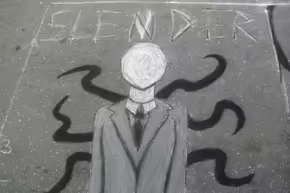
The nature of how these legends spread on Reddit draws some very important parallels to lost media. Reddit legends are folklore that disseminate through subreddits, sometimes with the original artifact linked, sometimes with just the memory left behind. Often, the original source is removed or forgotten. For example, Jeff the Killer is a Creepypasta (Lost Media Wiki, n.d.) that has been circulating for over 20 years with its original source unknown, with a debunked rumor surrounding its origin. Reddit legends can be considered mini forms of lost media as they live through collective memory and folkloric retellings when the original source is inaccessible or unavailable. I am interested in seeing if this phenomenon can create false memories for someone and make them believe they remember something they’ve never seen the origin of when these retellings and remixes become widespread enough.

The feedback I got from Mya and Dina was extremely helpful. I showed them a snippet of the intro to my proof of concept, which will also be the intro to my project. I got some great insight and advice about my sound design, background, and overall aesthetic and tone of my project.

I have a very clear vision for the beginning of my project, more specifically the first 4-5 minutes of it. I was able to bring a part of this vision to life by filming and editing the first half of my intro last week in Studio 2. I am filming the rest of the intro in my apartment tomorrow and Sunday and will have it all edited before class. The part I filmed will serve as a test shoot as I don’t believe it’s what I want for my final project, but it gave me great insight about what I want to do and what I want to change about it. Seeing it on my screen visually helped me understand how I can deliver the vision I want instead of what I have, which I consider progress!

I feel really good about where my project is currently and I’m honestly having so much fun doing. I also have an iconic committee (finally!) who I am very excited to work with.

References

Armstrong, C., & Ruths, D. (2020, July 3). Legends: Folklore on Reddit (Preprint). arXiv. https://arxiv.org/abs/2007.00750

Lost Media Wiki. (n.d.) Jeff the Killer (lost unedited image of Creepypasta character; date unknown). https://lostmediawiki.com/Jeff_the_Killer_(lost_unedited_image_of_Creepypasta_character;_date_unknown)

mdl70. (n.d.). Slender Man [Photograph]. Flickr. https://live.staticflickr.com/8173/7989638060_daf1d370ed_b.jpg

Leave a Comment

Evolution of Media Archeology

Huhtamo and Galili (2020) elaborate how far media archeology has come over the years. While it started in Europe and has been primarily Euro-centric, it’s beginning to go global and get the attention of many academics all around the world. It’s also creating sub-categories such as “public media archeology”, “network archeology”, and “experimental media archeology”. The authors state that the vagueness and complexity of this topic makes it chaotic to research and is called “the history of a question mark” by Colomnia and Wigley (2018). While this ubiquity makes media archeology rely on personal interpretation, there’s four commonly shared attributes is recognized by scholars. These are non-linear history, non-discursive media, rejection of medium-specific historiographies, and focus on forgotten or obsolete devices. This means that when we study media archeology; we’re jumping in time, we’re not just focusing on what material means but deeply investigating how it works, we’re not studying media in isolation but looking at connections, and looking at forgotten and obsolete technologies.

Huhtamo and Galili (2020) also mention how media archeology is expanding to studies of feminism, intersectionality,decoloniality, cultural semiotics, critical theory, design, and fashion. This article brings many of the topics and scholars I am looking into together by citing and referencing their works and can be extremely helpful to me when it comes to tying these political aspects together.

I filmed half of my proof of concept on Tuesday and got deep into my field research. I have a full committee now which I am very excited about but I have not met with them yet, I feel a little behind but I know I will be okay. I usually panic in my own time until I actually talk to someone and ask for help and every single time they end up calming me down and I realize I’m okay. I haven’t met with Kristina DeVoe yet but I will this week.

Leave a Comment

Losing my Revolution: Loss of Major World Events

Weeks ago, I used an article by Freeman, L (2022) that discussed what happens when important evidence online gets deleted or disappeared. “Losing My Revolution” by SalahEldeen, H. M. and Nelson, M. L. (2012) analyzes how much content gets lost on social media and how much of it actually gets archived and digitally preserved. They collected data from Twitter and other social media websites to determine which URLS were still operational. Additionally, they utilized the Memento framework, a free online service that allows users to see what a certain URL looked like on a certain date. So, if the URL was active, that would mean that the source still exists. If the URL didn’t work but it was available on Memento, that would mean that the source is preserved but not readily accessible. If the URL wasn’t active and didn’t exist on Memento, then that would mean that it’s lost media.

The authors looked at 6 major world events between between June 2009 and March 2012: the H1N1 virus outbreak, Michael Jackson’s death, the Iranian elections and
protests, Barack Obama’s Nobel Peace Prize, the Egyptian revolution, and the
Syrian uprising (SalahEldeen, H. M. & Nelson, M. L., 2012). They found that after a year of publishing about 11% of social media content would be gone and that we are losing 0.02% daily.

It’s important to note two things: I could not access Memento so I am not sure if it’s still an accessible source for archival content, and this article is 13 years old so the data might not hold up. Regardless of that, I found this study helpful to add to my discussion about how online archival fragility impacts documentation of culturally significant events and hurts collective memory. Last week’s writing exercise encouraged me to start making connections between my sources. So, while I was reading this I was thinking about how the Memento framework relates to Mandolessi’s (2024) point about content not getting truly lost but appearing elsewhere remixed or reworked, Haux et al.’s (2021) point about the lack of uniform standards in terms of proper documentation and preservation, and Freeman’s (2022) point about the loss of important evidence of atrocities in social media.

I started my field research and began writing my introduction for the paper. I met with Jan Fernback on Friday and discussed how I can define my project without making it too broad, especially with the political aspect. I had some moments where I considered touching on censorship as a form of lost media, but didn’t want to open a can of worms as censorship can be a whole project within itself. She helped me identify what points I want to make when it comes to the political side, and we both think leaning towards digital deterioration is sufficient and I don’t need to overcomplicate things with censorship.

I also have two committee members now, woo! And I have studio 2 booked on Friday to film my intro scene/proof of concept. I am excited about how fast things are moving!

Edit: I forgot to add something from the class activity so I’m adding my poem:

Zotero, Premiere, Canva, Highland two

What can we even do with you?

If I have many ideas in head

What do I even shoot?

Routine, perfecting, and organizing

Begging information to be useful, too

References

Freeman, L. (2022). Digitally Disappeared: The Struggle to Preserve Social Media Evidence of Mass Atrocities. Georgetown Journal of International Affairs 23(1), 105-113. https://dx.doi.org/10.1353/gia.2022.0017.

Haux, D. H., Maget Dominicé, A., & Raspotnig, J. A. (2021). A Cultural Memory of the Digital Age? International journal for the semiotics of law 34(3), 769–782. https://doi.org/10.1007/s11196-020-09778-7

Mandolessi S. (2024). Memory in the digital age. Open research Europe3, 123. https://doi.org/10.12688/openreseurope.16228.2

SalahEldeen, H. M., & Nelson, M. L. (2012). Losing my revolution: How many resources shared on social media have been lost? arXiv. https://arxiv.org/abs/1209.3026

Leave a Comment