Skip to content

MA Project Workshop Posts

Last Blog Post

I can’t believe this semester is already over. I am so close to getting my Master’s degree which feels so surreal! I am so happy with where my project is at and I am so excited to work on it more over break. I got some useful feedback and advice from my classmates about my proof of concept. Everyone seemed to like the color palette I had which I am very happy about because all of it was intentional, I even brought another outfit with me to see which one I liked more! Laura pointed out that I don’t have text saying “lost media” on screen which I didn’t even realize! I thought I did but I actually just have the title, so I will definitely add that to my intro so my audience knows what the video is. Additionally, everyone thought the eeriness and campiness was cool so I will definitely play into that more and practice not feeling so awkward on camera. I could also get someone else to do the intro as Dr. Shaw said. My classmates also thought the red background was too plain so I’m planning on adding clips and editing that scene more. I’m also thinking about just refilming it because I think I’d rather have a black curtain behind me instead of a green screen.

I do have a set committee and I’ll have all the signatures soon. I haven’t sent anything to them yet but I got some feedback in Project Workshop so half of my committee has seen everything I’ve made so far! I will share my progress with Jan and Carolyn soon as well. My first next step is to reshoot the introduction part in the studio and finish the script of the rest of my project. For the paper, I want to make a better and more detailed outline now that I have more of a structure and clear sources that are cohesive and related to each other. I also want to make an annotated bibliography because that helps me understand and work better. So my next deliverables will be the script and the outline!

I want to improve the website I made for my project and keep up with it after I graduate! I was thinking of doing a blog style website and maybe even a “lost media of the week” where I talk about all the examples of lost media that didn’t fit in my project! I will definitely put it in my portfolio and find a place where I can submit it.

Overall, I feel good about my progress!

Leave a Comment
Folklore: Files, Fables, and Everything in Between

As I’m deep into my field research, there are 3 websites I am focusing on: Lost Media Wiki, Reddit, and YouTube. I believe I can’t talk about Reddit without talking about digital folklore and the legends and myths of the Internet.

Two subcategories of lost media are “existence unconfirmed”, and “non-existence confirmed” media, both of which are sections of the Lost Media Wiki. This brings us to folklore and mythology on the Internet. It’s important to note that if something never existed, it can’t be lost. However, as I’m diving deep into online communities and discussing collective nostalgia, I think it’s important to give context.

Armstrong and Ruths (2020) explore Reddit legends and how they can be considered folklore. They highlight that while the majority of the Internet is centered around new and exciting trends, Reddit is the home of historical references and retellings of ancient events, memes, and content. They analyzed a subreddit dedicated to cataloguing content on reddit called r/MuseumofReddit and review 233 posts all made before 2016, excluding irrelevant posts. This resulted in 161 legends divided into 3 categories: structural forms, affect types, and content types. The authors determined that these legends have patterns, aka motifs, and can be classified and studied as folklore.

While Reddit is showing clear signs of being an important source regarding digital culture, many of these legends went unnoticed until they were retold, reposted, and referenced in different ways. The authors found that 52% of the most popular links were ignored and overlooked when they were first posted in 2011. Gossip, commentary, and references became one of the most important ways of spreading these links and original sources.

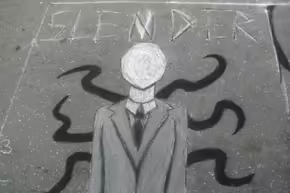
The nature of how these legends spread on Reddit draws some very important parallels to lost media. Reddit legends are folklore that disseminate through subreddits, sometimes with the original artifact linked, sometimes with just the memory left behind. Often, the original source is removed or forgotten. For example, Jeff the Killer is a Creepypasta (Lost Media Wiki, n.d.) that has been circulating for over 20 years with its original source unknown, with a debunked rumor surrounding its origin. Reddit legends can be considered mini forms of lost media as they live through collective memory and folkloric retellings when the original source is inaccessible or unavailable. I am interested in seeing if this phenomenon can create false memories for someone and make them believe they remember something they’ve never seen the origin of when these retellings and remixes become widespread enough.

The feedback I got from Mya and Dina was extremely helpful. I showed them a snippet of the intro to my proof of concept, which will also be the intro to my project. I got some great insight and advice about my sound design, background, and overall aesthetic and tone of my project.

I have a very clear vision for the beginning of my project, more specifically the first 4-5 minutes of it. I was able to bring a part of this vision to life by filming and editing the first half of my intro last week in Studio 2. I am filming the rest of the intro in my apartment tomorrow and Sunday and will have it all edited before class. The part I filmed will serve as a test shoot as I don’t believe it’s what I want for my final project, but it gave me great insight about what I want to do and what I want to change about it. Seeing it on my screen visually helped me understand how I can deliver the vision I want instead of what I have, which I consider progress!

I feel really good about where my project is currently and I’m honestly having so much fun doing. I also have an iconic committee (finally!) who I am very excited to work with.

References

Armstrong, C., & Ruths, D. (2020, July 3). Legends: Folklore on Reddit (Preprint). arXiv. https://arxiv.org/abs/2007.00750

Lost Media Wiki. (n.d.) Jeff the Killer (lost unedited image of Creepypasta character; date unknown). https://lostmediawiki.com/Jeff_the_Killer_(lost_unedited_image_of_Creepypasta_character;_date_unknown)

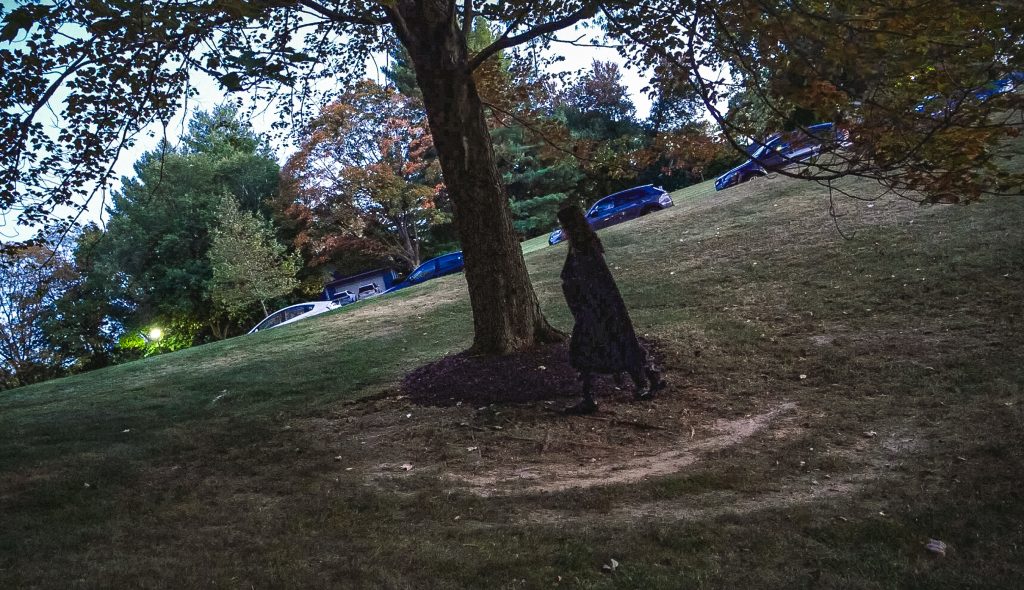
mdl70. (n.d.). Slender Man [Photograph]. Flickr. https://live.staticflickr.com/8173/7989638060_daf1d370ed_b.jpg

Leave a Comment

Evolution of Media Archeology

Huhtamo and Galili (2020) elaborate how far media archeology has come over the years. While it started in Europe and has been primarily Euro-centric, it’s beginning to go global and get the attention of many academics all around the world. It’s also creating sub-categories such as “public media archeology”, “network archeology”, and “experimental media archeology”. The authors state that the vagueness and complexity of this topic makes it chaotic to research and is called “the history of a question mark” by Colomnia and Wigley (2018). While this ubiquity makes media archeology rely on personal interpretation, there’s four commonly shared attributes is recognized by scholars. These are non-linear history, non-discursive media, rejection of medium-specific historiographies, and focus on forgotten or obsolete devices. This means that when we study media archeology; we’re jumping in time, we’re not just focusing on what material means but deeply investigating how it works, we’re not studying media in isolation but looking at connections, and looking at forgotten and obsolete technologies.

Huhtamo and Galili (2020) also mention how media archeology is expanding to studies of feminism, intersectionality,decoloniality, cultural semiotics, critical theory, design, and fashion. This article brings many of the topics and scholars I am looking into together by citing and referencing their works and can be extremely helpful to me when it comes to tying these political aspects together.

I filmed half of my proof of concept on Tuesday and got deep into my field research. I have a full committee now which I am very excited about but I have not met with them yet, I feel a little behind but I know I will be okay. I usually panic in my own time until I actually talk to someone and ask for help and every single time they end up calming me down and I realize I’m okay. I haven’t met with Kristina DeVoe yet but I will this week.

Leave a Comment

Losing my Revolution: Loss of Major World Events

Weeks ago, I used an article by Freeman, L (2022) that discussed what happens when important evidence online gets deleted or disappeared. “Losing My Revolution” by SalahEldeen, H. M. and Nelson, M. L. (2012) analyzes how much content gets lost on social media and how much of it actually gets archived and digitally preserved. They collected data from Twitter and other social media websites to determine which URLS were still operational. Additionally, they utilized the Memento framework, a free online service that allows users to see what a certain URL looked like on a certain date. So, if the URL was active, that would mean that the source still exists. If the URL didn’t work but it was available on Memento, that would mean that the source is preserved but not readily accessible. If the URL wasn’t active and didn’t exist on Memento, then that would mean that it’s lost media.

The authors looked at 6 major world events between between June 2009 and March 2012: the H1N1 virus outbreak, Michael Jackson’s death, the Iranian elections and
protests, Barack Obama’s Nobel Peace Prize, the Egyptian revolution, and the
Syrian uprising (SalahEldeen, H. M. & Nelson, M. L., 2012). They found that after a year of publishing about 11% of social media content would be gone and that we are losing 0.02% daily.

It’s important to note two things: I could not access Memento so I am not sure if it’s still an accessible source for archival content, and this article is 13 years old so the data might not hold up. Regardless of that, I found this study helpful to add to my discussion about how online archival fragility impacts documentation of culturally significant events and hurts collective memory. Last week’s writing exercise encouraged me to start making connections between my sources. So, while I was reading this I was thinking about how the Memento framework relates to Mandolessi’s (2024) point about content not getting truly lost but appearing elsewhere remixed or reworked, Haux et al.’s (2021) point about the lack of uniform standards in terms of proper documentation and preservation, and Freeman’s (2022) point about the loss of important evidence of atrocities in social media.

I started my field research and began writing my introduction for the paper. I met with Jan Fernback on Friday and discussed how I can define my project without making it too broad, especially with the political aspect. I had some moments where I considered touching on censorship as a form of lost media, but didn’t want to open a can of worms as censorship can be a whole project within itself. She helped me identify what points I want to make when it comes to the political side, and we both think leaning towards digital deterioration is sufficient and I don’t need to overcomplicate things with censorship.

I also have two committee members now, woo! And I have studio 2 booked on Friday to film my intro scene/proof of concept. I am excited about how fast things are moving!

Edit: I forgot to add something from the class activity so I’m adding my poem:

Zotero, Premiere, Canva, Highland two

What can we even do with you?

If I have many ideas in head

What do I even shoot?

Routine, perfecting, and organizing

Begging information to be useful, too

References

Freeman, L. (2022). Digitally Disappeared: The Struggle to Preserve Social Media Evidence of Mass Atrocities. Georgetown Journal of International Affairs 23(1), 105-113. https://dx.doi.org/10.1353/gia.2022.0017.

Haux, D. H., Maget Dominicé, A., & Raspotnig, J. A. (2021). A Cultural Memory of the Digital Age? International journal for the semiotics of law 34(3), 769–782. https://doi.org/10.1007/s11196-020-09778-7

Mandolessi S. (2024). Memory in the digital age. Open research Europe3, 123. https://doi.org/10.12688/openreseurope.16228.2

SalahEldeen, H. M., & Nelson, M. L. (2012). Losing my revolution: How many resources shared on social media have been lost? arXiv. https://arxiv.org/abs/1209.3026

Leave a Comment

Collective Remembrance: Memory as a Social Concept

I have been focusing heavily on collective memory and nostalgia throughout this stage of my project. This is solely because I wanted to explore the social side of remembering even before doing any research as I find it fascinating that people who have never met in real life can have genuine connections through mutual memories they have made in the digital world.

Mandolessi (2023) argues that the digital space completely revolutionized collective remembering and creating content by breaking down geographical barriers. Today, collective memory has evolved from the meaning it had in the old media as culture and history are actively being created in online communities. Traditionally, collective remembering happens when a group of people remember something they experienced together, like war for instance. But now, collective remembering happens constantly in the digital space.

She references Hoskin’s pessimistic view about the internet blurring the lines between the past and the present as the constant archiving and recirculation of information make it hard to differentiate what is a memory and what still exists. Paradoxically, everything being archived constantly creates more gaps in memory and culture when disappearance happens. Additionally, Mandolessi explains that the digital archive changed the way we think about archives. In old media, an archive was static, but now it is constantly changing, evolving, and devolving with media loss as well.

She also mentions that nothing gets truly lost, it can get remixed and remembered by appearing someone else. This is useful for my project because media reappearing in a different form is something I have yet to consider, but that is what found media is. Media gets lost, people come together to look for it and reminisce together, and sometimes it reappears changed, half-lost, or remixed.

I haven’t done much for my project this week as I have been dealing with life things, but I want to change that this week. While I don’t have a ton of progress on paper, lost media is now something I actively think about and mention to people. It’s like everywhere I look I see something that makes me brainstorm about my project. I can’t believe it’s already become so integrated in my life, I can’t imagine how much I’ll be thinking about in the upcoming weeks. However, I know I’m going to accomplish a lot this week because I will be filming my proof of concept this week with a green screen (YAY!). I hope to have better updates in the next blog post.

Mandolessi S. (2024). Memory in the digital age. Open research Europe3, 123. https://doi.org/10.12688/openreseurope.16228.2

Leave a Comment

Playable Memories: Papers, Please!

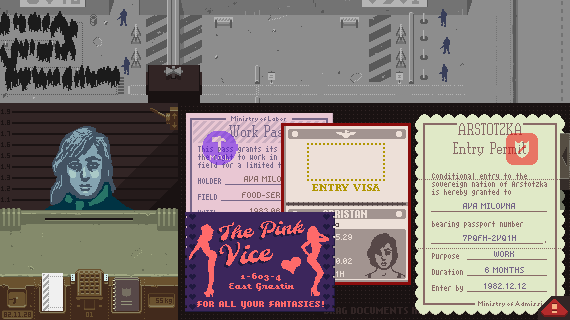
Image: Screenshot from the video game “Papers, Please” from Google Images.

Svetlana Boym’s nostalgia theory from her book The Future of Nostalgia (2001) divides nostalgia into two parts: restorative and reflective (Makai, 2018). I mentioned these terms in last week’s blog post, and I anticipate that they will be key terms throughout my project. Restorative nostalgia is fundamentally conservative. It is the idea of yearning for the “good ol’ days” and attempting to bring them back. However, the underlying idea is the illusion of an idealized, imagined, or misremembered past while subtly critiquing the present and how times have changed. On the other hand, reflective nostalgia is a more progressive and self-aware way of remembering and reminiscing. Reflective nostalgia is seen as “good nostalgia” and is often praised by scholars like Boym, Schiermer, and Carlsen (Makai, 2018).

Makai mentions that nostalgia is often criticize nostalgia as a whole and suggest that it’s something less than intelligent people “fall for” when companies exploit fond memories from the past to generate sales. He argues that while this criticism is valid, nostalgia has many benefits beyond its consumerist approach. It can create a sense of community and bring people together. He goes on the explain how prominent nostalgia is in the video game world, as video games are perhaps the only medium that’s both the newest and the fastest to become obsolete as new games, equipment, and consoles come out. “Retro-gaming” began as a way to revitalize vintage games for new generations.

I thought this article was interesting and the agreement between scholars that reflective nostalgia is “the good one” is something I can connect to lost media. Lost media is not something we can go back, change, and restore. While lost media can be found in some cases, most of the discussion surrounding it is about people’s reflection and feelings about what they remember. If I continue researching nostalgia, I can make a solid foundation for the collective memory section of my project.

This week, I’m starting field research. I made a spreadsheet to keep things organized. I will be looking at r/lostmedia, Lost Media Wiki, and YouTube to see how the people in those communities feel about certain examples of lost media. I organized them by date, platform, link, type of post, summary, emotions, themes, links to theory, and notes. I also made a second tab for the cases themselves so I can look at how they got lost, their political and emotional themes, and how they link to some of the theories I am looking at. My preproduction binder feels a bit incomplete but I am slowly getting things done! I also have a committee member now (woohoo! thank you Laura!) and I have a clear plan ahead of me, which is easing some of the stress I’ve been having.

References

Boym, Svetlana. 2001. The Future of Nostalgia; New York: Basic Books, vol. 41. Available online: https://books.google.se/books/about/The_Future_of_Nostalgia.html?id=WrvtAAAAMAAJ&redir_esc=y (accessed on 18 October 2025).

Google Images. (n.d.). Screenshot from Papers, Please [Image]. Retrieved from https://share.google/images/ZnpcEml3czFLy4tGx

Makai, P. K. (2018). Video Games as Objects and Vehicles of Nostalgia. Humanities7(4), 123. https://doi.org/10.3390/h7040123

Leave a Comment

Exploring the Missing Archive: My Progress

Screenshot

I feel pretty good about where I am with the research part of my project. My main concern was organization and research, but I managed to find several useful sources and I am organizing them as I go on Zotero. Right now I am working on making annotated bibliographies for each of them. Even though I don’t need to, it helps me to do things that way. Celina also mentioned in her visit that she did that as well, and I thought it was a great idea.

Speaking of Celina, her visit helped me so much with both production and research. The examples she provided from her project helped me visualize and plan mine better. I always understand things better when given clear examples, and I hope we can have more opportunities to see past work! I’m exactly where I need to be in my production process as well, the initial media assignment helped me plan some really cool shots as my b-roll. I wanted to have a script in progress at this point in the semester, and I do. I feel like I have so much of my vision in my head, so I want to work a bit more on my pre-production outline that I created in Canva and make little notes for myself.

My project meets the expectations because I am taking the necessary steps to ensure my project has a solid foundation. I already addressed the political implications of media loss and I will continue to develop an argument for how important this issue is. I am doing that by looking at theorists such as Wolfgang Ernst, Erkki Huhtamo, and Jussi Parikka, who study media archeology. I am also studying memory and nostalgia by studying the work of Svetlana Boym. Additionally, I’m researching many scholars who discuss the political side of media erasure and censorship, such as Rakesh Sengupta Wendy Hui Kyong Chun. Using creative cinematography, my project will help the user feel the loss through the screen via several effects and camera angles. While the project will be cinematic, these theories and research will support the concept academically.

I am so excited to make my pre-production binder! I am so glad I already started working on a pre-production outline so early, because it’s helping me shape my project and know the next steps to take.

The feedback I got for my initial media was so helpful! People mostly had nice things to say and it made me feel even more confident in my vision and style. While most of my shots are pretty good so far, they’re poorly edited. Moving forward, I wanna get familiar with the green screen since I will be using it a lot for my project.

References

Chun, W. H. K. (2005). Control and Freedom: Power and Paranoia in the Age of Fiber Optics. MIT Press.

Ernst, W. (2013). Digital Memory and the Archive (J. Parikka, Ed.). University of Minnesota Press. http://www.jstor.org/stable/10.5749/j.ctt32bcwb

Huhtamo, E., & Parikka, J. (Eds.). (2011). Media Archaeology: Approaches, Applications, and Implications. University of California Press.

Sengupta, R. (2020). Towards a Decolonial Media Archaeology: The Absent Archive of Screenwriting History and the Obsolete Munshi. Theory, Culture & Society38(1), 3-26. https://doi-org.libproxy.temple.edu/10.1177/0263276420930276

Leave a Comment

You Can Go Back, But No One Will Be There

I can’t discuss lost media without talking about people’s obsession with the past. The reason why I was so fascinated with the topic was mostly due the longing/nostalgia aspect, which I think will help me visually.

In “Finding the future in digitally mediated ruin: #nostalgiacores and the algorithmic culture of digital platforms” (Brown et al., 2024), the authors explore how social media platforms monetize feelings of nostalgia and reminiscence and turn it into profit by showing users an endless scroll of glimpses from the past. They argue that digitally mediated nostalgia is a product of the algorithm as these social media platforms are designed to recycle content to keep us engaged and scrolling. The authors mention two different types of nostalgia: reflective and restorative. Reflective nostalgia is the idea of mourning what could have (or should have) been, and yearning for the vision we once had for the future that is drastically different than the future we actually have. Restorative nostalgia, on the other hand, is the concept of finding safety and comfort in the past and wanting to go back to a “simpler time”.

Brown, et al. (2024) suggest that algorithmic nostalgia is a political matter as the dissatisfaction with the present whether it’s tied to restorative or reflective nostalgia implies that the capitalistic ideology promised us a future that we never got and we are subtly critiquing the current political climate by using social media to express how much we miss the past and want to go back. The irony in that online expression is that people are posting their longing for the past on social media apps that use user engagement to feed the algorithm and keep the scroll cycle going. So, users are essentially supporting the very thing they are criticizing by voicing their opinion on these platforms.

While this article isn’t about lost media, it makes some very important point regarding people’s feelings around nostalgia and nostalgic content on the internet. I also love their methodology and I’m interested in doing something similar. They employ a digital ethnography and they focus on people’s emotions around the topic, which I think would work well for my topic as well.

This week, I watched some of the LinkedIn Learning courses I found to figure out how I want to edit my video. I also took some b-roll and started working on a first draft script for my video. I don’t have any committee members yet so I know this week I need to start getting in touch with some professors. I feel a little stressed and a little behind but I know it’s going to be okay!

References

Brown, M. G., Carah, N., Tan, X. Y. (Jane), Angus, D., & Burgess, J. (2024). Finding the future in digitally mediated ruin: #nostalgiacores and the algorithmic culture of digital platforms. Convergence, 30(5), 1710–1731. https://doi.org/10.1177/13548565241270669

Leave a Comment

The Consequences of Forgetting

After exploring media loss in a 19th century Europe last week, I mentioned I wanted to take that concept and look at how it applies to more recent and digitized media. Lindsay Freeman’s “Digitally Disappeared: The Case For the Preservation of Atrocity Evidence in the Age of Digital Epherimerality” discusses the repercussions of important events digitally disappearing. Freeman (2022) argues that digital disappearance became a human rights issue after social media platforms started being used as an archive for historical evidence, war crimes, and mass atrocities.

Something I never thought about before was the importance of some of the “harmful” content that gets taken down on social media platforms. Freeman (2022) makes the point that when content that is violent, pornographic, or harmful for any other reason gets deleted, important evidence that could have been useful gets destroyed. The people who make these decisions are the ones that have the most power, and their motivation behind what gets taken down is uncertain and hazy. The selective deletion continues to give them more power and allows them to tell real stories the way they choose to, while others are silenced.

Like I said and planned last week, this article is a perfect gateway for me to transition from giving historical context to exploring the current issues we are dealing with regarding digital preservation and online deletion. Adding the political aspect to my project has completely taken it to a whole other level and I am excited about the fact that it feels more organized and I have decided on the sections that I will be covering.

I haven’t done much this week as I have been sick, but I added more things to my pre production outline and made it into a slideshow on Canva simply for aesthetic reasons. I also found a lot of inspiration regarding the type shots I want to have and watched videos about filming, and how to film the shots I want specifically. I found some locations I am looking into renting and I will be shooting some scenes that will hopefully make it to the final cut of the project tomorrow or Wednesday. I want to apply for the Philadelphia Student Media Maker grant, so I am trying to figure out my budget for my project and thinking about some of the specifics such as duration so I can fill out my application. I started a budget proposal using a template but I am struggling with what to include, but it’s getting there. I’m hoping to do more for this project this week.

Freeman, L. (2022). Digitally Disappeared: The Struggle to Preserve Social Media Evidence of Mass Atrocities. Georgetown Journal of International Affairs 23(1), 105-113. https://dx.doi.org/10.1353/gia.2022.0017.

Leave a Comment

Absent Archive

This week, I wanted to focus on historical and political aspects of my topic. Lost media is not just about deleted files and error pages, but rather a lens to what is valued in society. I found a few amazing sources about intentional lost media and I feel very good about how they connect to my project.

Rakesh Sengupta’s “Towards a Decolonial Media Archeology: The Absent Archive of Screenwriting History and the Obsolete Munshi” explains that the archival absence of film is a colonial issue and the lack of proper documentation of non-western epistemologies exhibits that dominant industries decide what is worth preserving and what isn’t. Consequently, Western cinema is privileged and prioritized while South Asian film industries are marginalized. He uses the phrase “obsolete munshi” to describe the scriptwriters whose art was erased or blocked from history despite having important and valuable contributions to the film industry. He suggests that we combine decolonial thinking and media archeology to search for the gaps in history that got ignored and erased and understand why they aren’t preserved. His work shows that archival absence is not accidental and has strong ties to colonialism, capitalism, and structural erasure.

If I take this very theory heavy article and apply it to more current and digital examples of lost media, I can show that media loss has serious effects on justice and human rights. When I first started this project, I was mostly thinking about things my generation remembers from our childhood that got accidentally or intentionally deleted, but doing the historical research made me realize that this topic is so much deeper than that. It has serious implications about what we get to see and remember. If people in power have the right to delete and filter through information that comes from marginalized communities, how can we study complex subjects people have opposing views on? If all we have is what is preserved, aren’t we continuing to empower the same people who silenced others’ voices in the first place? How does this differ from censorship? Don’t we and future generations have the right to study all of our cultural heritage? How can digital media loss be prevented? Should my project have a call-to-action? I intend to think about these questions and more in the coming weeks. This week, I plan on reading some sources that parallel Sengupta’s work but are about digital media loss and online spaces. I believe this will help me take history and apply it to current issues. I have already started finding some sources that will help me do that, but I haven’t had time to read them yet.

I’m planning on looking at missing websites, deleted tweets and posts on various social media, and other user generated content that gets deleted, but I am concerned that my topic might get too broad if I start including so many specific types of content. I am also wondering if it would be a good idea to split my subject into two sections: accidental and intentional loss. This way, I can talk about the political implications while thinking about intentional loss (or deletion) and touch on more logistical issues such as neglect and clutter and discuss better ways to organize and archive digital media. I spent the week thinking about these and making my outline more specific and clear. This is actually coming along nicely and I am happy about where I am!

Sengupta, R. (2020). Towards a Decolonial Media Archaeology: The Absent Archive of Screenwriting History and the Obsolete Munshi. Theory, Culture & Society, 38(1), 3-26. https://doi-org.libproxy.temple.edu/10.1177/0263276420930276

Leave a Comment