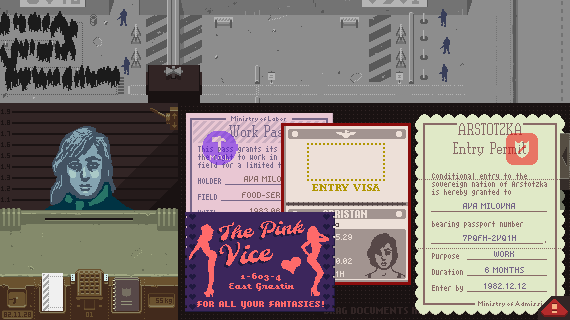
Image: Screenshot from the video game “Papers, Please” from Google Images.
Svetlana Boym’s nostalgia theory from her book The Future of Nostalgia (2001) divides nostalgia into two parts: restorative and reflective (Makai, 2018). I mentioned these terms in last week’s blog post, and I anticipate that they will be key terms throughout my project. Restorative nostalgia is fundamentally conservative. It is the idea of yearning for the “good ol’ days” and attempting to bring them back. However, the underlying idea is the illusion of an idealized, imagined, or misremembered past while subtly critiquing the present and how times have changed. On the other hand, reflective nostalgia is a more progressive and self-aware way of remembering and reminiscing. Reflective nostalgia is seen as “good nostalgia” and is often praised by scholars like Boym, Schiermer, and Carlsen (Makai, 2018).
Makai mentions that nostalgia is often criticize nostalgia as a whole and suggest that it’s something less than intelligent people “fall for” when companies exploit fond memories from the past to generate sales. He argues that while this criticism is valid, nostalgia has many benefits beyond its consumerist approach. It can create a sense of community and bring people together. He goes on the explain how prominent nostalgia is in the video game world, as video games are perhaps the only medium that’s both the newest and the fastest to become obsolete as new games, equipment, and consoles come out. “Retro-gaming” began as a way to revitalize vintage games for new generations.
I thought this article was interesting and the agreement between scholars that reflective nostalgia is “the good one” is something I can connect to lost media. Lost media is not something we can go back, change, and restore. While lost media can be found in some cases, most of the discussion surrounding it is about people’s reflection and feelings about what they remember. If I continue researching nostalgia, I can make a solid foundation for the collective memory section of my project.
This week, I’m starting field research. I made a spreadsheet to keep things organized. I will be looking at r/lostmedia, Lost Media Wiki, and YouTube to see how the people in those communities feel about certain examples of lost media. I organized them by date, platform, link, type of post, summary, emotions, themes, links to theory, and notes. I also made a second tab for the cases themselves so I can look at how they got lost, their political and emotional themes, and how they link to some of the theories I am looking at. My preproduction binder feels a bit incomplete but I am slowly getting things done! I also have a committee member now (woohoo! thank you Laura!) and I have a clear plan ahead of me, which is easing some of the stress I’ve been having.
References
Boym, Svetlana. 2001. The Future of Nostalgia; New York: Basic Books, vol. 41. Available online: https://books.google.se/books/about/The_Future_of_Nostalgia.html?id=WrvtAAAAMAAJ&redir_esc=y (accessed on 18 October 2025).
Google Images. (n.d.). Screenshot from Papers, Please [Image]. Retrieved from https://share.google/images/ZnpcEml3czFLy4tGx
Makai, P. K. (2018). Video Games as Objects and Vehicles of Nostalgia. Humanities, 7(4), 123. https://doi.org/10.3390/h7040123
Be First to Comment