Skip to content

Month: October 2025

Collective Remembrance: Memory as a Social Concept

I have been focusing heavily on collective memory and nostalgia throughout this stage of my project. This is solely because I wanted to explore the social side of remembering even before doing any research as I find it fascinating that people who have never met in real life can have genuine connections through mutual memories they have made in the digital world.

Mandolessi (2023) argues that the digital space completely revolutionized collective remembering and creating content by breaking down geographical barriers. Today, collective memory has evolved from the meaning it had in the old media as culture and history are actively being created in online communities. Traditionally, collective remembering happens when a group of people remember something they experienced together, like war for instance. But now, collective remembering happens constantly in the digital space.

She references Hoskin’s pessimistic view about the internet blurring the lines between the past and the present as the constant archiving and recirculation of information make it hard to differentiate what is a memory and what still exists. Paradoxically, everything being archived constantly creates more gaps in memory and culture when disappearance happens. Additionally, Mandolessi explains that the digital archive changed the way we think about archives. In old media, an archive was static, but now it is constantly changing, evolving, and devolving with media loss as well.

She also mentions that nothing gets truly lost, it can get remixed and remembered by appearing someone else. This is useful for my project because media reappearing in a different form is something I have yet to consider, but that is what found media is. Media gets lost, people come together to look for it and reminisce together, and sometimes it reappears changed, half-lost, or remixed.

I haven’t done much for my project this week as I have been dealing with life things, but I want to change that this week. While I don’t have a ton of progress on paper, lost media is now something I actively think about and mention to people. It’s like everywhere I look I see something that makes me brainstorm about my project. I can’t believe it’s already become so integrated in my life, I can’t imagine how much I’ll be thinking about in the upcoming weeks. However, I know I’m going to accomplish a lot this week because I will be filming my proof of concept this week with a green screen (YAY!). I hope to have better updates in the next blog post.

Mandolessi S. (2024). Memory in the digital age. Open research Europe3, 123. https://doi.org/10.12688/openreseurope.16228.2

Leave a Comment
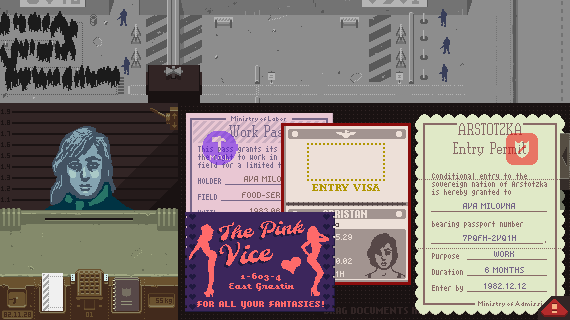
Playable Memories: Papers, Please!

Image: Screenshot from the video game “Papers, Please” from Google Images.

Svetlana Boym’s nostalgia theory from her book The Future of Nostalgia (2001) divides nostalgia into two parts: restorative and reflective (Makai, 2018). I mentioned these terms in last week’s blog post, and I anticipate that they will be key terms throughout my project. Restorative nostalgia is fundamentally conservative. It is the idea of yearning for the “good ol’ days” and attempting to bring them back. However, the underlying idea is the illusion of an idealized, imagined, or misremembered past while subtly critiquing the present and how times have changed. On the other hand, reflective nostalgia is a more progressive and self-aware way of remembering and reminiscing. Reflective nostalgia is seen as “good nostalgia” and is often praised by scholars like Boym, Schiermer, and Carlsen (Makai, 2018).

Makai mentions that nostalgia is often criticize nostalgia as a whole and suggest that it’s something less than intelligent people “fall for” when companies exploit fond memories from the past to generate sales. He argues that while this criticism is valid, nostalgia has many benefits beyond its consumerist approach. It can create a sense of community and bring people together. He goes on the explain how prominent nostalgia is in the video game world, as video games are perhaps the only medium that’s both the newest and the fastest to become obsolete as new games, equipment, and consoles come out. “Retro-gaming” began as a way to revitalize vintage games for new generations.

I thought this article was interesting and the agreement between scholars that reflective nostalgia is “the good one” is something I can connect to lost media. Lost media is not something we can go back, change, and restore. While lost media can be found in some cases, most of the discussion surrounding it is about people’s reflection and feelings about what they remember. If I continue researching nostalgia, I can make a solid foundation for the collective memory section of my project.

This week, I’m starting field research. I made a spreadsheet to keep things organized. I will be looking at r/lostmedia, Lost Media Wiki, and YouTube to see how the people in those communities feel about certain examples of lost media. I organized them by date, platform, link, type of post, summary, emotions, themes, links to theory, and notes. I also made a second tab for the cases themselves so I can look at how they got lost, their political and emotional themes, and how they link to some of the theories I am looking at. My preproduction binder feels a bit incomplete but I am slowly getting things done! I also have a committee member now (woohoo! thank you Laura!) and I have a clear plan ahead of me, which is easing some of the stress I’ve been having.

References

Boym, Svetlana. 2001. The Future of Nostalgia; New York: Basic Books, vol. 41. Available online: https://books.google.se/books/about/The_Future_of_Nostalgia.html?id=WrvtAAAAMAAJ&redir_esc=y (accessed on 18 October 2025).

Google Images. (n.d.). Screenshot from Papers, Please [Image]. Retrieved from https://share.google/images/ZnpcEml3czFLy4tGx

Makai, P. K. (2018). Video Games as Objects and Vehicles of Nostalgia. Humanities7(4), 123. https://doi.org/10.3390/h7040123

Leave a Comment

Exploring the Missing Archive: My Progress

Screenshot

I feel pretty good about where I am with the research part of my project. My main concern was organization and research, but I managed to find several useful sources and I am organizing them as I go on Zotero. Right now I am working on making annotated bibliographies for each of them. Even though I don’t need to, it helps me to do things that way. Celina also mentioned in her visit that she did that as well, and I thought it was a great idea.

Speaking of Celina, her visit helped me so much with both production and research. The examples she provided from her project helped me visualize and plan mine better. I always understand things better when given clear examples, and I hope we can have more opportunities to see past work! I’m exactly where I need to be in my production process as well, the initial media assignment helped me plan some really cool shots as my b-roll. I wanted to have a script in progress at this point in the semester, and I do. I feel like I have so much of my vision in my head, so I want to work a bit more on my pre-production outline that I created in Canva and make little notes for myself.

My project meets the expectations because I am taking the necessary steps to ensure my project has a solid foundation. I already addressed the political implications of media loss and I will continue to develop an argument for how important this issue is. I am doing that by looking at theorists such as Wolfgang Ernst, Erkki Huhtamo, and Jussi Parikka, who study media archeology. I am also studying memory and nostalgia by studying the work of Svetlana Boym. Additionally, I’m researching many scholars who discuss the political side of media erasure and censorship, such as Rakesh Sengupta Wendy Hui Kyong Chun. Using creative cinematography, my project will help the user feel the loss through the screen via several effects and camera angles. While the project will be cinematic, these theories and research will support the concept academically.

I am so excited to make my pre-production binder! I am so glad I already started working on a pre-production outline so early, because it’s helping me shape my project and know the next steps to take.

The feedback I got for my initial media was so helpful! People mostly had nice things to say and it made me feel even more confident in my vision and style. While most of my shots are pretty good so far, they’re poorly edited. Moving forward, I wanna get familiar with the green screen since I will be using it a lot for my project.

References

Chun, W. H. K. (2005). Control and Freedom: Power and Paranoia in the Age of Fiber Optics. MIT Press.

Ernst, W. (2013). Digital Memory and the Archive (J. Parikka, Ed.). University of Minnesota Press. http://www.jstor.org/stable/10.5749/j.ctt32bcwb

Huhtamo, E., & Parikka, J. (Eds.). (2011). Media Archaeology: Approaches, Applications, and Implications. University of California Press.

Sengupta, R. (2020). Towards a Decolonial Media Archaeology: The Absent Archive of Screenwriting History and the Obsolete Munshi. Theory, Culture & Society38(1), 3-26. https://doi-org.libproxy.temple.edu/10.1177/0263276420930276

Leave a Comment

You Can Go Back, But No One Will Be There

I can’t discuss lost media without talking about people’s obsession with the past. The reason why I was so fascinated with the topic was mostly due the longing/nostalgia aspect, which I think will help me visually.

In “Finding the future in digitally mediated ruin: #nostalgiacores and the algorithmic culture of digital platforms” (Brown et al., 2024), the authors explore how social media platforms monetize feelings of nostalgia and reminiscence and turn it into profit by showing users an endless scroll of glimpses from the past. They argue that digitally mediated nostalgia is a product of the algorithm as these social media platforms are designed to recycle content to keep us engaged and scrolling. The authors mention two different types of nostalgia: reflective and restorative. Reflective nostalgia is the idea of mourning what could have (or should have) been, and yearning for the vision we once had for the future that is drastically different than the future we actually have. Restorative nostalgia, on the other hand, is the concept of finding safety and comfort in the past and wanting to go back to a “simpler time”.

Brown, et al. (2024) suggest that algorithmic nostalgia is a political matter as the dissatisfaction with the present whether it’s tied to restorative or reflective nostalgia implies that the capitalistic ideology promised us a future that we never got and we are subtly critiquing the current political climate by using social media to express how much we miss the past and want to go back. The irony in that online expression is that people are posting their longing for the past on social media apps that use user engagement to feed the algorithm and keep the scroll cycle going. So, users are essentially supporting the very thing they are criticizing by voicing their opinion on these platforms.

While this article isn’t about lost media, it makes some very important point regarding people’s feelings around nostalgia and nostalgic content on the internet. I also love their methodology and I’m interested in doing something similar. They employ a digital ethnography and they focus on people’s emotions around the topic, which I think would work well for my topic as well.

This week, I watched some of the LinkedIn Learning courses I found to figure out how I want to edit my video. I also took some b-roll and started working on a first draft script for my video. I don’t have any committee members yet so I know this week I need to start getting in touch with some professors. I feel a little stressed and a little behind but I know it’s going to be okay!

References

Brown, M. G., Carah, N., Tan, X. Y. (Jane), Angus, D., & Burgess, J. (2024). Finding the future in digitally mediated ruin: #nostalgiacores and the algorithmic culture of digital platforms. Convergence, 30(5), 1710–1731. https://doi.org/10.1177/13548565241270669

Leave a Comment