~Spring 2024~
Monday, April 8, 2024
Dr. Nadeer Jeevanjee, NOAA (Seminar). The landscape of climate science.
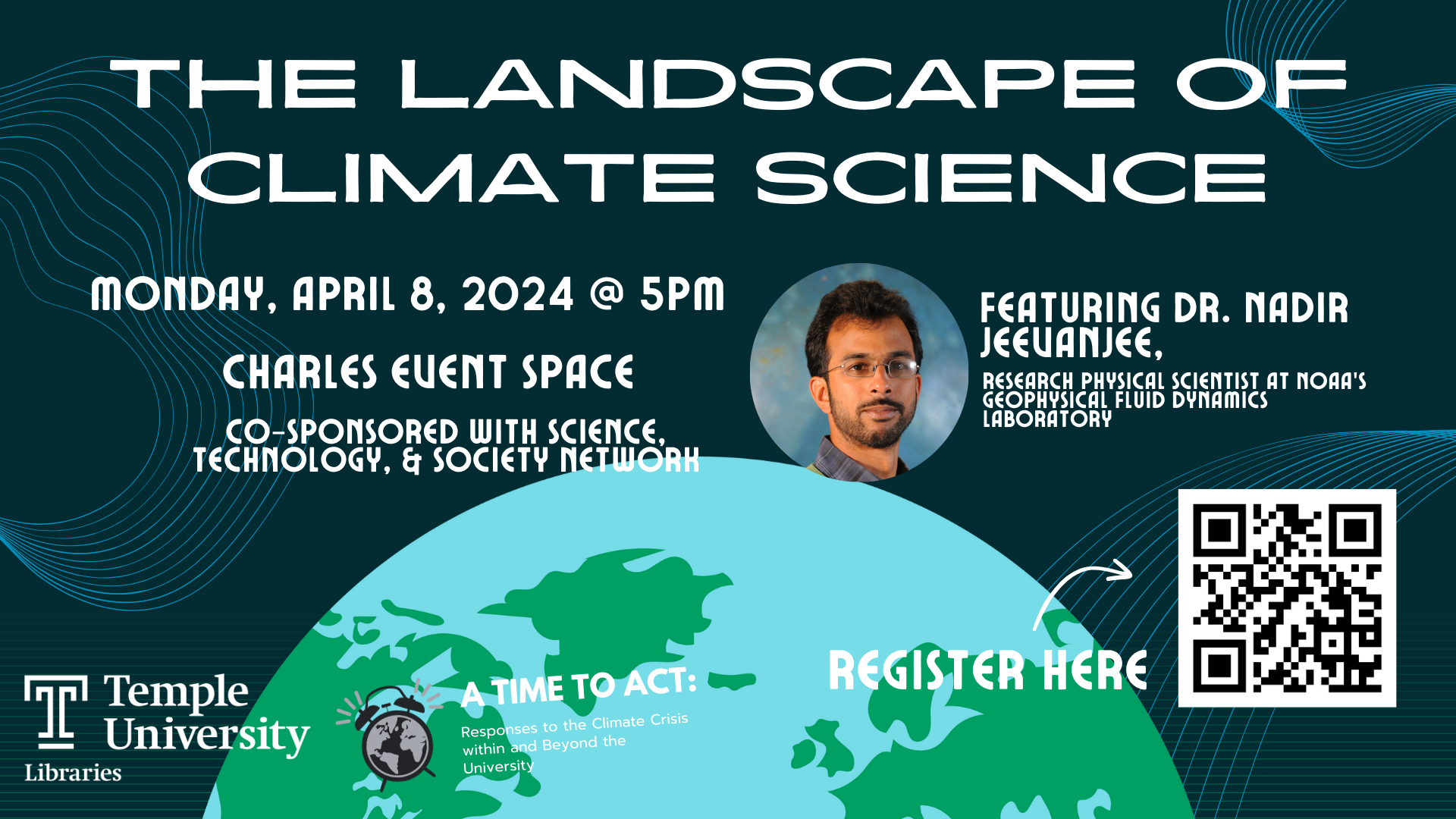
Climate change is described in some quarters as a “crisis” and in others as a “hoax”, with a range of views in between. How can one square this with climate science, which should be more objective? This talk, led by Nadir Jeevanjee, will emphasize that there is a spectrum of climate science, ranging from well-established, “settled” science (such as global warming due to anthropogenic CO2) to highly uncertain frontier topics (such as various proposed “tipping points”). To properly interpret climate science, one must acknowledge the existence of this spectrum, and appropriately place climate and weather phenomena within it.
Jeevanjee studies the physics of clouds, radiation, and climate, using a hierarchy of approaches ranging from pencil-and-paper theory to comprehensive computer simulations. He currently is a Research Physical Scientist at NOAA’s Geophysical Fluid Dynamics Laboratory. This event will be co-sponsored by the Science, Technology, and Society network at Temple University.
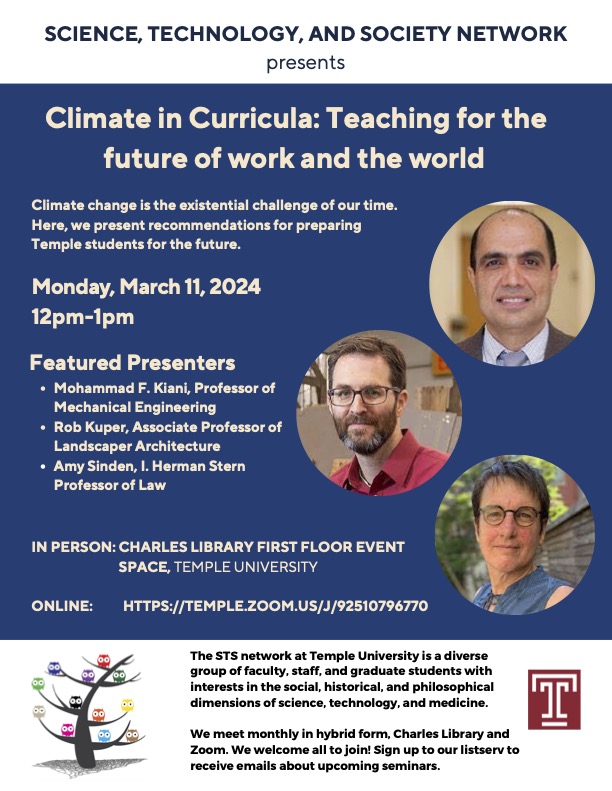
Monday, March 11, 2024
Drs. Mohammad Kiani (Mechanical Engineering), Rob Kuper (Landscape Architecture), Amy Sinden (Law School). Round Table Discussion. Climate in Curricula: Teaching for the future of work and the world
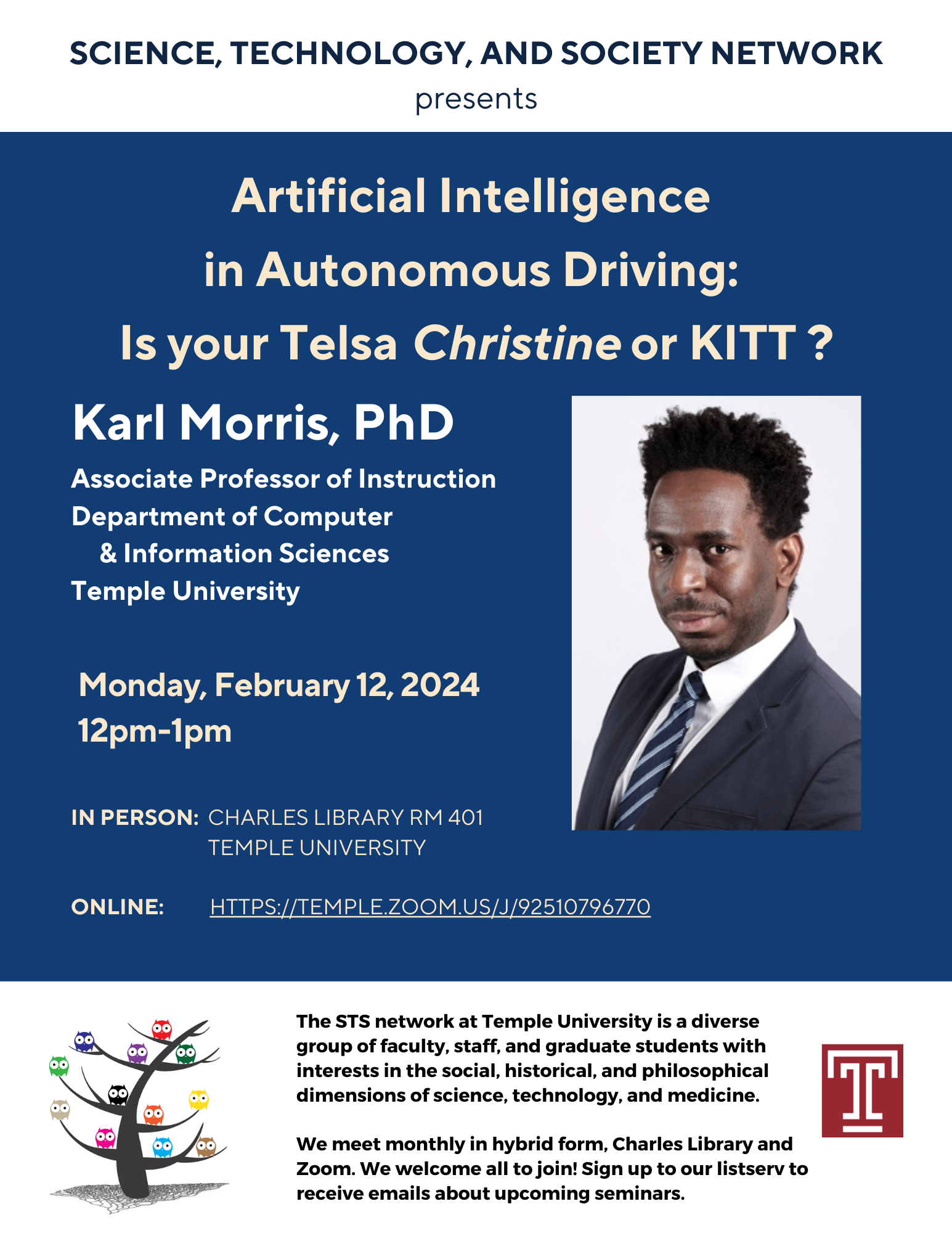
Monday, February 12, 2024
Dr. Karl Morris, Computer and Information Sciences (Seminar). Artificial Intelligence in autonomous driving: Is your Tesla Christine or KITT?
Monday, January 22, 2024
Dr. Richard Souvenir, Vice-Provost for Strategic Initiatives (Talk). New initiatives in interdisciplinary education & research at Temple University.
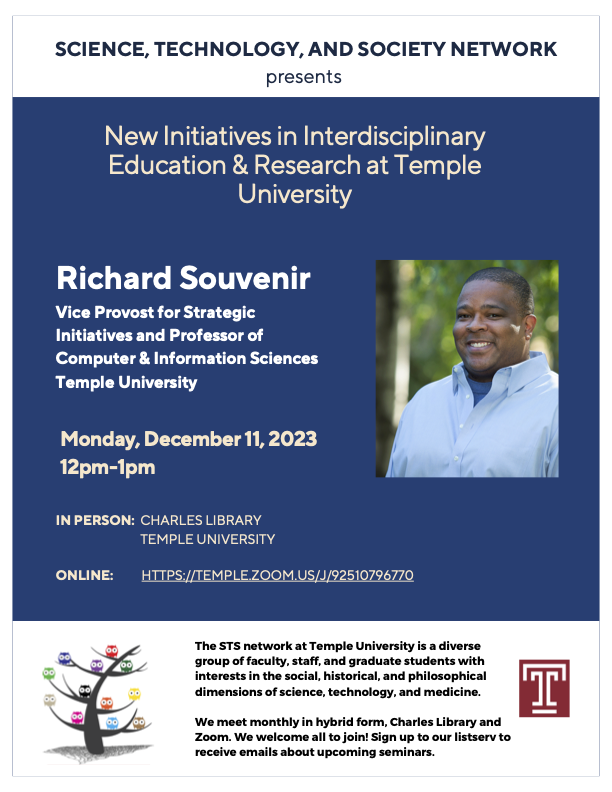
The power of a comprehensive research university lies in the vast array of educational offerings at all levels. The sheer size of such an institution, however, presents logistical roadblocks to interdisciplinary collaboration across different Colleges. This includes both undergraduate degree offerings and graduate research opportunities. In Spring 2023, the Provost charged a group of faculty with finding ways to lower these logistical barriers and fostering interdisciplinary education and enhancing interdisciplinary research. This “Interdisciplinary Collaboration Committee” recently completed its work and submitted a detailed report to the Provost.
~Fall 2023~
Monday, December 11, 2023
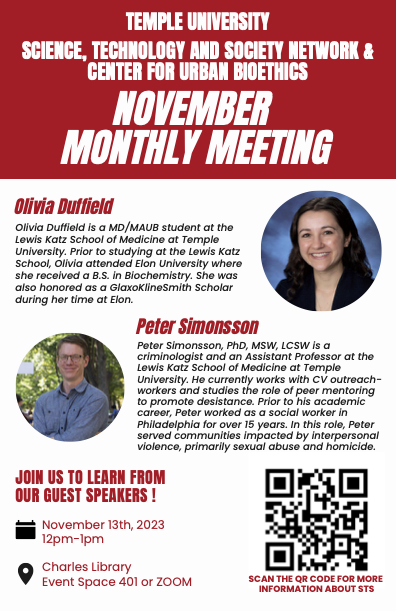
Dr. Peter Simonsson (Lewis Katz School of Medicine)
“Cure Violence Philadelphia: Implementing and Studying Gun Violence Prevention Program at Temple University’s Medical School”
Gun violence is a significant social and medical concern in Philadelphia. As a response, the city develops and funds a variety of interventions to prevent violent injuries caused by gun violence. Lately, more interest and investment has been funneled towards the use of public-health models to prevent gun-violence. Public health programs often use so-called “credible messengers” or “experts by experience” to identify and engage individuals who are at-risk for either gun-related injuries or violent perpetration. Temple University hosts the Cure Violence (CV) program, which is a public-health model to reduce gun violence. CV relies on credible messengers who operate independently of law enforcement and can more easily gain trust in marginalized inner-city communities impacted by violence. Once CV has gained trust, they will identify at-risk individuals and engage them in mentoring to motivate them to leave the streets. Research exploring how CV mentoring can support desistance from gun-violence is scarce. This presentation will focus on: introducing the CV public-health approach to reduce gun violence, discuss the research evidence for it’s effectiveness, and introduce the audience to two ongoing and funded CV research projects in North Philadelphia.
and
Olivia Duffield (Lewis Katz School of Medicine)
“Getting Well: Opioid Agonist Therapy as Harm Reduction”
Hospitals are critical safety nets that engage patients with opioid use disorder (OUD) in both medical care and recovery from addiction. However, research shows that patients with OUD intentionally delay seeking care, have high rates of self-directed hospital discharge, and frequently require readmission for unaddressed medical problems. This is due, in part, to untreated pain and withdrawal. Standard of care management for withdrawal includes methadone or buprenorphine, but many patients see these options as insufficient or unrealistic due to significantly elevated opioid tolerance from a street supply dominated by highly potent, synthetic opioids such as fentanyl. Using themes derived from qualitative interviews with patients at Temple Hospital with OUD, we make the argument that it is an ethical imperative for hospitals to expand protocols to include long and short-acting opioid agonist medications to treat opioid withdrawal.
Monday, October 9, 2023
A Graduate Student Forum
Daniel Remer (Philosophy)
“Ethical Considerations in Expanding Available Donor Hearts through Normothermic Regional Perfusion”
Traditional approaches to organ donation have limited the recovery of hearts to only brain dead donors. Recent technology known as normothermic regional perfusion (NRP) has allowed for available donor hearts to expand to non-brain dead deceased donors (i.e., cardiac dead donors). However, because NRP involves restoring a flow of oxygenated blood to the body, as well as a heartbeat, there are ethical considerations to be addressed, among which includes whether such donors really are dead. While NRP can help expand available donor hearts for transplant, the ethical implications must first be considered to prevent moral and actual harm and to ensure continued public trust in the organ donation process.
and
Gabriel Reagan (Geography and Urban Studies)
“The Digital (De)Construction of Food: Encountering taste, pleasure, and satiation in a reapidly interconnected world”
Consuming food media today requires interacting with an endless array of actors—varying in intentions and expertise—each with the potential to impact media users’ health and well-being in positive or adverse ways. At the same time, the growing dissonance between science and facts, influencers, and the public sphere is fostering incessant confusion and contradiction. Intensifying parasocial relationships, or nonreciprocal socio-emotional connections with individuals such as influencers, are rapidly transforming the ways in which we come to understand food and bodies. As media influencers and corporate-sponsored, algorithmically powered content creators exploit the affective power of food for personal gain, locating answers to food-related conundrums now requires traversing a vast information landfill where opinions are plentiful, but legitimacy remains murky.
My current research aims to unpack the affective ways in which we come to know food through the consumption of social media. I envision media as another somebody in the room, provoking an exchange between creator and consumer, an exchange that ‘does something’. If influence now has the power to supplant science, how do we know what information to take in and which to ignore? Timely and relevant, this paper tackles the increasingly common ways in which we come to know food digitally and further asks who is a creator, who is a consumer, and what is the relationship between them. What are the moral and ethical implications and who stands to gain, or lose, in the social construction of food?
Thursday, September 21, 2023
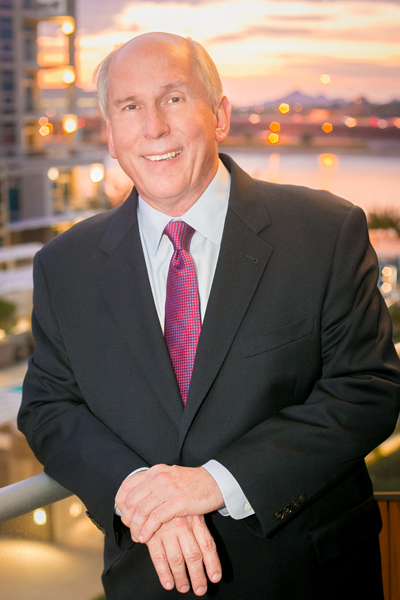
Dr. Ira Lawrence (Temple alum)
“Ethical Dilemmas in the Pharmaceutical Industry: an Insider’s Perspective”
Jointly sponsored by the Science, Technology, and Society Network, the Philosophy Department, and the College of Liberal Arts