~Spring 2023~
Monday, May 8, 2023
Alyssa M. Newman, PhD, Georgetown University
Making Families, Choosing Race: Sperm Banks and the Limits of Diversity
The widespread use of assisted reproductive technologies, coupled with demographic and social change, are normalizing new family configurations that extend beyond biological kinship. Despite the new populations and family formations utilizing these technologies, sperm donor selection is dominated by heteronormative logics and an interest in family resemblance achieved through racial matching. Yet the achievement of racial matching is hardly a given, as 70% of the sperm donors at banks across the United States are white. This talk will interrogate the racialized meanings assigned to donor sperm, drawing on interviews with interracial lesbian couples who encountered difficulties finding a donor of their desired racial background. This talk will also explore the sperm banks’ “diversity problem,” examining how, despite the fertility industry’s quick embrace of diversifying family formations including queer clients and intended parents of color, it continues to center around the reproduction of the white family. In a context of increasing state control over reproduction, the rise of both regulated as well as unregulated sperm markets raises the question of who is being served, or controlled, in the presence or absence of state intervention and policy.

Monday, March 13, 2023
STS NOW! – CONVERSATIONS IN SCIENCE, TECHNOLOGY, SOCIETY
Professor Erik Cordes (Department of Biology)
The Industrialization of the Deep Ocean: Can we avoid the Tragedy of the Commons on the High Seas?
As we struggle to move beyond fossil fuels and avoid the most catastrophic outcomes of global climate change scenarios, we are increasingly turning to the ocean and the emerging Blue Economy for solutions. Our fisheries are moving into deeper waters further offshore, we are drilling for oil and gas in places that were thought impossible a few years ago, and emerging industries like deep-sea mining and marine genetic resources are looking to international waters as a way to avoid the regulations and expense of working with the exclusive economic zones of nation-states. Currently, there are negotiations underway at the UN to govern these activities, which range from the designation of the management entity to the methodology for determining environmental impacts. Among these consideration is the proper valuation of ecosystem services and the creation of a global fund that would contain the dividends from the extraction of natural resources. Because these considerations are happening at a global scale, beyond areas of national jurisdiction, we have an opportunity to consider some new(ish) ideas related to ownership, nature’s rights, and a global universal income. Time will tell whether any of these creative ideas gain traction in this forum.
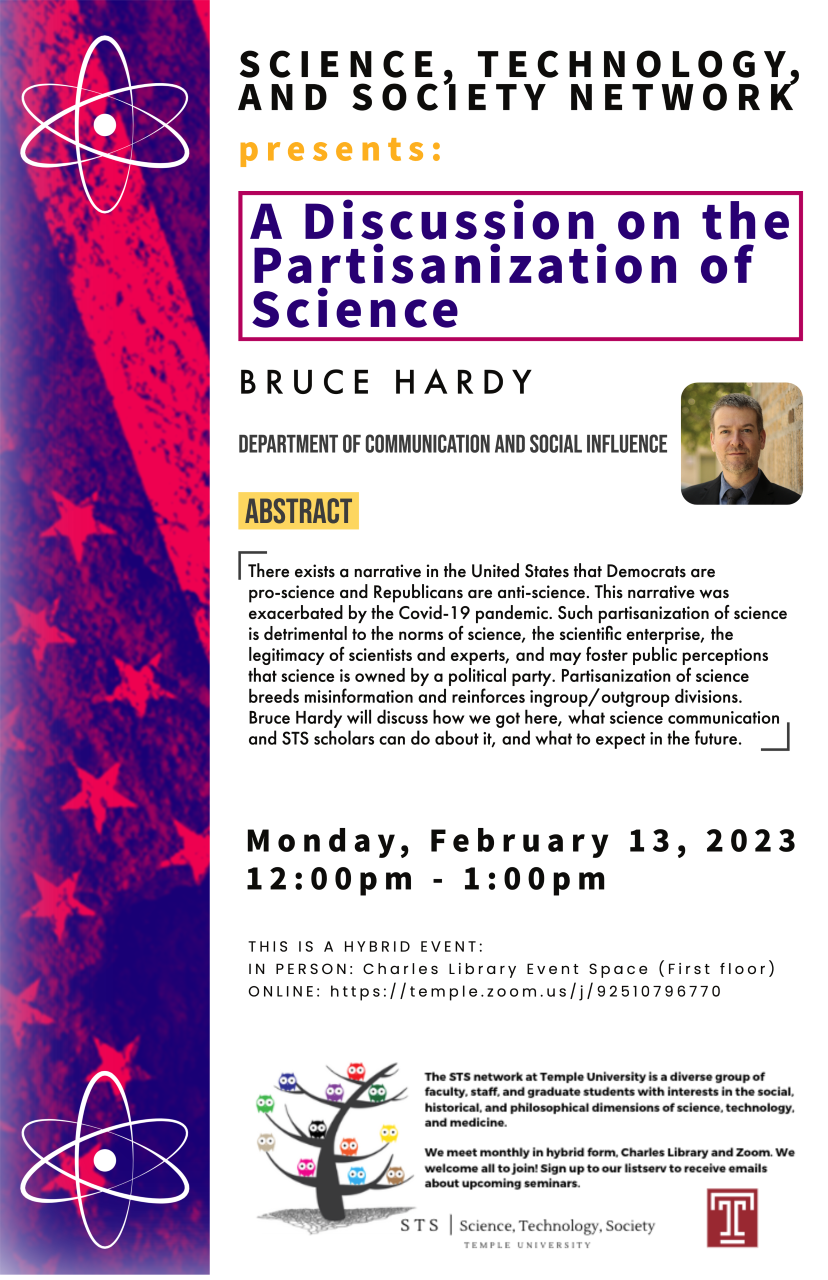
Monday, February 13, 2023
STS NOW! – CONVERSATIONS IN SCIENCE, TECHNOLOGY, SOCIETY
A discussion of the partisanization of science.
Professor Bruce Hardy (Department of Communication and Social Influence, Klein College of Media and Communication)
There exists a narrative in the United States that Democrats are pro-science and Republicans are anti-science. This narrative was exacerbated by the Covid-19 pandemic. Such partisanization of science is detrimental to the norms of science, the scientific enterprise, the legitimacy of scientists and experts, and may foster public perceptions that science is owned by a political party. Partisanization of science breeds misinformation and reinforces ingroup/outgroup divisions. Bruce Hardy will discuss how we got here, what science communication and STS scholars can do about it, and what to expect in the future.
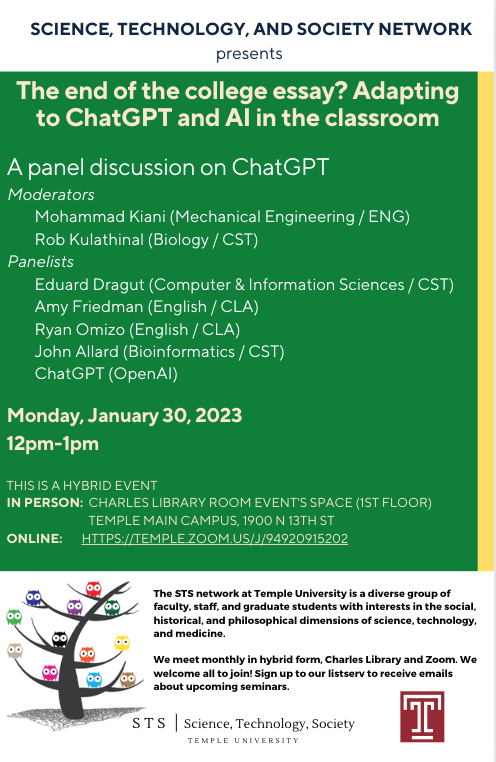
Monday, January 30, 2023
A Panel Discussion on…The end of the college essay? Adapting to ChatGPT and AI in the classroom.
Panelists: Dr. Eduard Dragut (Computer & Information Sciences), Dr. Amy L. Friedman (English, First Year Writing), Dr. Ryan Omizo (English), John Allard (PhD student, Bioinformatics), and ChatGPT (OpenAI)
Moderated by: Dr. Mohammad F. Kiani (Mechanical Engineering) and Dr. Rob J. Kulathinal (Biology)
∼ Fall 2022 ∼
Monday, December 12, 2022
Book Talk
Asta Zelenkauskaitė, Drexel University
discussing her recent book entitled, “Creating Chaos Online: Disinformation and Subverted Post-Publics”
With the prevalence of disinformation geared to instill doubt rather than clarity, Creating Chaos Online unmasks disinformation when it attempts to pass as deliberation in the public sphere and distorts the democratic processes. Asta Zelenkauskaitė finds that repeated tropes justifying Russian trolling were found to circulate across not only all analyzed media platforms’ comments but also across two analyzed sociopolitical contexts suggesting the orchestrated efforts behind messaging. Through a dystopian vision of publics that are expected to navigate in the sea of uncertain both authentic and orchestrated content, pushed by human and nonhuman actors, Creating Chaos Online offers a concept of post-publics. The idea of post-publics is reflected within the continuum of treatment of public, counter public, and anti-public. This book argues that affect-instilled arguments used in public deliberation in times of uncertainty, along with whataboutism constitute a playbook for chaos online.
Monday, November 14, 2022
STS NOW! – Conversations in Science, Technology, Society
Andrew Spence (BioEngineering, College of Engineering)
Neuromechanics, Neurogenetics, and Spinal Cord Injury: Uncovering the mechanisms of movement and how they may help us improve recovery from a paralyzing injury.
Movement is key to health and quality of life. Yet our understanding of the principles we use to control our bodies and the clever mechanisms that have evolved to get us around are far from complete. Furthermore, hundreds of thousands of people in the US alone are living with spinal cord injuries, reducing their quality of life, with few treatments available. This talk will present work seeking to understand how we control our movement, asking why legged locomotion tends to look like bouncing over a pogo stick. It will then move into more recent work that seeks to understand how forms of spinal cord stimulation help improve recovery from a spinal cord injury, employing new genetic tools that allow for ever more sophisticated manipulation and tracing of neural networks.
Monday, October 10, 2022
STS NOW! – Conversations in Science, Technology, Society
Todd Schifeling (Fox School of Business)
Divest, Delay, or Distract: Managing Conflicting Stakeholders amid Industry Disruption
While managers prefer to integrate the interests of multiple stakeholders, these groups often have conflicting goals. Industry disruptions intensify these conflicts, with some stakeholders favoring the status quo and others encouraging change. We investigate how managers balance conflicting stakeholders under such duress. Using the context of the U.S. electricity industry from 2008-2015, we find that inertial and activist stakeholders influence the divestment of coal generators in opposite directions. Further, by disentangling divestment announcements from implementation and considering the additional outcome of solar investments, we show how managers use strategic delay and distraction to mollify activists, while also benefitting inertial stakeholders.