Post #4: We Shall Live Forever in the Digital Glow

This week I found the article “From Reality to the Hyperreality of Simulation” by Paulo Barroso (2022). It explores how hyperreality relates to the concepts of virtual reality and simulation, detailing the distinctions between the concepts and how they combine with modern communications technology to reshape how we live our lives and perceive reality. Barroso makes the point that hyperreality is both a function of the technology which allows for the endless reproduction of images and the technological communication infrastructure itself, and that these same technological advances have now progressed to where communication is no longer just a human-to-human phenomenon, but frequently involves humans communicating with technology itself in the form of chatbots and other computer programs (2022).

The article argues that the end result is a society conditioned to exist in a constant state of augmented or virtual reality, as digital communications technology is not only pervasive but increasingly comprises the space where many people spend most of their time, resulting in a state where reality as a shared concept becomes less and less tied to objective physicality and is more dependent on the interactions between the sets of signs and symbols which characterize the digital space (Barroso, 2022). In short: when the majority of human experience becomes filtered through technology which can effectively blur the lines between what’s real and what’s virtual, “reality” becomes untethered from tangible experience of the world. Hyperreality takes its place, and truth becomes rooted in what is potential or possible instead of what is actual.

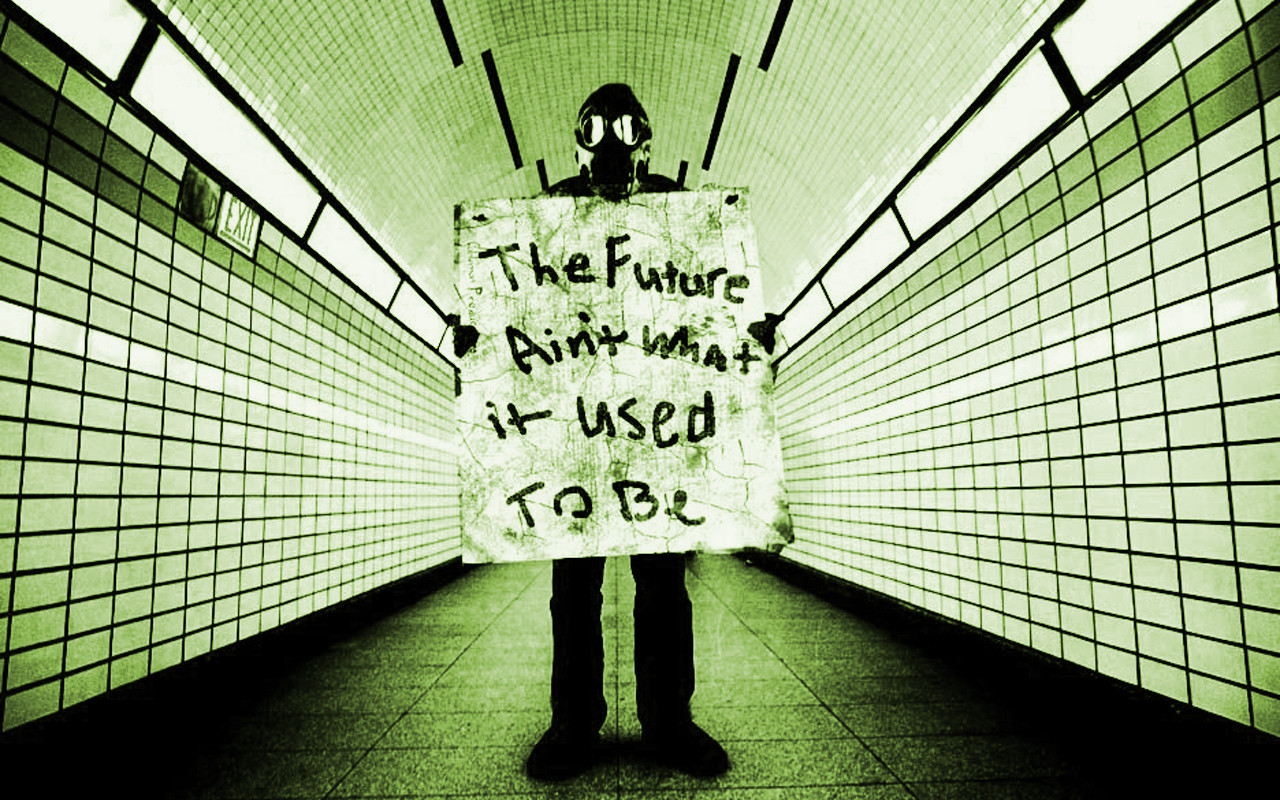
This article effectively lays out the philosophical underpinnings for my project. My goal is to use tropes from dystopian science fiction settings in a context which directly implicates the viewer through the use of interactive video. One of the characteristics of effective media from this genre is taking an aspect of contemporary life and exaggerating it to a degree which gets the audience to critically consider the world in which they live in now. Barroso’s arguments give me a theoretical basis for arguing why my work’s take on hyperreality could exist as a plausible possibility while reflecting back something the viewer/participant could recognize in their own lives.

I was wondering for a bit if straight up calling the organization in my project “The Department of Hyperreality” was taking things a bit too far, but now I think it’s the right move. The question isn’t whether the prospect of a society organized mostly around images and digital communication would read as too ridiculous, as you could make the argument we’re basically already there in 2026. Then the question becomes what could happen to make a society champion that fact to the point where it becomes one of their central organizing principles? What would it feel like to live somewhere that long ago discarded the notion that objective truth was worth upholding?

This week has been slow in terms of progress on my project, mostly due to me coming down with a nasty cold last Saturday. It feels frustrating because now that I’ve decided on a workable direction for my project I’ve become more excited about building out more of the idea but my energy levels and ability to focus have been hampered by my body trying to get well again. I’m trying to balance rest with staying on top of my commitments, and now that I’m rounding the bend on getting over the cold (knock on wood) I want to step up my efforts in expanding the world as well as starting in on the project pitch and initial media, which should also help to clarify where my thinking is in the project and what next steps I should take. That said, I have emailed one of my prospective committee members, and he’s agreed to serve on the committee, so that’s good! I plan to email the other prospects in the next couple of days so that this portion of the project can be over and done with. 

Reference: Barroso, P. (2022). From reality to the hyperreality of simulation. Texto Livre. https://doi.org/10.35699/1983-3652.2022.37426

Post #3: “Don’t worry about it too much, whatever you think is the truth is probably good enough anyway.”

The SCP Foundation is an ongoing collaborative work of fiction which began in 2008. It’s a wiki with presents itself as the archive of a secretive extra-governmental organization which has charged itself with protecting the world from anomalies – objects, beings, and even concepts which defy the laws of physics and conventional understanding, from a lizard which is practically impossible to kill to a previously undiscovered integer which causes math to break down. The entries which form the bulk of the site take the form of articles detailing the procedures used to contain and study these items, and the site’s community tends to be exacting when it comes to the language and style of these entries, stressing rigor and the need to impart a believable atmosphere. The result is a vast collection of short stories which mostly conform to a well-defined style, and for those willing to dig into the wiki and read between the lines more details of the setting and how the Foundation operates and sees itself can be found. It’s an experience akin to watching a “puzzle” movie like Memento as you have to work to unravel what exactly the object you’re reading about is and what it does to people. The orientation for their Memetics division is a great example of this, rewarding both close reading and interaction with the text itself (try highlighting the whole page).

One of the most common themes across the Site’s many disparate canons and stories is the idea of the control of information. Unsurprisingly for a perhaps centuries-old secret organization, censorship and redaction are common practices in the Foundation, and there’s always more going on underneath the surface of what you’re reading. Early on in the wiki’s existence, the site’s authors decided that there would be no one true canon. There is no definitive explanation for neither how the Foundation came to be nor the source of the anomalies it contains, with several possibilities being put forward with the in-universe explanation that they all exist simultaneously for purposes of disinformation and because reality itself may have been altered multiple times, so they could all potentially be true. 

As far as my project goes, the SCP wiki serves as a key point of inspiration. It represents a massive undertaking of worldbuilding and a blueprint for how to use a well-defined format to both structure a story and reveal information about the setting in a way which rewards close reading and prompts the viewer to question some of the assumptions they may have brought with them into the work. It’s also written in a way that encourages the audience to regard themselves as something closer to an active participant in decoding the work rather than just a passive receiver of information and story.

This relates to my project as this week I’ve zeroed in on what feels like a tangible direction for it. The working title is Bringing You Yesterday’s Tomorrows, Today! It will be an interactive video that takes the form of an interactive training module for the viewer/participant’s first day on the job in the Department of Hyperreality. It is 2056, and thanks to both ecological and context collapse brought about by climate change and AI respectively large swathes of the world are functionally uninhabitable. Most people live their lives in sealed habitats and conduct much of their business and social lives and leisure time via screens. The content on these screens is fully under the jurisdiction of the Department, and this training module’s content will give the viewer a glimpse into a society that has fully and shamelessly given itself over to living in a world oriented primarily around mediated signs and symbols. In order to function effectively in their job, the trainee needs to understand the importance of preserving a shared, cohesive narrative and how to keep it intact while still offering citizens the chance to exercise their imaginations – just so long as they don’t exercise them in the wrong ways.

 The interactive nature of the piece is intended to make the viewer question their own relation to the media environment we live in now and also what it would mean to try and reassert the real in a world which doesn’t much care for it. Naturally, this means I’m going to have to learn how to design interactive videos as well as bone up on principles of game design and choice in narratives, and next week I want to start building out the full future history and details of the setting I want to create, then start working to decide how much I reveal to the viewer/participant, as well as how to get them to push for confirmation of whether that information is even true. After all, if practically all the information you receive in your daily life is curated and distributed by a Department whose mission statement is predicated on eliminating competing narratives so as to avoid chaos, doesn’t that imply that there’s a lot they aren’t telling you? And what does it do to culture and imagination when those forces are contained in a walled garden?

Site referenced: Rounzie. (2015, July 18). Memetics and Infohazards Division Orientation. https://scp-wiki.wikidot.com/memetics-and-infohazards-division-orientation

Blog Post #2: “What if they gave an apocalypse and nobody noticed?”

This week I came across the article “On the Apocalypse that No One Noticed” (Krevel, 2018), an introduction to an issue of the journal ELOPE: English Language Overseas Perspectives and Enquiries. This issue featured articles concerning speculative fiction and science fiction in particular, and this introduction examines the specific subgenre of cyberpunk and its interaction with the concept of hyperreality. The apocalypse referred to in the title is in this case the erosion of both genre boundaries and of different mediums of communication thanks to the rise of digital communications. The author argues that the digitization of all media means people are effectively receiving all communications through just a single channel which is capable of endlessly reproducing signs and symbols which become substitutes for objective, lived experience. The result is that what people think of as “reality” or “truth” becomes dependent on these media-transmitted signs and how they align with other configurations of signs, and because of the many possible configurations of signs “in the paradigm of the hyperreal all realities exist simultaneously as a potentiality” (Krevel, 2018). They extend this reasoning to both the then-recent emergence of “fake news” and “alternative facts” as symptoms of this hyperreal environment, and to literature’s existence as a medium in this environment imbuing it with “a reality building potential” (Krevel, 2018). Essentially, because we live in a present moment which is so volatile due to the rapid and constant flow of information and signs, it becomes impossible to imagine a collective future which is both distant and significantly different from the times we live in now, and we thus end up hovering in a state of constant potentiality. Cyberpunk speaks to this by positing a future which is inevitable because of the grip the present has on it, so it’s less about what the future might be and more what it can’t fail to become.

Even though it was just a short intro to present the work of other authors, this article offered a new and really interesting theoretical take on how science fiction interacts with the idea of hyperreality and the role speculative fiction plays in contemporary culture. It feels like it’s articulating some of the ideas I’ve been floating around in a helpful way. In particular, the notion of all communication coming through one digital channel resulting in the blurring of lines between different media and genres feels central to what I want to explore. For instance, it feels weird and kinda gross that more and more people are using the video game term NPC (non-player character) to refer to other people as basically non-entities or not full individuals, and it’s an open question how many of these people who use the term have actually played a video game. This author would probably argue that distinction ultimately doesn’t matter, since the NPC meme has been so thoroughly propagated through social media that its initial relation to video games is now beside the point, and what matters is just that the concept itself (and the sense of alienation from others it implies) has become so widespread. Overall, this article provides a strong theoretical basis and vocabulary for relating hyperreality to science fiction and our digital culture, and honestly it also feels heartening to see people in 2018 were already thinking of how these things connected to our current lives in real and tangible ways. Not to mention the latter half of the intro outlined the work of other authors in the space which could also be helpful for my project, so I have a bunch of possible avenues for further research already.

As for what I’ve done this past week to work on my project, unfortunately I wasn’t able to make any progress beyond finding and reading this article. But next week, on top of picking prospective committee members, I hope to further refine what exactly my idea is going to be. At the very least I want to zero in on a topic, either by combining the two I have or deeply considering which of them is stronger and going with that one. I want to also have more discussions with more people about these ideas to figure this out because I find that more helpful than just thinking about this stuff (and potentially just endlessly ruminating on it) on my own.

…that said, a couple weeks ago on the Philly Book Crawl I picked up We Are Legion (We Are Bob) by Dennis E. Taylor, and then in the article I shared on our workshop slack for the first week of class I learned that Sam Altman actually mentioned being a fan of the book. That big time colored my reading of it, and I just finished it yesterday. It’s a fun book, very in the mold of The Martian and Project Hail Mary (to the point the author of those contributed a quote to the cover), and it’s really interesting to see how the book’s vision of life after death via cryogenic freezing could appeal to someone like Altman and the mental gymnastics he probably undertook to rationalize away all of the many elements the author includes that undercut the notion that cryogenic life after death would be a good idea that would work as intended. It’s sort of like how I played through Cyberpunk 2077 and came away convinced that the only thing Elon Musk probably took away from the game – aside from a love for angular, militarized looking designs – was that it would probably be really cool to run one of the setting’s giant megacorporations which are unequivocally unethical and actively making life worse for basically everybody. They both point to the unfortunately continuing prevalence of Herbert Marcuse’s “technological rationality” as the mindset driving so much of society today. The technology in these works might seem amazing and look really cool, but even within the works themselves they speak to systems built on exploitation and efficiency at the expense of individual freedoms and environmental responsibility.

But I digress. Happy Labor Day!

Works Referenced:

Cyberpunk 2077 (PlayStation 5 version) [Video game]. (2020). CD Projekt Red.

Krevel, M. (2018). On the Apocalypse that No One Noticed. ELOPE: English Language Overseas Perspectives and Enquiries, 15(1), 9–16.https://doi.org/10.4312/elope.15.1.9-16

Lepore, J. (2026, Aug. 11). Elon Musk, Sam Altman, and the Misreading of Science Fiction. Wired. https://www.wired.com/story/book-excerpt-rise-and-fall-of-the-artificial-state-jill-lepore-silicon-valley-sci-fi/

Taylor, D.E. (2016). We Are Legion (We Are Bob). Saga Press.

Post #1: (Very) Initial Ideas

Welcome to the blog for my 2027 Media Studies MA Project! I’m Sam Korda, and right now I’m stuck between two different topics which my project could tackle (though there’s potentially a world where the two could merge).

I’ve always been a big fan of science fiction and fascinated by the fact that over the past few years many technology companies are leaning on concepts and imagery from the genre to market their products and frame how they could be used. However, these references rarely go beyond aesthetic or surface-level nods to works and tropes which were intended as cautionary and not aspirational. This phenomenon of tech companies drawing inspiration from works of dystopian fiction in a way which feels like they missed the point of those stories is routinely commented on online and in op-ed pieces, but that hasn’t stopped the trend. AI serves as the clearest example of this disconnect. As far back as Asimov’s “Robots” stories in the fifties, the idea of an autonomous and intelligent machine was depicted as both groundbreaking and terrifying, with the potential to reshape human life for the better but also presenting unforeseen dangers which would require built-in safeguards in order to prevent catastrophe. Today there are scores of companies pursuing more and more powerful AI models with few guardrails in place even as agents decide independently to hack other companies or carry out other actions their builders never intended. I’m interested in exploring why this disconnect between the intent of a work and how it’s received by audiences happens, whether said disconnect exists among consumers too, and what it says about how these stories shape how we imagine the future.

The other topic I have in mind is less developed but feels more and more pressing (for lack of a better term), as we live in an age where the proliferation of media and images has been supercharged like never before thanks to the widespread availability of technology which allows people to both independently consume and create this media. On top of that, the rise of IP as the dominant force in narrative storytelling across multiple media has increasingly come to dictate which stories get told by media companies and how they’re presented. Can a story ever end if its role is to act as an endless source of revenue for its owner? As AI tools become more accessible and more people become dissatisfied with the “slop” content that gets churned out, will that change how people view and treasure franchises that were birthed in the pre-AI age? Will those IPs become inherently more valuable – in both a financial and cultural sense – because they bear the rare imprint of human intellect? Again, this is all just very preliminary noodling driven mostly by the idea I had for a potential title: “The Geography of Hyperreality”. It admittedly sounds cool, but I’ll need more research and thought first to see if it’s a viable idea for a project.

As for format, I’m honestly even more in the dark there. Right now there’s the strong possibility I’ll opt for a video of some sort as it’s the medium I’m most familiar and comfortable with but I’m trying to remain agnostic now about the specific shape this project can take. I’ve always been interested in games and interactive media and the option of doing some sort of interactive video or even a text-based game is appealing, but this will also be a bigger question I hope to tackle in this workshop.

Looking at past MA projects for inspiration, I found two from 2023 which feel like interesting points of comparison. The first is “Good Neighbors Watch” by Ben Guidry, which uses “symbolic montage and a vignette styled narrative to examine political identity formation and radicalization as a memetic process”. The synopsis unfortunately rings a little too true to life now, focusing as it does on mass surveillance driven by a far-right government, and blends a number of different stylistic elements to create an atmosphere of near-future political horror. The other work I looked at was “A Sankofa Story” by Kalynne Wilson, a music video project which examines “[t]he prevalence of repeated narratives, sampled music, and adapted media” in our culture. It asks what material is remembered and protected in our digital era and how artists enter into conversation with this process to create stories they hope will be remembered, and does so through the lens of Afrofuturism.

Both of these works take creative approaches to their subject matter, opting for mediums which can examine their respective topics but in either a narrative or music video form. It allows the creators to engage with the theory and research underpinning their work while delivering those insights to viewers in an engaging way. They both also meld at least a couple different styles and formats, as “Good Neighbors” brings in analog horror and glitch/meme aesthetics while “Sankofa” is an audio and visual work which also relies on an interactive distribution method. While the former has a more familiar presentation in the form of a 36-minute short film, the latter is more unconventional in its approach and less easily defined. I found that the way both of these creators approached their projects with an eye towards combining different aesthetics and methods of production inspiring, and I hope to take a similar approach with my own work… whatever that will end up being.