
Beyond the Notes presents
Beyond the Notes:
A Jazz Suite Performed Live!
Wednesday, September 23, 2026 12:00 PM
Charles Library Event Space
Light refreshments served. Boyer recital credit given.
All programs are free and open to all, and registration is encouraged.
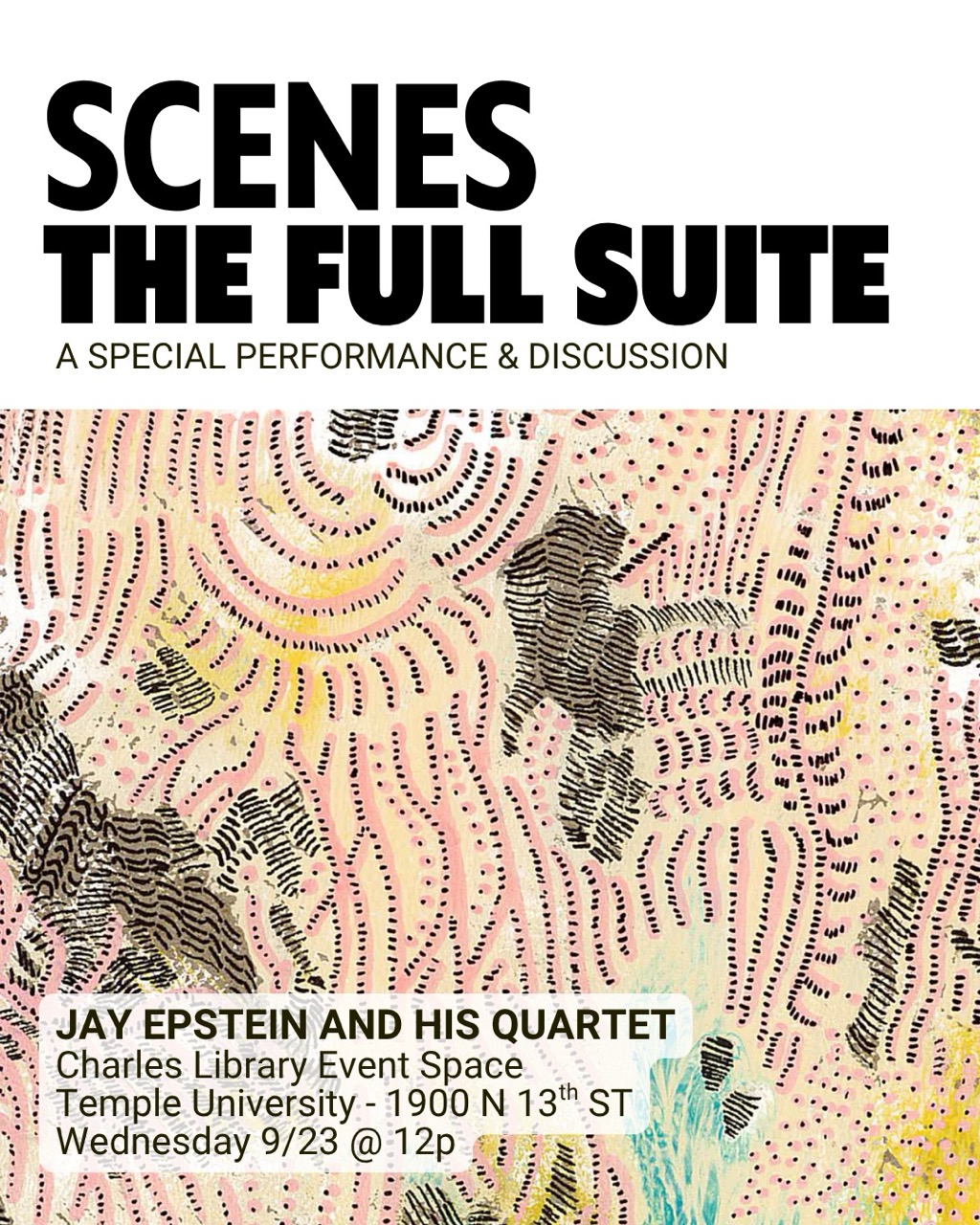
On September 23, pianist and composer Jay Epstein will bring his quartet to Temple University’s Charles Library for Beyond the Notes: A Jazz Suite Performed Live. Joined by bassist Madison Rast, drummer Wayne Smith Jr., and alto saxophonist Jon Katz, Epstein will present SCENES, a three-section jazz suite built around 10 connected musical “scenes.”
In advance of the performance, Epstein spoke with Boyer grad student Christopher Vu about the suite’s gradual development over several years.
This conversation has been edited and condensed for length and clarity.
CHRISTOPHER VU: Let’s start basic. For someone who’s meeting you for the first time, how would you describe yourself and the music you make? And how would you describe SCENES?
JAY EPSTEIN: I’ve been playing and performing pretty much most of my life. It’s always been part of my life. I went to conservatory, studied in New York, and then came to Philly and did my master’s here [Temple University].
Even while I was doing that, I always had this balance in the activity of my life. Half of my work has been focused on music and performance, and half has been teaching or working other jobs. I work in the private sector and do a lot of random activities that help subsidize my creative path. I think that has always come through in my writing, too. I look for a lot of balance in what I’m doing.
SCENES is a project I’ve been working on for the past couple of years. It’s a multilayered work that takes this singular idea and weaves it through several sections. The overall work is about an hour, maybe an hour and 15 minutes, depending on how it’s played. It’s a little different every time because it’s jazz. It’s written in lead-sheet format, so the ideas are written out. Some of it is very structured, but most of it is relatively loose and offers a lot of interpretation to whoever is performing it.
The themes remain consistent. It’s broken down into Sections 1, 2, and 3, and you can hear the different arcs moving through it. Some of the ideas have been sewn together over the years. I think the last one in the series was pulled from something I was working on in 2015 or 2016. It was buried in my notes somewhere, and I thought, “Oh, that actually fits right into what I’m doing here.”
The premise is really this interpretation of structure and balance, and how ideas can move and shift as we continue to progress and evolve them. That’s also been the trajectory of my musical, performance, and educational life.
VU: When you say “ideas,” you mean musical ideas, motifs and things like that? Because the word SCENES makes me think of something cinematic. You’re not necessarily thinking of places, people, or events.
EPSTEIN: Yeah, almost exactly. I’ve been asked a lot if I did this project as a film score or for a specific thing it represents. There are jazz suites that do that, of course. And it could apply, technically speaking, but the idea was really based on these thematic ideas that get tweaked and pulled and stretched. They change and evolve as the work moves forward.
You hear one consistent theme reappear every three or four tracks, and then it’s interspersed with other musical ideas that connect everything.
VU: When you first conceived this a few years ago, did you already have the concept of three sections and a certain number of SCENES? Or did you begin with SCENE 1 and keep adding to it, almost like working on a bonsai tree over the years?
EPSTEIN: More the latter. A lot of it came together in pieces. Sometimes I would write a four-, six-, or eight-bar idea, and that was the thing. Other times I’d write three pages of really constructed direction. It depended on where I was in that journey, but a lot of it connected back.
It’s funny. When I thought, “Oh, this is getting somewhere. We’re almost there,” one of the last things I did was go back to the beginning and add a pre-SCENE function. Before we even get to the first real theme, I added something else. Something wasn’t settling right, and it needed something different.
So it has been constructed, cut and pasted, and merged in different ways. We have 13 tracks that will be recorded, but only 10 principal SCENES. The other tracks are connection points. Between SCENE 3 and SCENE 4, for example, I have SCENE 3.5, which is this short connection point that merges the two together.
VU: How much of that did you discover in the rehearsal room? Were you bringing in a few bars and finding the arc with the band, or was most of it already there in the lead sheets?
EPSTEIN: Probably around 75 percent comes together as a finished product in the rehearsal room. You can have great ideas all day long, right? Whether they work is a totally different story.
I had an old version of SCENE 6. It was cool, and it was doing something, but it wasn’t driving the connection point between SCENES 5 and 7 that I was looking for. It had too much energy. There was just something going on that didn’t fit.
Most of it got chopped up and restructured into a totally different thing because of playing through it with people and really hearing, “No, this is a cool thing, but it’s just not part of this project. We’ll do that thing later. This needs something different.”
VU: Tell me a little about the band. Are these the people who have been playing the piece with you over the past few years?
EPSTEIN: We’ll have Wayne Smith Jr., who’s one of the leading drummers in the Philly area and has been around for a long time. Madison Rast [double bass] plays all over the city. And Jon Katz is on alto saxophone. He’s also a well-known Philly guy.
They’re all local musicians and really great players. We get together pretty often to play, work on new arrangements and new tunes, read stuff, and, of course, play out.
VU: I’m thinking about this being performed in a library. Do you think the space will change the concert? Do you see yourself talking more about the SCENES in between? How will it feel different from a recording session or a jazz club?
EPSTEIN: Truthfully, I don’t know yet. We’ll see. The space and the audience play a lot into the output of the performance. We’ll have to see what the vibe is that day and how everything is feeling.
I’m always down to talk about the work. I want people to understand, or at least have a decent concept of, how some of it has been pieced together and where ideas connect later in the work. But I also want the music to be the primary focus.
The library show gives us an opportunity to be a little more concise and really focus on the compositional aspect of the work, versus a heavy, solo-featured performance. If we’re playing at a club, the sets are an hour long, so we probably won’t get through the full piece. And something that’s three minutes in the studio could be 15 minutes live. It becomes this whole long, drawn-out experience. It’s a totally different vibe.
At the library, we’ll be able to do the entire suite.
VU: Once it’s recorded, do you still see SCENES evolving? Could there be a live album in a few years, or a five- or 10-year revisit of the music?
EPSTEIN: I think there could be. Let’s say we take SCENE 4 and go perform it. You can do these SCENES individually. That’s fine. But any time you play SCENE 4, it’s going to be different. That’s the cool part about this music and the way it works. There’s always this natural evolution in how the music shapes itself over time.
This project will live, and we’ll be able to bring the SCENES back into performance whenever we want. But I’m already moving on to a different project, and my next project is very different from this. I’ll probably finish that and then come back and do something like a SCENES 2, or another version with a different variety of music.
I don’t know that I would intentionally evolve the compositional aspect of this album. But when we go out and perform it, it naturally shifts and grows.
VU: Have you had favorite SCENES over the years? Are there SCENES you look forward to playing, or maybe ones you’re sick of playing?
EPSTEIN: I’m biased, but I enjoy them all. It depends on who I’m playing with, too. I often play with different people, and people with different strengths, experiences, and voices gravitate toward different parts of the work.
The SCENES have very distinct vibes, especially in the latter half, where the tone shifts a bit. A player with a certain approach might fit SCENES 7, 8, and 9 better than SCENES 3, 4, and 5. Maybe we choose what they naturally gravitate toward.
VU: I found some of the SCENES on your YouTube channel, and I noticed SCENE 4.5. What makes something a “half” SCENE?
EPSTEIN: It’s a connector, an interlude between SCENES 4 and 5. SCENE 4 ends, the band drops out, and the piano continues through and brings in a new motif. That becomes SCENE 4.5, which ends, and then the piano brings through the new motif that becomes SCENE 5.
SCENES 4 and 5 are full structures. SCENE 4.5 is just an idea, a smaller cadence with this repeated function that pushes us into the next segment.
VU: You mentioned teaching [at Temple Music Prep] as part of your work. Do you ever bring SCENES into a lesson to discuss how a musical idea evolves or how to improvise on it?
EPSTEIN: At times. It’s very student-based: where people are, what they’re interested in, and the kinds of concepts we’re working through. But SCENES is always sitting in my bag, right? So it’s easy to pull out.
Any time I can reference a specific application of what we’re discussing, I will. If we’re working through a tonal idea, a voicing-based idea, or some type of pattern development, I can refer back to something I’ve built. It’s an easy connection point.
We always look for the application: “Remember that thing McCoy Tyner is doing on this album? This is what we’re talking about.” Or, “Remember what Chick Corea does coming out of this section of ‘Matrix’? Here’s the motif he’s developing, and this is why it makes sense.” Then I can say, “Here’s what we’re doing at the end of SCENE 9, and here’s how I’m interpreting that application of harmony or structure.”
VU: Since you mentioned McCoy Tyner and Chick Corea, who are some of your biggest influences, either on this piece or on you as a performer and composer?
EPSTEIN: I don’t think anybody is completely original. I listen to a ton of music. I grew up on Keith Jarrett and pretty much every single Brad Mehldau album that came out. That’s why I went to the New School in New York. I thought, “Well, maybe Mehldau will come back and do a session,” which he did. And that was, wow.
I’m sure a lot of my influences and what I’ve listened to come out in my natural performance, in what I’m hearing and what goes down. But I like to think it has all merged into more of a unique sound. Who knows?
VU: You’ve come back to this idea of balance a few times. What has that looked like as you’ve moved from being a student at Temple to working professionally in Philly and then returning to teach?
EPSTEIN: Pretty smooth, for the most part. I mean, I’m really busy. I have two little kids, a five-year-old and a seven-year-old. That alone is a whole full-time job. There’s always a lot going on.
I try to put myself out there enough to keep playing the stuff I want to play. I don’t necessarily rely on gigs or music for my income, so it’s helpful to be able to do the sessions I want to do, the gigs I want to do, and write the stuff I want to write. I don’t have to get caught up in the minutiae of trying to “make it” as a musician.
That goes back to the balance I’ve been able to find over the years. I know a lot of people who are just in it: they’re teaching full-time, playing, running music programs at schools, and doing all the good stuff. That’s great. This is the balance that has worked for me.
Beyond the Notes: A Jazz Suite Performed Live takes place Wednesday, September 23, 2026, from noon to 1 p.m. in the event space at Temple University’s Charles Library.
Jay Epstein is on faculty at Boyer College of Music and Dance in the Music Prep Department, teaching Jazz Theory and Performance for Busy Adults, as well as individual lessons in Suzuki, traditional, and jazz piano.
by Christopher Vu
Christopher Vu is a composer, pianist, and interdisciplinary artist whose work moves between concert music, theatre, dance, and collaborative performance. He is currently a PhD student in Composition at Temple University. Learn more at www.chrisvumusic.com.
Suggested reading:
Herzig, Monika. Experiencing Chick Corea: A Listener’s Companion. The Listener’s Companion. Rowman & Littlefield, 2017. https://librarysearch.temple.edu/catalog/991036840793403811.
Peterson, Lloyd, ed. Music and the Creative Spirit: Innovators in Jazz, Improvisation, and the Avant Garde. Studies in Jazz, no. 52. Scarecrow Press, 2006. https://librarysearch.temple.edu/catalog/991013538239703811.
Zwerin, Michael. The Parisian Jazz Chronicles: An Improvisational Memoir. Yale University Press, 2005. https://librarysearch.temple.edu/catalog/991011250199703811.