
Beyond the Notes presents
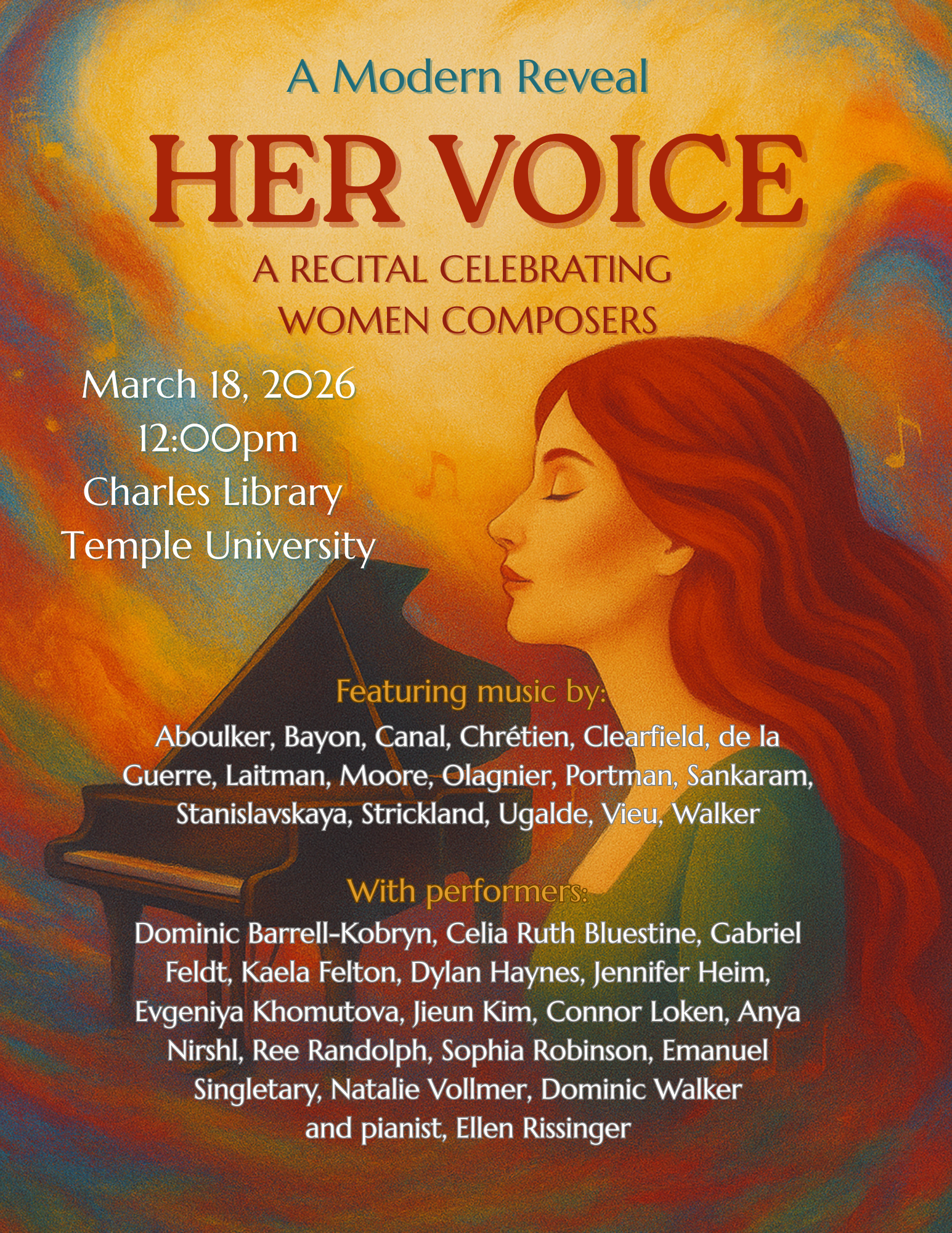
A Modern Reveal: Her Voice
Wednesday, March 18th, 2026, 12:00 PM
Charles Library Event Space
Light refreshments served. Boyer recital credit given.
All programs are free and open to all, and registration is encouraged.
In honor of Women’s History Month, Temple Libraries and musicians from the Boyer College of Music and Dance celebrate women composers from the past and present in a program of art songs and arias in French and English. Featuring songs from the early 18th century through the present, this program serves as testament to the creativity and perseverance of artists who have often been systemically erased from history and from concert halls.
While women composers have long been ignored, relegated to special programs, or represented solely by the most famous names (Clara Schumann, Hildegard von Bingen, and Florence Price come to mind), these artists have always been with us, and numerous contemporary organizations and individuals have devoted their time and resources to correcting these gaps in the music historical record. In this month’s post, we highlight several resources that are helping to promote women and other minority composers in both classrooms and concert halls.
A Modern Reveal
The curators of this month’s Beyond the Notes concert, Randi Marrazzo and Nicole Leone, are the women behind A Modern Reveal, an organization aimed at promoting the music of women composers of the past and present through publication projects, recitals, and education. Their two score publications, 24 Italian Songs and Arias by Women Composers and 24 French Songs and Arias by Women Composers, both published by Hildegard Publishing Company, challenge the dominance of the well-known Twenty-Four Italian Songs and Arias songbook that is the bane of many an undergraduate voice major’s existence. Other projects include women composers of early modern Italy, Jewish and Eastern European composers, and musical theater composers.
The Boulanger Initiative
Like A Modern Reveal, the Boulanger Initiative seeks to promote performance and collecting of music by women and gender-marginalized composers. In addition to their vast database of composers and works, the Boulanger Initiative also offers workshops, edit-a-thons, concerts, and consultation services aimed at instruction and programming curation. They also boast an online shop with women composer-themed merchandise including posters and tee-shirts.

Composer Diversity Database
Created by the Institute for Composer Diversity at the School of Music of State University of New York Fredonia, the Composer Diversity Database lists “women and non-binary composers, those from historically excluded racial, ethnic, or cultural heritages, and/or people who identify in the LGBTQIA2+ community.”1 Comprising both a composer and works database, users can search or browse for composers by different categories including gender identity, race/ethnicity, disability, and music genre.
In addition to the database, the Institute for Composer Diversity also conducts an annual survey in partnership with the League of American Orchestras to create the Orchestra Repertoire Report to track the diversity of orchestra programming throughout the United States.
Music by Women
While the above organizations focus on promoting women and other underrepresented composers for the purposes of the changing performance practices and diversifying concert halls, Music by Women has another aim: to give music theory instructors more diverse teaching examples to use in their classrooms. In order to teach concepts such as meter and rhythm, musical form, harmonic progressions, and more, music instructors often look to the most famous examples from the established musical canon–works by dead, white, male composers. Websites like Music by Women seek to normalize the presence of women composers in the classroom not only as part of the music history curriculum, but also by making it easier to find such examples to teach music theory concepts. For example, clicking on the “Aloha ‘Oe” example reveals not only the complete musical score and original manuscript of the famous song by Hawai’i’s Queen Lili’uokalani (1838–1917), but also a list of musical concepts that can potentially be taught through the song (e.g., half cadences, parallel period, sentence, etc.).
Similar websites that also offer diverse musical examples for instruction include Diverse Music Theory Examples, Expanding the Music Theory Canon, and Music Theory Examples by BIPOC Composers.

For more works and resources about women composers, check out these and other works from Charles Library!
Beer, Anna R. Sounds and Sweet Airs: The Forgotten Women of Classical Music. Oneworld Publications, 2016. https://librarysearch.temple.edu/catalog/991023114129703811.
Briscoe, James R., ed. Historical Anthology of Music by Women. Indiana University Press, 1987. https://librarysearch.temple.edu/catalog/991025059119703811#doc-991025059119703811.
Carrington, Terri Lyne. New Standards: 101 Lead Sheets by Women Composers. Berklee Press, 2022. https://librarysearch.temple.edu/catalog/991038160259203811.
Claghorn, Charles Eugene. Women Composers and Songwriters: A Concise Biographical Dictionary. Scarecrow Press, 1996. https://librarysearch.temple.edu/catalog/991036794983803811.
Halstead, Jill. The Woman Composer: Creativity and the Gendered Politics of Musical Composition. Ashgate, 1997. https://librarysearch.temple.edu/catalog/991001399389703811.
Hamer, Laura, ed. The Cambridge Companion to Women in Music Since 1900. Cambridge University Press, 2021. https://librarysearch.temple.edu/catalog/991038016391803811.
Marrazzo, Randi, and Nicole Leone, eds. 24 French Songs & Arias by Women Composers. Hildegard Publishing Company, 2023. https://librarysearch.temple.edu/catalog/991039053044003811.
Marrazzo, Randi, and Nicole Leone, eds. 24 Italian Songs & Arias by Women Composers. Hildegard Publishing Company, 2020. https://librarysearch.temple.edu/catalog/991037974084803811.