
Beyond the Notes presents
Beyond the Notes:
Music of P. D. Q. Bach (and Peter Schickele)
Wednesday, February 18th, 2026 12:00 PM
Charles Library Event Space
Light refreshments served. Boyer recital credit given.
All programs are free and open to all, and registration is encouraged.
This month, Beyond the Notes will be presenting music by P. D. Q. Bach, the fictional composer of musical parody created by Peter Schickele. Accordingly, this month’s blog post will be dedicated to celebrating the composer who brought P. D. Q. Bach to life.
Meet Peter Schickele, the man who “discovered” P. D. Q. Bach
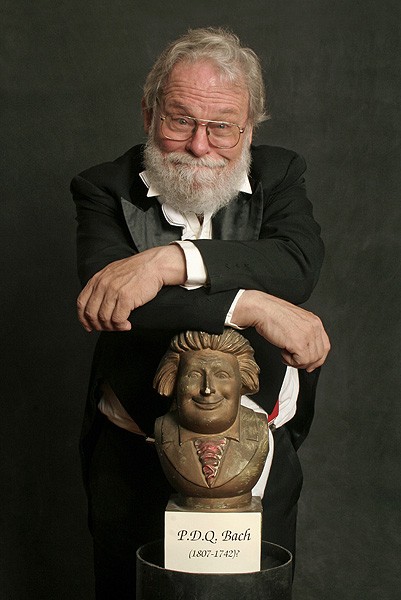
Peter Schickele (1935-2024) was primarily known for his roles as a composer and musical satirist, but he also was a skilled bassoonist and host of the music educational radio show Schickele Mix. After graduating high school with the distinction of being Fargo, North Dakota’s only bassoonist, he went on to become one of the first people to receive a music degree from Swarthmore College. During his time at Swarthmore, Schickele composed his first film score for his colleague Ted Nelson.
After graduating from Swarthmore, Schickele attended the Juilliard School and studied composition with Roy Harris and Vincent Persichetti. He graduated with his masters degree in composition in 1960 and returned to Juilliard to teach from 1961 to 1964. In 1965, he left Juilliard to pursue composing and arranging music full time.
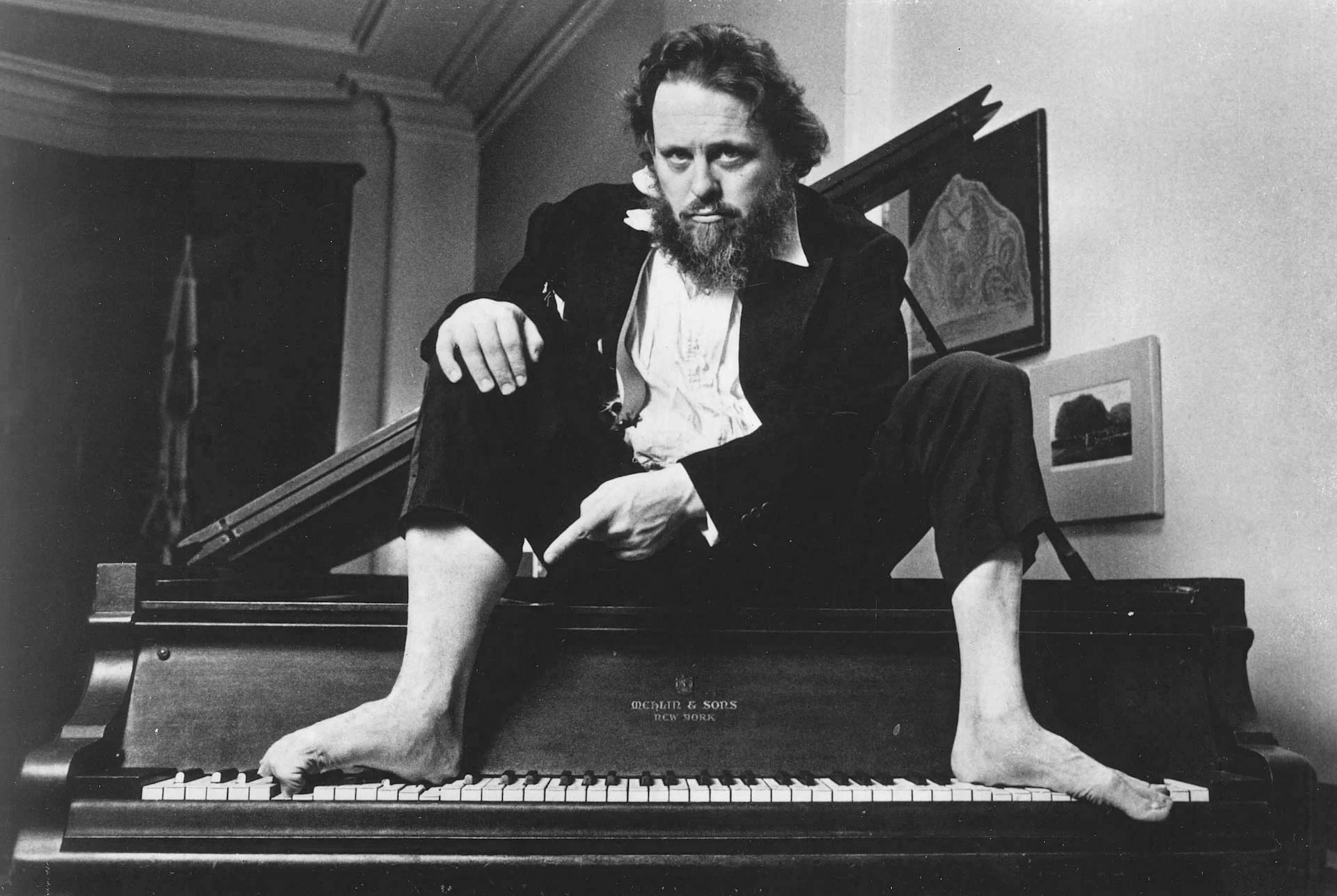
In addition to his instrumental compositions, Schickele also wrote and arranged folk music during the 1960s, most notably orchestrating and arranging three albums for Joan Baez. Once his P. D. Q. Bach concerts started achieving widespread recognition, Schickele began touring and recording albums of P. D. Q. Bach’s music. The rest, as they say, is history.
Who’s this P. D. Q. Bach Guy Anyways?
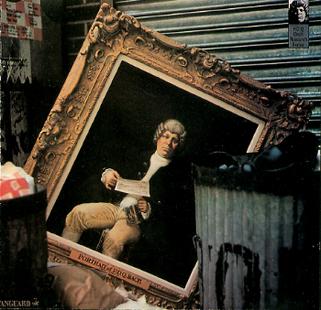
P. D. Q. Bach (1807-1742)?, the fictional composer created by Peter Schickele for his satirical music, was supposedly born on April 1st and was the twenty-first of Johann Sebastian Bach’s twenty children. He was “rediscovered” from obscurity by Prof. Schickele, the Very Full Professor of Musicology and Musical Pathology at the (fictional) University of Southern North Dakota at Hoople. Like many composers of the western canon of classical music, P. D. Q. Bach’s music can be divided into three compositional periods: the initial plunge, the soused period, and contrition. While there do not seem to be any unifying elements in any of the three musical periods, P. D. Q. Bach does exhibit a tendency towards more expansive orchestration as his compositional career progresses.
Initial Plunge
Described by Schickele in his alter ego as Professor, this initial period is the result of P. D. Q. Bach’s six-day foray into compositional study during which he supposedly learned everything he needed to know about the art of composition. Representative pieces from this period include the Traumarei for unaccompanied piano, Echo Sonata “for two unfriendly groups of instruments”, and the Gross Concerto for Divers Flutes, two Trumpets, and Strings.
The first of these, the Traumarei, is part of a collection titled “Notebook for Betty-Sue Bach”, which is a play on the Notebook for Anna Magdalena Bach, a collection of works that J. S. Bach compiled for his wife that included several of his own compositions. The movement title is also a reference to Robert Schumann’s “Traumerei“.
The compositions of this period are primarily shaped by humorous titles, musical quotations of well-known pieces in the western canon, and a humorous twist drawn from the twentieth century middlebrow emphasis on music education.
The Soused Period
This second period was reportedly the longest period of P. D. Q. Bach’s compositional career and is characterized by expanding orchestration and length of compositions as well as a fascination with puerile themes. Examples of the former include a Sinfonia Concertante, a Concerto for Piano vs. Orchestra, a Concerto for Bassoon vs. Orcestra, The Stoned Guest, and the Grand Serenade for an Awful Lot of Winds and Percussion.
Compositions of the latter category include titles such as theErotica Variations, Pervertimento for Bicycle, Bagpipes, and Balloons, and a Seranude that features the tromboon (a trombone whose mouthpiece has been replaced by the reed and bocal of a bassoon). While all of the compositions of the soused (or brown-bag) period feature some sort of humorous element in the title, the compositional techniques are generally a little more nuanced and complex than P. D. Q. Bach’s earliest works.
Contrition
According to Professor Schickele, this last period was P. D. Q. Bach’s attempt to compose “as if he were oblivious to all the music he had written.” During this phase of his compositional career, P. D. Q. Bach wrote a cantata called Iphigenia in Brooklyn, his oratorio The Seasonings, Fanfare for the Common Cold, Grossest Fugue, and P. D. Q. Bach’s final composition, Missa Hilarious.
Schickele the Composer
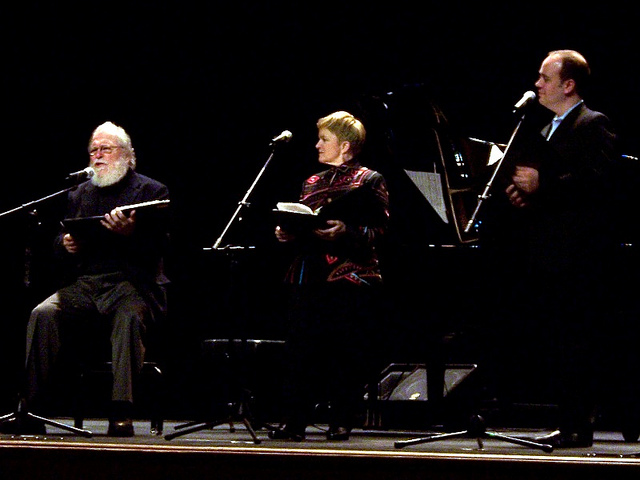
Aside from his work as P. D. Q. Bach, Peter Schickele wrote more than 100 original works for a variety of ensembles. This includes three percussion sonatas, two piano concertos, two symphonies, and a variety of solo concertos. While his parody works have received relatively widespread recognition, his serious music has remained under-performed for the most part.
Suggested Reading:
Schickele, Peter. The definitive biography of P. D. Q. Bach, 1807-1742?. Random House. 1976. https://librarysearch.temple.edu/catalog/991003363399703811
Ravas, Tammy. Peter Schickele: a Bio-Bibliography. Praeger. 2004. https://librarysearch.temple.edu/catalog/991001595829703811
Ravas, Tammy. “‘The Initial Plunge,’ ‘The Soused Period,’ and ‘Contrition’?: Moving Towards a Style of Peter Schickele’s Funny Music in His P.D.Q. Bach Works,” Notes (Music Library Association). Vol.62 (2), p.322-353. https://librarysearch.temple.edu/articles/cdi_proquest_miscellaneous_57604386
By Joanna Moxley