Data centers are the new buzzword, and it seems like there’s either a new lawsuit or state action around them every day. Many challenges have been brought against them, especially since mega tech companies are building them largely to support AI growth. Local communities consistently push back in different ways, citing concerns about rising utility bills, air pollution and climate change, and water pollution. According to the International Energy Agency, data center electricity demand is set to double by 2030 to around 945 Terawatt-hours, more than Japan’s entire electricity demand today. Further, AI data centers create a heat island effect: Once operational, they can raise local land surface temperature by as much as 16 degrees Fahrenheit in some areas and, on average, by 3.6 degrees Fahrenheit in the months after they become operational. With all the updates around the country, what can be done, or is being done, in Pennsylvania specifically? This is the rundown.
Litigation
Litigation against data centers can be a powerful tool to halt construction, delay approval, or flag inconsistencies or construction issues early. Two main waves of litigation exist. The first wave involves permitting, siting, environmental review, and land-use issues in establishing a data center site. The second wave includes negligence, nuisance, and other tort claims like trespass—more substantive claims tied to specific community and individual harms arising from data center operation.
Around the country, data center litigation is booming. In Mississippi, the National Association for the Advancement of Colored People sued xAI Corp over exposure to data-center harms, interference with property, and Clean Air Act violations. Additionally, Pearson v. Amazon Data Services, Inc. was a win for communities in Eastern Oregon when Amazon agreed to a $20.5 million settlement in a class action alleging that the AWS data center contributed to nitrate contamination of community drinking water.
In Pennsylvania, developers are suing townships for denying their data center permits, but community members are also pushing back and challenging further construction. Cumberland County has already approved the PAX-1 data center project, and construction has begun, but residents have gone to court to challenge the decision. Zoning law and the fact that the township previously denied a housing development project because it would visually impair the Appalachian Trail could also support viable arguments to halt this data center project.
Pennsylvania Legislation and Executive Action
Governor Shapiro signed an Executive Order at the end of August requiring compliance with the Governor’s Responsible Infrastructure Development standards and mandating that companies building new data centers bring their own energy, prioritize transparency with local communities, and ensure local workforce development while meeting environmental standards. It does not call for a moratorium. Senate Bill (SB) 939 was introduced to promote data center development and incentivize data center investment. In contrast, SB 1345, which advanced out of committee in June and is currently in the State Senate, would let municipalities opt into an eighteen-month moratorium. State Senator Katie Muth’s statewide moratorium was not ultimately adopted. House Bill (HB) 2496, also currently in the Senate, allows municipalities to adopt a six-month pause on data center considerations while local governments develop or amend their rules for proper protections. While some argue it does not go far enough, given that data centers usually have impacts beyond a single municipality, it has promising implications and broader support. Other legislation introduced and pending includes HB 1834 (The Data Center Act), HB 2150 (The Data Center Reporting Bill), and HB 2246, which imposes water-usage requirements for data centers.
Community organizing efforts against data centers across the state have largely called for moratoriums, especially since almost seventy-five percent of PA residents oppose data centers in their communities. Penn Future continues to track any new legislation that would end data center development by law. Clean Air Council isn’t impressed by the Executive Order and wishes it went farther. Alex Bomstein, Executive Director of Clean Air Council, said it best: “Clean Air Council continues to urge the Governor, the General Assembly, and every official grappling with dirty AI data center proposals to focus on protecting the public from the dangerous pollution they so often promise to bring to our neighborhoods.”
Advocacy Efforts
Erin Brockovich, a well-known environmental activist and the protagonist of the eponymous film, has launched a national data center tracker that centers community reporting and shares updates on proposed projects. According to her data, at least 25 projects were canceled in 2025 alone; 116 active moratoriums exist, and approximately $256 billion in data center investment has been blocked. Advocacy efforts have been successful around the country, and that’s the goal for many communities here in PA.
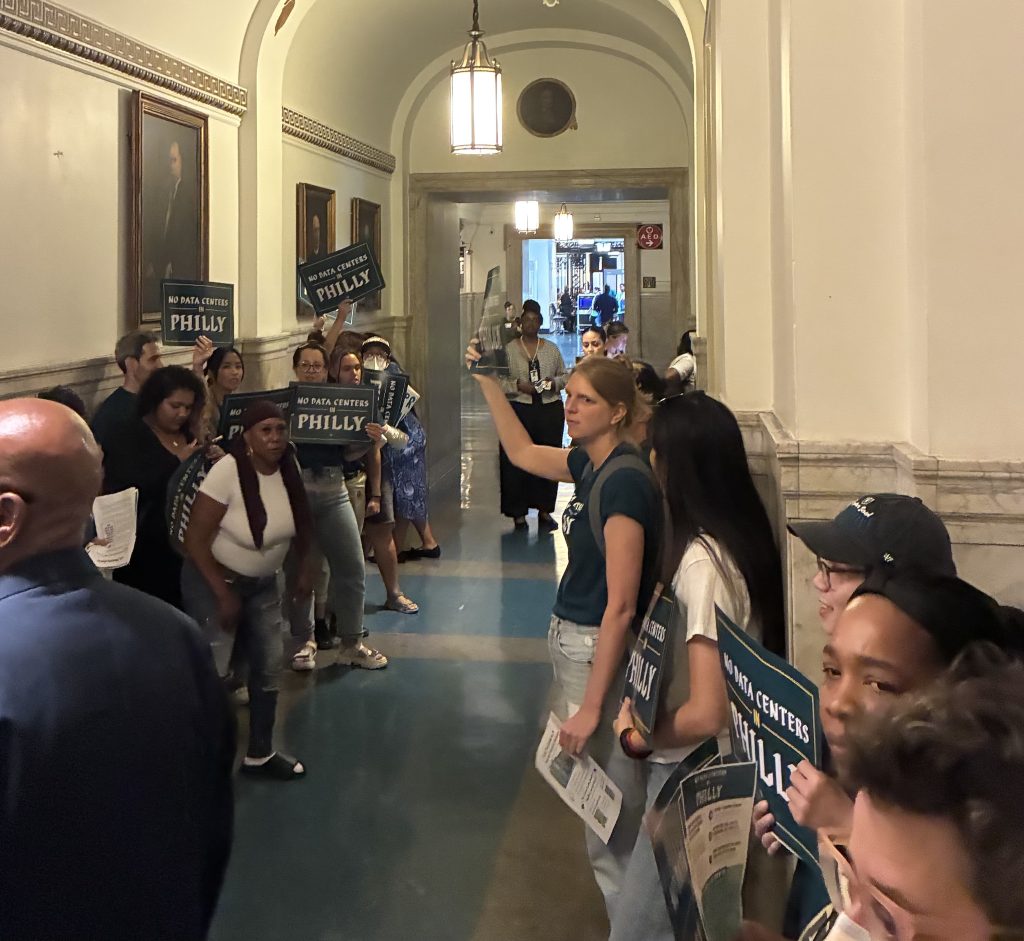
In Philadelphia, biweekly lobbying efforts at City Hall are underway to push City Council to adopt meaningful changes that align with people’s values. The Philadelphia No Data Centers Campaign held a kickoff rally on September 14, bringing together stakeholders from numerous justice organizations across the city. The Campaign has three main demands: (1) calling on City Council to pass a data center moratorium for three years until meaningful procedures and protections are in place; (2) urging the City to center the people of Philadelphia when creating standards that protect their health and environment, data privacy, and public resources; and (3) centering transparency with the public at large to ensure Philly residents are prioritized. Supporters argue that this holistic, three-tiered approach would be most effective in ensuring moratoriums work by allowing cities and states time to prepare for, or halt, data center growth.
Meanwhile, at the federal level, the Environmental Protection Agency has been working to limit public comment before approving air-pollution permits for facilities, such as data centers and the power plants that keep them running. In light of this abdication of federal regulatory oversight, anti-data center advocates maintain that local and state protections like the ones the Campaign is advocating for in Philly are needed to keep the process transparent and reflect what communities really think about data centers, even if the EPA tries to limit their input.
Advocates have shown how data centers have already affected Philadelphians’ finances, utility bills, and communities since 2024. The National Resource Defense Council estimates that, if the current trajectory continues without needed guardrails, PECO bills will be $840 higher each year by 2028 because of data centers, and health consequences like asthma will worsen by then as well.
To support these efforts, the Campaign is calling for everyone to get involved. Ask your Councilmember to support a moratorium and sign the petition to back the campaign. There are also volunteer opportunities at City Hall and around Philly to talk with people about supporting the work. With this intersectional support and collective action against data centers, I, for one, hope they will have no future in Philadelphia.
