
Research
Our work develops along three connected strands.

- Learning
Essays carry the signatures of a student’s thought process: how a thesis develops, how ideas connect, how revisions show reflection. When students rely on generative AI, those signatures can be simulated on the page but disconnected from the student’s own reasoning.
The Lab is developing guided exchanges that help students work through their reasoning and make their engagement recognizable to teachers. Working with their own text, students paraphrase claims, add examples, revise transitions, and reflect on their choices. We investigate which exchanges strengthen students’ thinking and provide useful evidence of their engagement, while preserving private exploration. Teachers remain responsible for assessing the work.
The aim isn’t to catch cheaters, monitor students, or replace teachers, but to confirm that the essay still reflects the student’s thinking in action, that the cues in the writing still “light up” when the student is guided to engage with them. Crucially, the adaptive exchange could help bring about the ownership it is intended to recognize. A student might begin with substantially AI-produced material and acquire a meaningful relationship to it through revision and reflection. Depending on the assignment, that could be educational success.
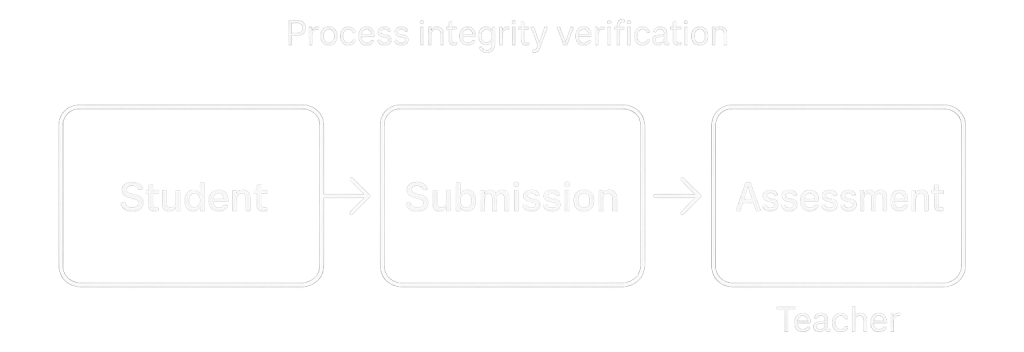
This approach helps protect the essay as a space for learning, while also laying the groundwork for new tools and protocols that support human agency more broadly.
- Systems Evaluation
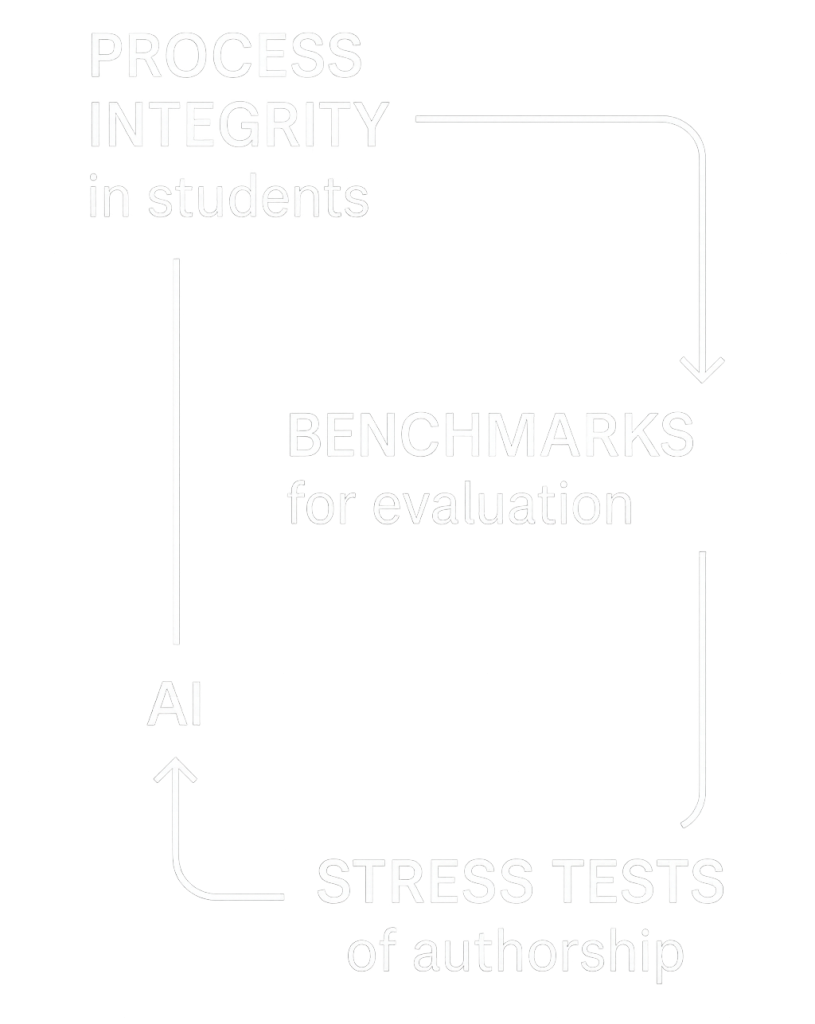
We are developing ways to evaluate AI systems by how they affect human thinking over time. Do they help people notice errors, question assumptions, and revise their judgments or encourage them to accept suggestions without understanding them?
Classroom pilots can help us develop criteria for these evaluations, while the evaluations can help refine the interactions we offer students. This connects our work to the broader study of cognitive mediation: how people engage with their own work and with one another when AI participates.
- Institutional Practices and Intellectual Freedom
We ask whether AI policies protect the intellectual capacities they are intended to serve, and what their requirements cost in access and freedom of inquiry. This includes examining disclosure rules, detection practices, and restrictions on assistance, alongside the safeguards we propose ourselves. The aim is to develop principles that communities can use to evaluate and revise their practices.
Why This Matters
When authorship blurs and reflection weakens, freedom of thought erodes, whether in student essays, professional work, or civic discourse. AI is neither just a tool nor a true collaborator but a cognitive environment that is already recalibrating how we think and interact. Our research develops ways to maintain human agency within that environment. By establishing principles for cognitive integrity, we’re creating protocols that empower individuals and institutions to integrate AI on their own terms.
AI, Authorship, and Intellectual Freedom: Selected Reading
Cognitive Integrity Lab · Temple University