
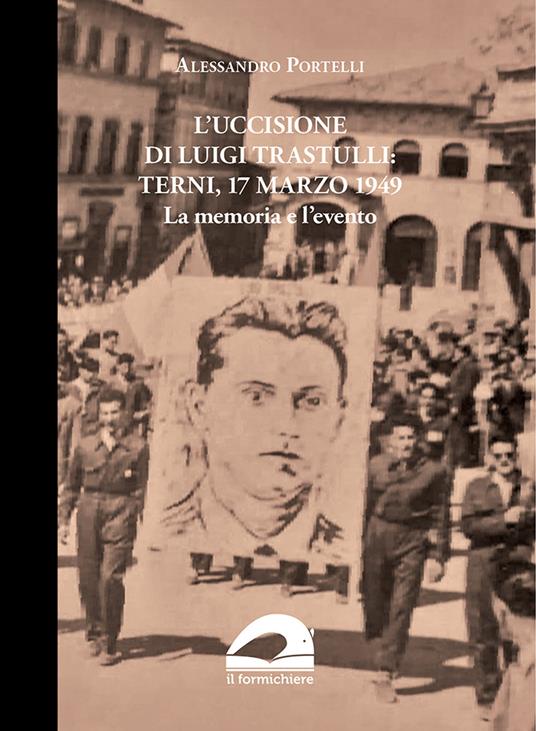
This week, we explored the WPA Slave Narrative Collection and read several articles. Two articles, “Oral History: How and Why it was Born” and “Oral History” by Allan Nevins and Louis Starr, respectively, serve as the first and second chapters of Oral History: An Interdisciplinary Anthology. We read both chapters this week, along with Rick Halpern’s “Oral History and Labor History: A Historiographic Assessment after Twenty-Five Years” from The Journal of American History, as well as “What Makes Oral History Different” from Alessandro Portelli’s book titled The Death of Luigi Trastulli and Other Stories. Each of these pieces speaks in some way to the history of oral history, how it began, and how it grew over the course of the twentieth century.
Rick Halpern’s historiographic survey provides the clearest timeline of oral history’s development. He splits oral history into two threads that diverged in the early 1970s: a more scholarly, empirical strand sparked by the Lynd duo’s Rank and File project; and a more theory-heavy, interviewer-as-a-participant strand launched by Peter Friedlander’s The Emergence of a UAW Local. Both projects explored the prominence of labor unions in the 1930s and those unions’ failure to alter the momentum of American capitalism. Both projects endured criticism due to methodological shortcomings; haphazard interview-collecting in the Lynds’ case, and excessive theorizing in Friedlander’s.

Allen Nevins, who established the Oral History Research Office in 1948, declares that “oral history was born of modern invention and technology,” (Nevins, Oral History, 30). As the pace of daily life accelerates with technology, free time and attention spans plummet, reducing a person’s ability to settle at a desk long enough to produce the rich ego documents characteristic of earlier centuries. Louis Starr echoes Nevins’s point, expressing a more pessimistic view of the present state of affairs. “Oral history has failed to receive the critical attention it needs if it is to fulfill its potentialities,” he declares, lamenting the difficulty in getting academic peers to fully take oral history seriously even after convincing them of its merits (Starr, Oral History, 55). Alessandro Portelli, fascinated by the fallibility of human memory, takes aim at anti-oral prejudice against by reminding readers that written records, like any oral record, are products of imperfect translation: “The most literal translation is hardly ever the best, and a truly faithful translation always implies a certain amount of invention” (Portelli, Luigi Trastulli, 47).
These articles all inevitably veer into discussion of the most important part of oral history: methods. Even the WPA Slave Narrative Collection, which used amateur interviewers unequipped to engage in critical dialogue along with never making clear its criteria for selecting interviewees, stands as a great example of how an oral history project’s value can be negatively impacted by methodological shortcomings. Even as oral history becomes more accepted among academic historians, greater importance is still placed on archiving written transcripts of instead of an oral history interview’s audio. Portelli argued in favor of pairing written transcripts with audio by default, correctly believing both media to be stronger and more valuable together than they are apart. Much can be gleaned from someone’s tone, word-emphasis, and other patterns of speech. Perhaps it could further be argued that even audio tapes lack additional nuance which video footage could provide – facial language, micro-expressions, etc. Should a scholar who consults an oral source make sure they interpret that source through every possible available medium? When using words from an oral history transcript in our research, when is it appropriate to include or exclude tone of voice? Or body language, if the interview was videotaped?