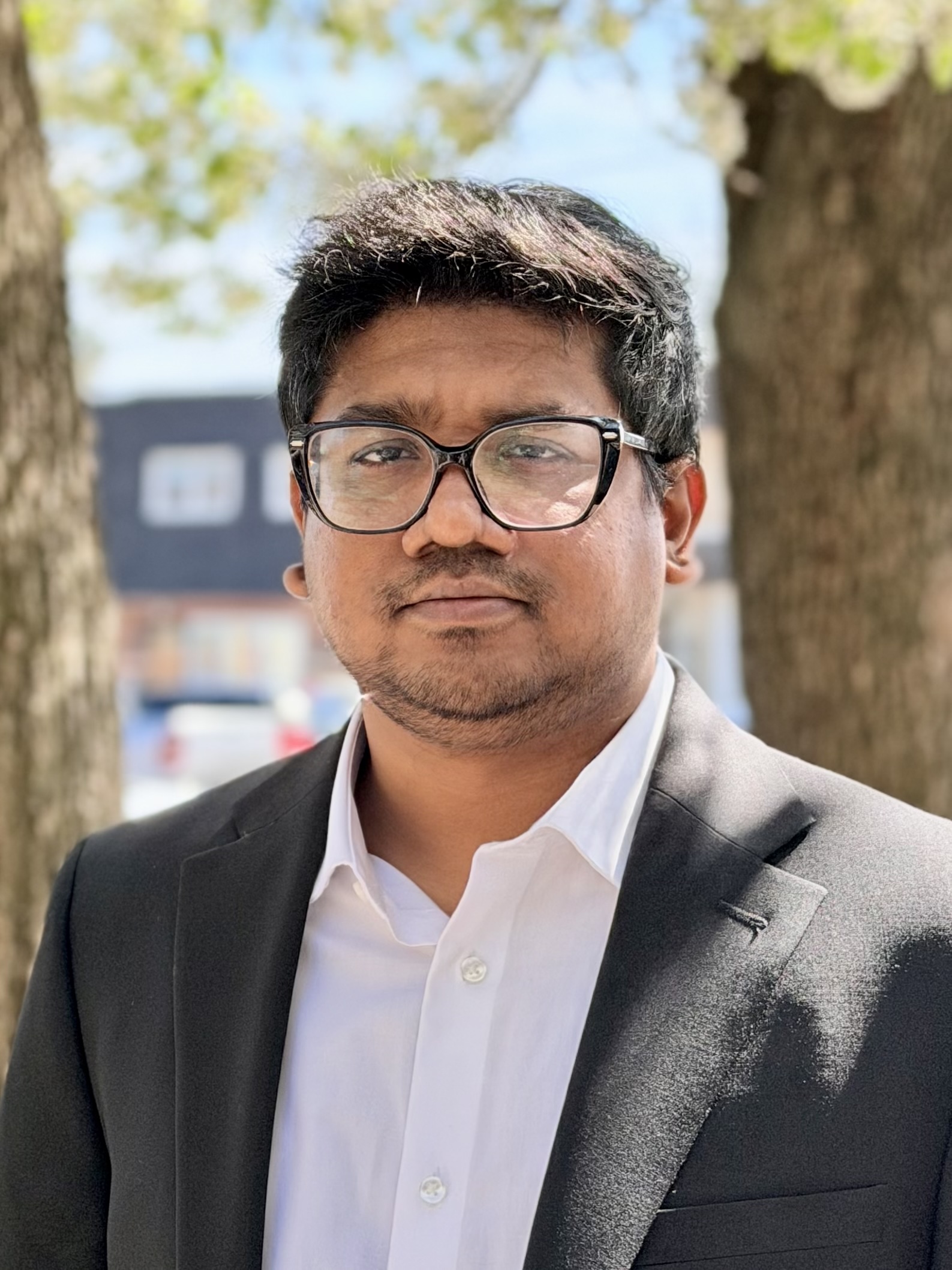
Saidur Pavel’s journey toward his PhD began under extraordinary circumstances. Admitted to the PhD program at Temple University’s College of Engineering in Fall 2020, his plans were disrupted by the COVID-19 pandemic, which led to the closure of U.S. Embassy operations in Bangladesh and delayed his visa process. Despite these challenges, Saidur remained focused and proactive from the very beginning.
During the months he spent waiting for his visa, he did not remain idle. Instead, he began engaging in productive research remotely. Collaborating with Advanced Signal Processing (ASP) Lab PhD student Shuimei Zhang, he co-authored a journal paper titled “Crossterm-Free Time-Frequency Representation Exploiting Deep Convolutional Neural Networks,” which was completed by the end of 2020 and published in Signal Processing in March 2022. By that time, Saidur had already established himself as an exceptional student. As a high school student, he distinguished himself in mathematics Olympiads. He later graduated at the top of his class from the Chittagong University of Engineering and Technology and subsequently served as a Lecturer at Premier University. His outstanding academic record and strong research potential earned him the prestigious Temple University Presidential Fellowship. In January 2021, while Temple University was still operating largely in remote mode, Saidur finally arrived on campus and joined the ASP Lab as a PhD student. Throughout his PhD program, Saidur maintained an exceptional level of research productivity. Supported by the Temple University Presidential Fellowship, as well as external funding from the National Science Foundation (NSF) and the Air Force Office of Scientific Research (AFOSR), he made significant contributions at the intersection of array signal processing, machine learning, information theory, and optimization. By the time he defends his dissertation titled “Array Processing with Compressive Measurements and Coherent Signals” in April 2026, Saidur had published five journal papers in top-tier venues, including IEEE Transactions on Signal Processing, IEEE Signal Processing Letters, and Signal Processing, with three additional journal papers under review. In addition, he authored more than a dozen conference papers in leading conferences such as IEEE International Conference on Acoustics, Speech, and Signal Processing (ICASSP), IEEE Radar Conference, Asilomar Conference on Signals, Systems, and Computers, and IEEE Sensor Array and Multichannel Signal Processing (SAM) Workshop. Among his several research contributions, Saidur made particularly impactful advances in the following two areas: Hybrid Beamforming for Massive Multiple-Input Multiple-Output (MIMO) Systems. Massive MIMO, which leverages large antenna arrays, is a key technology for next-generation wireless communications and radar sensing. However, it presents significant challenges in hardware complexity, cost, and power consumption. Saidur developed advanced optimization techniques for hybrid beamforming, which partitions signal processing between analog and digital domains. His work introduced deep learning–based frameworks, including fully connected neural networks, LSTM models, and reinforcement learning approaches, to optimize compressive measurement matrices considering variety of operational environments. He further extended these methods by incorporating information-theoretic criteria and novel network architectures, leading to more efficient and practical system designs. Direction-of-Arrival (DOA) Estimation for Coherent Signals. DOA estimation is fundamental for signal localization and wireless channel estimation. Many classical DOA estimation methods assume uncorrelated signals and perform poorly in the presence of coherent sources—a common scenario in real-world applications. Saidur addressed this limitation by developing innovative algorithms that exploit the structure of covariance matrices and tensor representations, particularly for two-dimensional arrays. His methods effectively decorrelate coherent signals, enabling accurate and robust DOA estimation even under challenging conditions. Saidur’s work has already made strong impacts on the research community. According to Google Scholar, his publications have accumulated nearly 200 citations, the majority of which stem from work conducted during his time in the ASP Lab. In addition to his technical achievements, Saidur actively engaged in collaborative research with leading scholars across academia, federal agencies, and industry within the United States, as well as with international collaborators in Italy, Australia, and Brazil. In recognition of his outstanding research contributions and their significance to U.S. national interests, Saidur successfully obtained his U.S. Permanent Resident (Green Card) status prior to graduation. This milestone not only reflects his accomplishments as a researcher but also positions him strongly for career opportunities in a highly competitive global job market. Reflecting on his decision to pursue his PhD in the ASP Lab, Saidur shared that “the ASP Lab provided an exceptionally supportive and intellectually stimulating environment, where I had the freedom to explore new ideas while receiving invaluable guidance. The collaborative culture and high research standards of the lab played a crucial role in shaping my development as an independent researcher.”