Monthly Archives: October 2025

Blog #10: Finding Rhythm Between Theory and Filming✨

This week I read the article “Influence of social media exposure on body image: An experimental study of Instagram use and body dissatisfaction among college women” by Kleemans et al. (2018). The study explores how idealized Instagram content affects female college students’ perceptions of attractiveness, mood, and self-esteem. Participants who viewed “fitspiration” and beauty influencer posts reported significantly higher body dissatisfaction than those who viewed neutral lifestyle content. The authors explain this through social comparison and objectification theories, showing how even short exposure to appearance-focused content can trigger negative self-evaluation and desire for body modification. The study also points out that media literacy and self-awareness can help reduce these negative effects, suggesting that critical engagement, not total avoidance, may be a healthier approach.

This article supports my MA documentary project, by providing strong empirical evidence that aligns with the personal stories I want to highlight. While my project takes a qualitative approach, Kleemans et al.’s findings help frame the mechanisms social comparison, body surveillance, and algorithmic exposure—that I plan to illustrate visually through interviews and narrative structure. It also reinforces my intention to balance critique with empathy: not portraying social media as purely harmful, but showing its emotional complexity and the blurred line between pleasure and pressure.

I also developed a short writing piece that may serve as an opening scene for my film:

“It’s a normal Monday night. I open the fridge and see the leftover mandarins from Cherry Pantry. I tell myself I just want one but I keep eating. Yes, my relationship with food is not healthy. Unexpected food like this makes me nervous. This is an eating disorder a result of years of dieting. Over the past two years, I’ve lost 22 pounds. I thought it was about a breakup. Later, I realized it was about Xiaohongshu.”

This week, I focused on reviewing the footage I shot earlier and planning my next interviews. I haven’t filmed new scenes yet, but I’m organizing my interview questions and identifying potential participants. I plan to film one interview this weekend and capture more b-roll that connects food, emotion, and social media imagery. My next goal is to integrate the academic research more clearly into my visual storytelling and begin experimenting with voiceover narration.

Reference
Kleemans, M., Daalmans, S., Carbaat, I., & Anschütz, D. (2018). Picture perfect: The direct effect of manipulated Instagram photos on body image in adolescent girls. Media Psychology, 21(1), 93–110. https://doi.org/10.1080/15213269.2016.1257392

These are some of the thoughts and pieces I wrote during the Writing Workshop class, as I reflected on my MA project and my progress this semester.

Free Writing

Professor Laura mentioned today that two-thirds of the semester has already passed. I didn’t realize time went by so fast! When I look back, even though I’ve been moving a bit slowly, I can see that I’m moving in the right direction. I’m really glad I took this class this semester. If my project had to jump directly into the spring semester, I think I would have felt very stressed.

This week, I started working on the literature review for my paper. Because I will interview people for my documentary, I feel that using interviews as my research method is a good idea—it allows me to contribute to both my paper and my film at the same time. But now I realize I don’t yet know how to find my interview participants. This is something Professor Laura asked me last week, and it made me realize I need to find people very soon. My plan is to put up flyers on campus and give a $10 Starbucks gift card to each participant.

While reviewing the articles I’ve read for previous blogs, I noticed that some of them will be useful in my paper, and some may not be directly needed. But I also realized that not every article must appear in my final paper. Some readings helped inspire my topic and method, and that’s still valuable for my research process.

My next plan is to continue collecting stronger and more focused academic articles for my literature review. I also want to start writing down how these theories connect to the real stories my participants will share. This way, my paper and documentary can support each other more closely.

I know I still have a lot to do, especially finding interview participants and planning the shoots. But I feel clearer about each step now. I believe if I keep going like this, I will finish a project that I’m proud of. I’m excited to move forward and see how everything will come together in the rest of the semester

Poem – “Moving, Still Forward”

Time went by so fast.
Moving slowly, but moving forward.
Interviews and stories help my project.
Planning clearly makes me confident.
Small steps still mean progress.
I will finish something proud.

Short Reflection (Optional)

Editing others’ work helped me reflect on my own project and gave me ideas for better examples, references, and stylistic inspirations for my film. It also made me realize what I still need to improve and reminded me how helpful collaboration is in this class.

Blog 9 — Turning Research Into Action🎬✨

This week, I read the article Influence of Appearance-Based Social Media Use on Body Image and Eating Behavior in Young Women by Brown and Tiggemann (2023). The authors examined how frequent exposure to beauty-focused and diet-centered content on platforms such as Instagram and TikTok affects young women’s self-perception and eating habits. Their findings show that repeated appearance-based social media use intensifies body dissatisfaction, increases restrictive eating intentions, and heightens negative mood—especially among women who actively engage in self-presentation behaviors online. The article also highlights how algorithmic reinforcement can create a continuous loop where users are repeatedly exposed to idealized bodies, making comparison almost unavoidable on these platforms.

This article contributes strongly to my documentary project, which explores how social media amplifies body image anxiety and unhealthy food relationships among female college students. It supports my focus on the emotional and behavioral consequences of scrolling through curated content. The concept of self-presentation reinforcement will directly guide my interview design, as I plan to ask participants about how likes, comments, and editing tools shape their eating behavior and self-confidence. It also confirms that TikTok and Instagram are not just passive influences but actively promote ongoing comparison that can lead to disordered eating patterns — an important connection I want to illustrate visually in my opening scenes and interview structure.

Feedback reflection
From the preproduction binder review, I received helpful feedback that I should:
• begin recruiting interview participants as soon as possible
• diversify my interviewees to show a range of experiences
• improve some visual decisions and strengthen lighting/audio setups
• borrow higher-quality equipment from the Klein

• regularly share work-in-progress with others to gain more critique and suppor

Based on this feedback, my next steps include finalizing interviews with at least 3–4 students, scheduling equipment checkout, and continuing conversations with peers and faculty for creative input. I will also test both sit-down interview setups and more natural eating-moment B-roll to refine my visual language. I’m excited to push my project forward with more intentional production planning.

Reference

Brown, Z., & Tiggemann, M. (2023). Influence of appearance-based social media on body dissatisfaction and restrained eating: The role of self-presentation. Body Image, 46, 274–283. https://doi.org/10.1016/j.bodyim.2023.05.009

Blog 8: Moving Forward with Research and Production🎬

This week, I read the article NetGirls: The Internet, Facebook, and body image concern in adolescent girls by Tiggemann and Slater (2017). The authors conducted a longitudinal study exploring how Facebook use relates to body image concerns among adolescent girls over time. They found that increased Facebook use predicted greater internalization of the thin ideal and higher body dissatisfaction, even when controlling for age and baseline media exposure. The study emphasizes that the visual and interactive nature of social media—where users post and evaluate images—creates constant opportunities for appearance-based comparison. The findings suggest that the psychological mechanisms linking social media and body image issues begin early in adolescence and may persist into young adulthood.

This article contributes to my documentary project by reinforcing the idea that body image anxiety linked to social media is not only widespread but also deeply internalized. While my project focuses on female college students rather than adolescents, the study helps contextualize how early social media habits shape long-term patterns of self-evaluation and eating behavior. I plan to draw from this insight by including interview questions that explore participants’ histories with social media—when they first started comparing themselves online, and how those experiences have evolved over time.

This week during production day, I filmed several new B-roll shots for my project, focusing on moments of everyday detail and emotion to help build the visual rhythm of my documentary. I also began organizing potential interview settings and plan to film my first interviews this weekend. Additionally, I spoke with Professor Jan Fernback, the MSP program director, about my project’s direction. She encouraged me to stay consistent and manage my time strategically so I can make steady progress each week. Moving forward, I’m determined to improve my time management, follow the project timeline closely, and keep pushing myself creatively and academically.

Reference
Tiggemann, M., & Slater, A. (2017). NetGirls: The Internet, Facebook, and body image concern in adolescent girls. International Journal of Eating Disorders, 50(1), 80–83. https://doi.org/10.1002/eat.22557

Blog 7: Reflecting on My Progress So Far✨

Looking back on the first half of the semester, I feel that my research has been progressing steadily toward the goals I set at the beginning. My main aim was to build a strong theoretical foundation connecting social media use, body image anxiety, and eating behaviors among young women. I am proud that I have developed a solid literature base through consistent reading, including works by Perloff (2014) and Fardouly et al. (2015). I also refined my research strategy by using broader and more precise keywords, following earlier advice from Kristina DeVoe, which helped me find more relevant academic sources. This process has made me more confident in situating my documentary within a well-defined scholarly conversation.

In terms of production, my project vision has become much clearer. At the start of the semester, I only had a broad idea of exploring social media’s effects on body image. Now, I can visualize how I want the documentary to look and feel. I’m especially proud of the initial media I created—close-up shots of colorful desserts, ice cream, and fresh fruits and vegetables. These test shots not only helped me experiment with lighting and framing but also deepened my understanding of how idealized food imagery on social media can represent both pleasure and pressure.

Academically, I believe my project aligns well with the MA project expectations of producing theoretically informed creative work. My documentary applies concepts such as social comparison theory and objectification theory to real, lived experiences. By translating abstract theory into visual storytelling, I aim to create a piece that is both analytically grounded and emotionally resonant. The accompanying paper will connect my visual choices and interview narratives back to these frameworks, demonstrating how the medium itself becomes part of the critical inquiry.

For the rest of the semester, I look forward to conducting interviews and combining them with the visual metaphors I’ve already begun developing. I’m excited to hear participants’ perspectives and to see how their stories can shape the final narrative.

Feedback summary:
During the Project Treatment and Initial Media workshop, I received encouraging feedback from my professor and classmates. They appreciated the aesthetic quality of my food imagery and how it captured both temptation and tension. They also suggested that I consider filming people eating—to contrast the polished, idealized food seen online with the natural, imperfect, and emotional act of eating in real life. This idea really inspired me, and I plan to experiment with these scenes in my next round of filming. My next step is to prepare detailed interview outlines and explore how to visually blend everyday eating moments with the theoretical themes of my project.

References

Fardouly, J., Diedrichs, P. C., Vartanian, L. R., & Halliwell, E. (2015). Social comparisons on social media: The impact of Facebook on young women’s body image concerns and mood. Body Image, 13, 38–45. https://doi.org/10.1016/j.bodyim.2014.12.002

Perloff, R. M. (2014). Social media effects on young women’s body image concerns: Theoretical perspectives and an agenda for research. Sex Roles, 71(11–12), 363–377. https://doi.org/10.1007/s11199-014-0384-6

Blog 6# Research, Reflection, and Next Steps

This week I read the article Social Media Effects on Young Women’s Body Image Concerns: Theoretical Perspectives and an Agenda for Research by Perloff (2014). The article reviews the emerging research on how social media shapes young women’s body image and eating concerns, emphasizing theoretical frameworks such as social comparison theory and objectification theory. Perloff argues that social media differs from traditional media because it is interactive, peer-driven, and visually oriented, which intensifies pressures to compare appearance and internalize unrealistic body ideals. He proposes a conceptual model that connects individual vulnerability factors (such as low self-esteem or high appearance comparison tendency) with specific social media uses, leading to body dissatisfaction, dieting, and disordered eating. The article also points out gaps in existing studies, including the need for more qualitative work and intersectional perspectives.

This article contributes directly to my MA documentary project about how social media platforms such as TikTok and Instagram amplify body image anxiety and eating concerns among female college students. Perloff’s framework helps me understand how interactive features like likes, comments, and algorithm-driven feeds can encourage negative social comparisons and self-objectification. Importantly, the call for qualitative research validates my decision to use a documentary format and personal interviews, giving voice to lived experiences that quantitative surveys might miss. His discussion of vulnerability factors will also shape my interview questions — for example, I want to ask participants about how they compare themselves to peers online, and whether they feel pressure to alter eating habits or body image because of content they see on social media.

This week, I focused on expanding my literature review and improving my research strategy. Based on earlier suggestions from Kristina DeVoe, I refined and broadened my keyword searches to include terms such as “appearance-based social comparison,” “objectification theory,” and “college women eating behaviors.” This helped me discover more relevant, high-quality academic sources and gave me a clearer plan for building the theoretical foundation of my project. Next week, I plan to continue refining my interview questions and start identifying potential participants for my documentary.

Reference
Perloff, R. M. (2014). Social media effects on young women’s body image concerns: Theoretical perspectives and an agenda for research. Sex Roles, 71, 363–377. https://doi.org/10.1007/s11199-014-0384-6

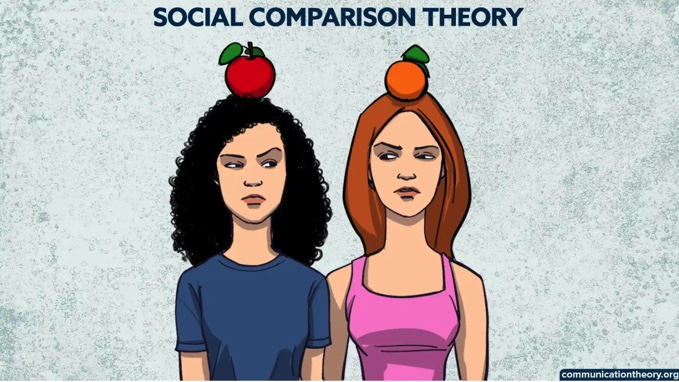
Figure 1
Social comparison theory illustration. Adapted from “Is social comparison good or bad? Explained with examples,” by Communication Theory, n.d. (https://www.communicationtheory.org/is-social-comparison-good-or-bad-explained-with-examples/).