Get Oil Out! by (Randy Le)
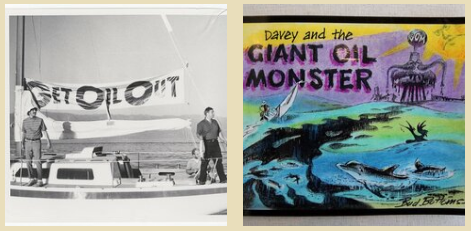
Get Oil Out! Inc. (GOO!) is a public interest group inspired by the 1969 Santa Barbara oil spill. In 1969, an environmental disaster occurred when an oil platform near the coast of Summerland faced a blowout. The blowout was caused by a U.S. Geological survey that authorized the oil company to operate with poorly-conditioned steel pipes that were used to drill oil. As a result, approximately 200,000 gallons of crude oil rapidly spread around the beaches of Summerland in an 800-mile radius. The effects of the were detrimental, especially to the organisms already living nearby. Birds, dolphins, seals, and other animals died due to ingestion or suffocation caused by oil. For more than a week, workers had attempted to cap the rupture, but the effects of the crisis impacted much of the surrounding animal life.
Ultimately, Get Oil Out! uses the caregiver archetype as a result of the 1969 Santa Barbara oil spill to protest against oil drilling regulations. The public interest group advocates that individuals and collective action must be made to reduce oil production. This may be through using other sources of energy as GOO! recognizes the oil development will forever exist as long as individuals use oil. Thus far, GOO! has made efforts like publicizing photos of the oil spill aftermath and has had rallies to get oil out of Santa Barbara. There was even a petition sent to President Nixon that had over 200,000 signatures which forced the government to take action. Another example is the book, Davey and the Giant Oil Monster, written by Bud Buttons, the founder of GOO!. The book casts oil companies as monsters to the ocean and surrounding organisms which happened to empathize with the media.
2019 Global Climate Strike (Randy Le)
In 2019, waves of young people took over their local streets to protest the lack of climate change action. Across the world, children and young adults demanded the government to no longer stay inactive since signs of climate change only revealed the worst for the planet’s future. During this time, protestors took full advantage of the sustainability movement’s size and demonstrated how important it is to address climate change before it is too late. For example, in the Guardian News video above, a sign reads “Do you have a plan? Can I see it?” at the 1:28 timestamp. Similar signs questioned the government’s plans to address climate change while others also sign stated they would bring climate action through the movement.
Like Get Oil Out!, the 2019 Global Climate Strike took on the caregiver archetype to gain supporters for their campaign. By having such a large-scale strike, the movement was able to demand specific goals for the government to complete by a set time. For example, some participants demanded that there be a complete transition to renewable energy in 2030. Overall, this use of strikes showed not only the large display of discontent with climate change action but also how the movement presents a moving message that they care about the planet’s future.
Save the turtles movement (Jacqueline Devone)

The save the turtles movement suddenly burst onto the forefront of the sustainability movement within the last three years. The goal was simple; reduce ocean pollution in order to help save the turtles, specifically plastic straws. The movement was particularly popular on social media, and during its peak, social media was flooded with #savetheturtles, fundraiser links, and videos that informed the public on the harm pollution was doing to sea turtles. But getting the message out on social media wasn’t the main goal for save the turtles. They wanted to ban single-use plastic straws because they’re harmful for the environment and they often get ingested or stuck in the noses of turtles. The movement got legislation passed in a few states that banned plastic straws and replaced them with biodegradable ones. The movement was also successful in changing the public’s views on straws, instead of influencing people to buy reusable ones or to just forgo them altogether.
Similar to many other campaigns led by the sustainability movement, Save the turtles uses the advocate archetype. The movement itself takes on the advocate archetype, as they are advocating for the turtles who cannot do it for themselves. The message is that together, we need to change our lifestyles and convince the government to implement laws to make these changes permanent because otherwise the turtles, who are completely innocent and can’t change anything themselves, will continue to suffer and die.
Chief Iron eyes Cody commercial (Jacqueline Devone)
The Cheif iron eyes Cody stop pollution commercial blew up after its release on earth day in 1971 and itt did so well, there were billboards and print ads of it. This commercial’s influence helped propel it to become the face of the call to save the environment. In the commercial there is a Native American man, Chief iron eyes Cody, rowing down the river in his boat. Suddenly, a piece of trash floats by the boat. Then, it’s revealed that there are several big boats in the water, and flashes of infostructure and steam appear. As the commercial ends, Chief iron eyes docks on a beach filled with trash, next to a bustling interstate full of cars with people throwing their trash out the windows and onto his feet. The commercial ends by zooming in on Cheif iron eye’s eye as a single tear rolls down his cheek. This commercial inspired people to do their part in taking care of the environment. It also acted as a wake-up call to show just how much beauty is destroyed by city development.
The archetype that was used in this commercial is the caregiver and the advocate archetype. The caregiver archetype is presented through the Cheif which is demonstrated when the Cheif looks around at all of the pollution and sheds a tear. This tear is for the earth because it is being ruined and not enough people are fighting for it, which makes him very sad because he cares deeply for the earth. The narrator that says “People start pollution, people can stop it” is playing into the advocate archtype by being a voice for the earth. The narrator is trying to spur people into trying to end pollution by calling people out for their inactivity, thus embodying the advocate archetype.
The Lorax (Maddi)

A major voice in the environmental movement is so popular that we often forget about it. The children’s book “The Lorax,” written by Dr. Seuss in 1971 is a commentary on how capitalism and mass production threaten the environment. It tells the tale of the Lorax who “speaks for the trees” and wishes to stop the Onceler, who cuts down all of the trees in their town to mass produce garments. Slowly, their town becomes devoid of all nature as the Onceler gets richer and richer off of his factories. Seuss’s message at the time was incredibly controversial and was even banned in some schools, but the book had such a famous impact on the environmental movement because it shed light on how greed can destroy the planet. By developing such a serious issue into a very simple and innocent children’s book, the book was able to progress the movement further. Suess’s work also further popularized the concept of protecting the planet for future generations, thus exhibiting the caregiver archetype that the movement often possesses.
BP Oil Spill Protests 2010 (Maddi)
In 2010, the U.S. was hit with the largest oil spill in its history along the Gulf of Mexico, to which the ecosystems impacted may never fully recover. When this occurred, the entire country was outraged against BP, the fuel company responsible. Protests broke out across the country against BP in the aftermath of the spill. Many of the protestors used tactics to portray their outrage. Some of which included covering themselves and model ducks in fake oil, creating signs to defame BP’s logo, and praying in front of their headquarters. Their tactics gained attention throughout the country and gained popularity for the environmental sustainability movement. Their tactics also portray a caregiver/protector type of archetype because of the lengths they went to punish the company responsible for the spill. Pictures below show some of the major protests across the states.

https://www.cnbc.com/2010/06/03/Scenes-From-Protests-Over-The-BP-Oil-Spill.html
