On July 27, 2024, the Central Pennsylvania Energy Project worked together with community partner, Central Susquehanna Opportunities, to host the very first Energy Summit in the area at Commonwealth University- Bloomsburg. The summit featured panelists from Pennsylvania Power & Light, the Pennsylvania Office of the Consumer Advocate, the Pennsylvania Utility Law Project, Geisinger Health, CSO and Temple University, and provided a space for attendees to forge community relationships and openly discuss their experiences with energy and utility issues.
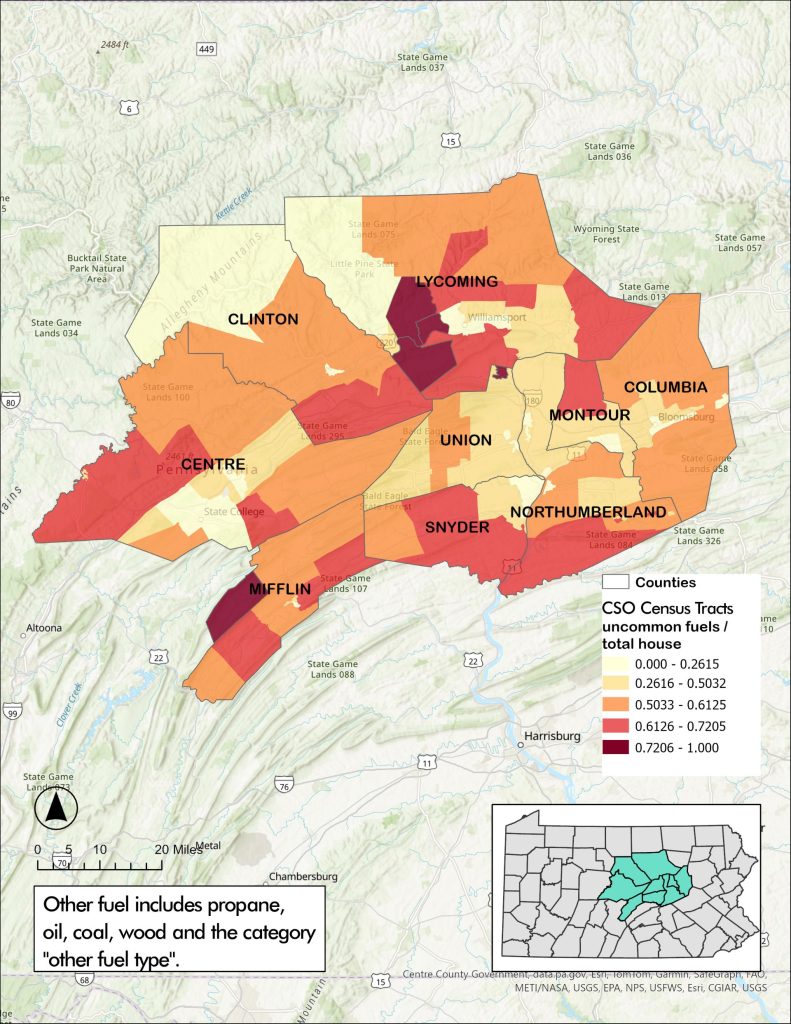
With a tendency to be perceived as uncommon, deliverable fuels are pivotal in energizing Pennsylvania homes but offer unique challenges to under resourced households. For example, these fuels are often unregulated by the Public Utility Commission and purchased on an “as needed” basis with a required minimum amount, leaving households who cannot afford this minimum vulnerable. The map above features our study area and the CSO service region, specifically depicting the total percentage of households that use “uncommon fuels”; the U.S. Census Bureau’s ACS combined counts of households that recorded usage of oil, coal, wood or the “other fuel” type. Geographic boundaries of “uncommon fuel” percentage are organized by Census Tract and increase in red saturation as precents increase. Notable areas within our study area include:
- A deeply saturated cluster within the southern part of Lycoming County, representing the uppermost bin of 0.7206- 1.000 (72.06-100%). Census Tracts surrounding these high-percentage clusters are also within the second highest bin.
- Census Tracts in the second most saturated bin of 0.6126- 0.7205 (61-72.05%) scattered across the counties of Mifflin, Snyder and Northumberland within the southern part of the entire study area.
- Mifflin County, where all Census Tracts have percentages no less than 0.5033 (50.33%) of households that are “uncommon fuel” users.
CSO, a community action agency, is a social services non-profit based in Northumberland County that employs an extensive network of case workers and various programs geared at targeting unique county-based issues. By pairing this utility data, with CSO’s contextual knowledge of local resource gaps from their extensive community outreach and case worker/ client interviews, energy geographies can be better understood from a programming standpoint. Further, community action agencies are guided by a Community Needs Assessment conducted every three years. As local needs are constantly changing, this assessment identifies existing programs that are still relevant, programs that should be created, and attributes of programs that should be changed or expanded.
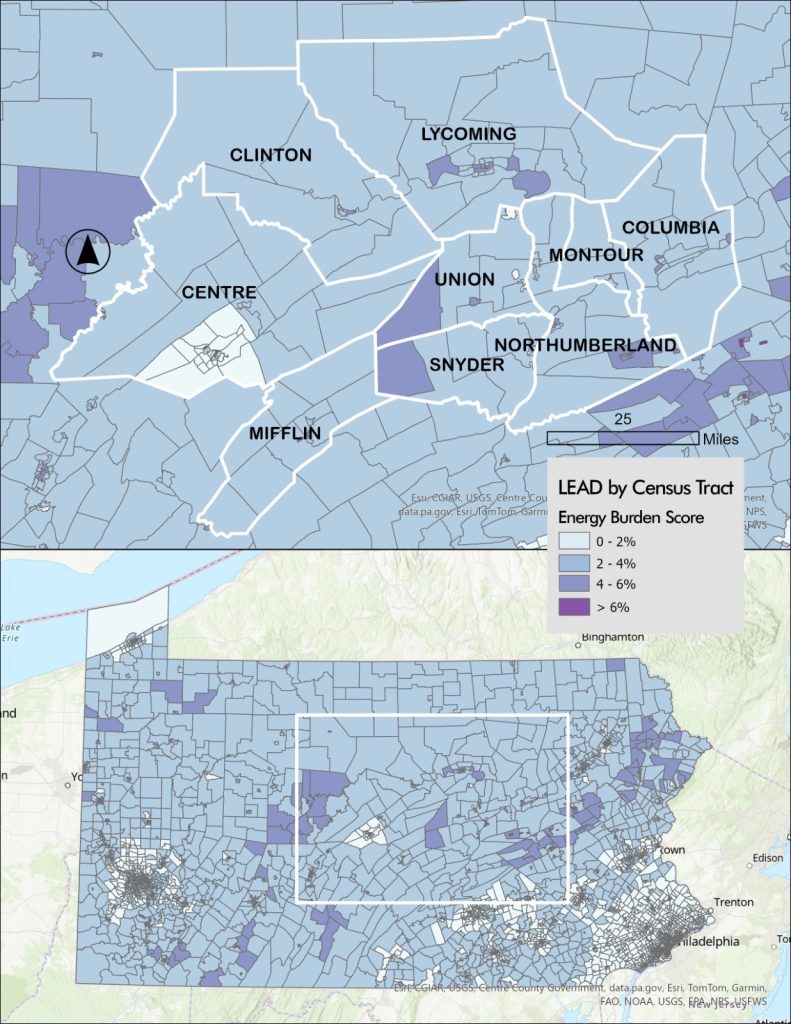
This second map depicts Low-Income Energy Affordability Data (LEAD) by Census Tract, showing the average household energy burden by percent income from the Department of Energy. Energy burden is defined as the percentage of gross household income spent on energy costs (source), and is calculated by dividing the Census Bureau’s ACS average housing energy cost by the annual average household income. Though the Department of Energy notes that an average energy burden of 6% or greater is considered high burdened, there are nuances that should be considered when examining this data at a smaller scale. Specifically, the influence that differing fuel types have on individual energy consumption cost and patterns. It’s for this reason that the Public Utility Commission has set different brackets for what is considered the max burden based on fuel type, with a max of 2% of income spent on non-electric heating being the threshold for “uncommon” fuel types (source). You can read more about these thresholds at the link provided.
In rural Pennsylvania, community is a lifeline. Our project aims to bridge the gap between social agencies, utilities, and clients to foster a deeper understanding of energy burdens and their impacts. By leveraging data analysis and community insights, this project helps to identify unique challenges faced by under-resourced households and further social service programming. Through ongoing collaboration with CSO and future energy summits, we hope to continue exploring these energyscapes and continue to provide a platform for rural communities to voice their experiences.
To learn more about this project and other related projects, please follow the link to our website!
Energy Geographies Network: https://dahlia-strawberry-39yf.squarespace.com