
By Tyler Blankenship
Cities across the world claim greatness in some form or fashion when it comes to the pride they have of their homes. With sports this only becomes more and more contentious. Debates and arguments are commonplace in the world of sports, especially with the constant presence of social media. One thing that is often accepted as truth is that New York is THE basketball city. Its premier arena, Madison Square Garden, is even known as the Mecca of basketball. However, I think a Philadelphia has just as much claim to being the complete Mecca of basketball, and its history speaks for itself.
June 6th, 2001: A David versus Goliath battle is happening in the world of basketball. The Los Angeles Lakers and its two superstars in Kobe Bryant and Shaquille O’neal have made it to the NBA finals without losing one game in the playoffs. The opponent for the juggernaut Lakers? The Philadelphia 76ers who are being led by their own superstar Allen Iverson, the MVP of the 2001 season. The Philadelphia basketball team fought tooth and nail just to make it to the finals and were big underdogs going into the final’s series. Yet somehow, game one is in overtime and Iverson is about to have one of the most iconic moments in basketball, and Philadelphia sports history.
Fifty seconds to go and the Sixers lead by 2 (101-99) and Iverson has the ball on the wing, he drives right, steps back, and nails the long 2 with his defender Tyronn Lue falling next to him. Iverson proceeds to step-over Lue with fervor and the Sixers take game 1 handing the Lakers their only loss of the playoffs. Fans around the world marvel at the momentous play that will forever be known as “The Step-over” including myself, a young kid who was just forever made a Philadelphia sports fan.
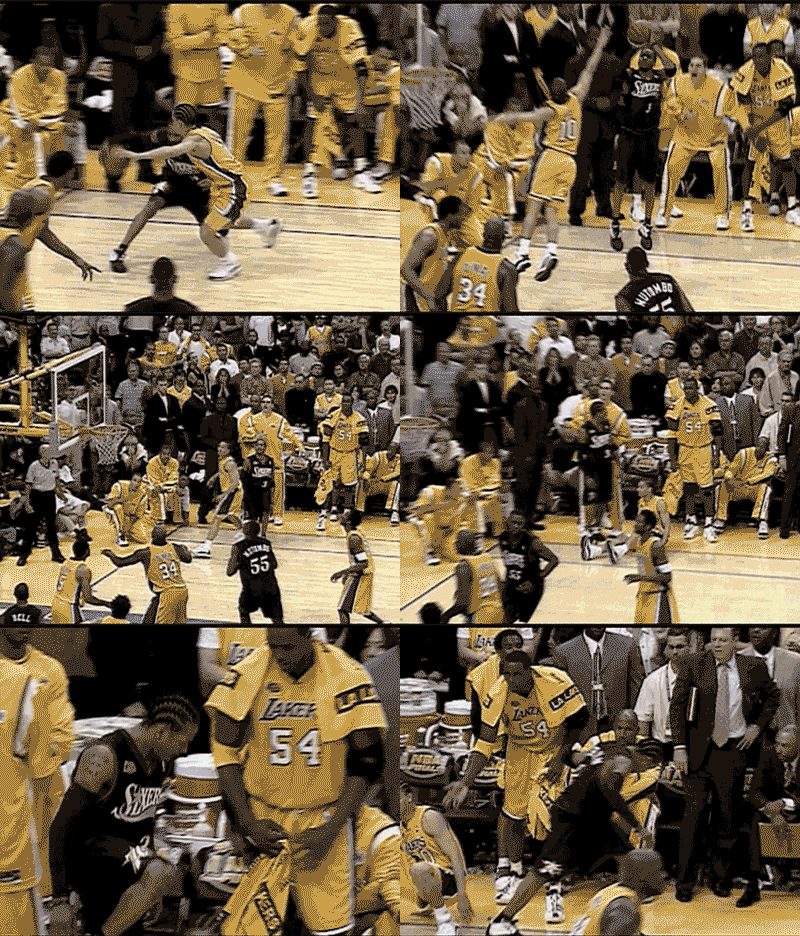
Iversons Step-Over
Basketball is one of the most popular sports in America and has continued to grow as a global sport over the years. Iconic moments provided by players such as Allen Iverson have contributed to that rise in popularity. Culture is an ever present and growing aspect of basketball that all who enjoy it hold dear. Yes, basketball is a game, but it is also more than that as it influences everything from communities, pop culture, fashion, politics, and so on and so forth. One thing that is undeniable in the history of basketball is that the city of Philadelphia has had an immense and ever lasting impact on the game of basketball and its culture.
Basketball is the second most popular team sport in the world now. This does not happen without the contributions Philadelphia basketball has made to the culture of the sport. First, going back to Allen Iverson, his impact on basketball goes way beyond his most famous moment in a game. Iverson famously wore a shooting sleeve which has continued to be an on-court fashion trend to this day. His body was covered in tattoos in a time when it was still seen as taboo, but because Iverson was who he was the tattoos were seen as more of an aesthetic that all players could now freely use and express. His fashion style was ever present in the NBA and he was never one to dress like previous NBA players who would arrive in business casual attire.
Iverson and his “street” style were looked down upon by then commissioner David Stern who then created a dress code in response, but the impact had already been made and shines through today. His famous “Practice” speech at a press conference is referenced and parodied still to this day and his signature crossover move is still fondly remembered today. All of this done while perfectly representing the city of Philadelphia and impacting the game and its culture.
Apple TV’s Ted Lasso doing Iversons “Practice” Speech
Will we ever see footage of Wilt Chamberlain’s 100 point game? Who knows, but the fact remains that it is recorded in history and that Wilt and his famous picture after the game all happened while he was a member of the then Philadelphia Warriors. Wilt Chamberlain was once the best player in basketball and is still viewed by some as the best ever. The “some” are likely those who saw him play on televisions with three channels, but the point remains. Wilt, who has his number retired in Philadelphia, still to this day holds many records some view as unbreakable. To list a few, most points in a game by a rookie (58), most rebounds in a game(55), highest scoring average per game(50), and many more.
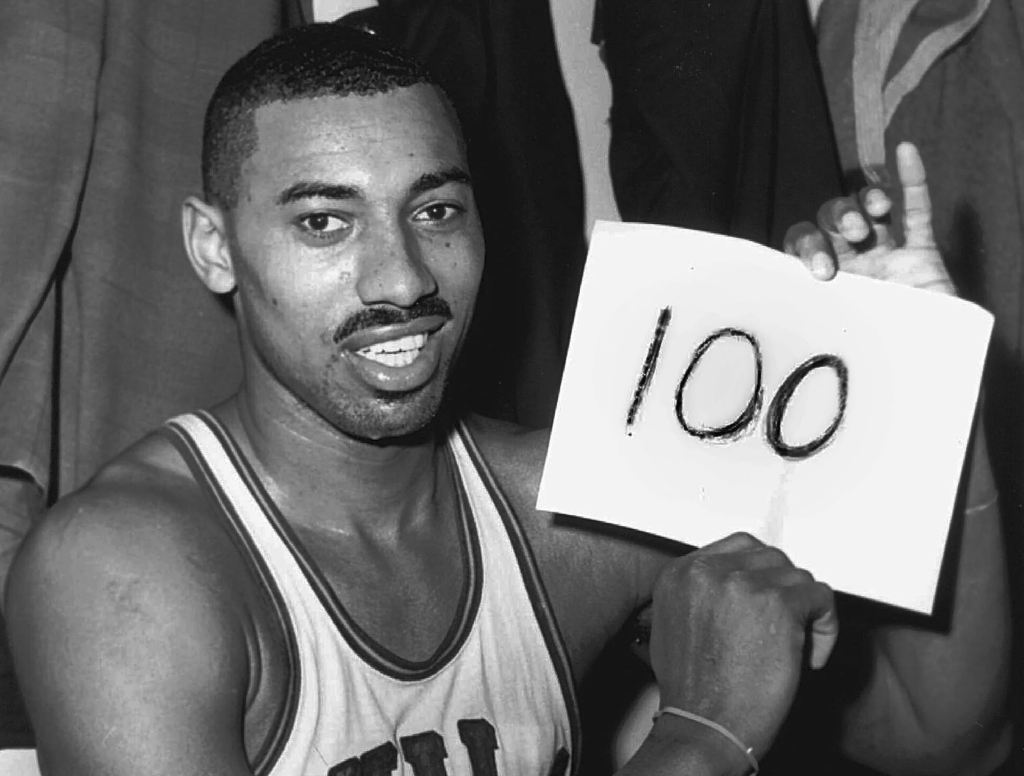
(AP Photo/Paul Vathis)
Not only did he do a lot of his work as a member of the pro Philly team, he was also from the city! Born in West Philadelphia and going to high school in the city before leaving to play college ball in Kansas. Wilt had one of the most legendary careers in basketball history starting the career in the city he was born and raised in. His 100 point game will forever be talked about as will his impact on every team he played for. A monumental representative of the city of Philadelphia who helped shape the game and culture forever.
Basketball has a way of influencing other sports often in many different ways. NFL players have improved route running by mimicking crossovers from the NBA. Players in other sports have copied celebrations such as alley-oops, step-backs, so on and so forth. And of course there are known sayings in basketball that often get used in life and in other sports. One player born and raised in Philadelphia coined a line so famous you hear it used almost every day now watching not just basketball, but any sport.
Think of when you are watching your favorite team, any sport, and they get called for what you think is an unfair penalty or foul by the refs. The opposing team is then given possession and a chance to take advantage thanks to the “bad call”. However, this opposing team then misses a shot, makes a mistake, or puts the ball back in your teams hands. What is one of the first things you’ll hear an announcer or player say? Three simple words most likely: “Ball. Don’t. Lie.” One of the most iconic phrases in sports. A line coined and made famous by Philadelphia basketball legend Rasheed Wallace.
Wallace was born and raised in Philly where he became high school player of the year before going on to have success in both college and the NBA. The latter of which he would become a champion in. He would often torment refs every game he played, even getting a technical foul once just because he looked at one, but his best way to torment them became yelling “BALL DON’T LIE” anytime the opposing team missed a free throw. Now this is a term you hear in basketball and other sports given any such similar situation. Yet another Philly basketball icon having a lasting impact on basketball, and all other sports.
Players of course are always the focal point of any sport we watch as they are the ones on the court, but what about the coaches at the bench? One of Philadelphia’s own has been both and is still currently finding success and impacting the game today. Dawn Staley, a name well known today, has had repeated success at any level and role she has had when it comes to basketball. Born in North Philly she has always been and continues to be a perfect representative of what Philly basketball and the city really are.

(Photo of Dawn Staley: Tim Nwachukwu / Getty Images)
Consistently labeled as a “blue collar” city, it is hard to find a person in basketball who better signifies this than Dawn Staley. Her accomplishments range from 4 Olympic gold medals, 3 as a player and 1 as a coach, to a 3-time NCAA tournament winner as a coach at South Carolina. She broke records as a college player and was an All-Star in the WNBA while simultaneously coaching a Philadelphia basketball team as the Temple University Women’s coach. Her city still loves her and creates murals for her, names gyms after her, and supports her all the way in everything she does. Philadelphia is Staley, and she is Philadelphia, and her impact on the game of basketball is still happening in front of everyone’s eyes at every level as she finds continued success.
It is important to know why basketball is so important to Philadelphia and how it has been a part of its culture for a long time now. Basketball itself is one of the most popular sports because of how accessible it can be in cities such as Philadelphia. Philly has over 200 basketball courts throughout the city used everyday by locals. So when someone who also used those courts becomes a pro or even a legend they are going to be held in high regard by everyone in the city and Philly has no shortage of these icons to include Wilt, Kobe, and Dawn.
Outside of the individuals who impact the game at every level there is also the cities own events, programs, and local culture itself that add to it all. A great example of this is the Big 5, a collection of 5 local Philly colleges that come together to compete every year. The round-robin tournament involves Temple, Penn, La Salle, Saint Joseph’s, and Villanova. 5 programs each with their own success individually throughout the history of college basketball coming together to showcase what often involves a good amount of local players competing for local pride and the City Series Champion title. The tournament began in 1955 and has not stopped since and for the first 31 years was played at what is known by many as “The Cathedral of College Basketball”, the Palestra.

(Doug Pensinger/Getty Images)
The Palestra is Penn’s home basketball court that has been in use for almost 100 years now (1927) and has become an iconic location overtime not just in local Philadelphia basketball, but in all of basketball. It is the oldest sports venue in America still in use and has been host to countless memorable matchups overtime. Local hoop legends such as Kyle Lowry had big games in the Palestra helping catapult himself to the NBA where he has had a long career. Temple and Saint Joseph’s had epic overtime matches. Legendary historical coaches such as Temple’s John Chaney and Villanova’s Jay Wright, both from the area, revered the Palestra and the moments they had in it with their teams. The Palestra is a living, standing legend in the world of basketball that continues to impact the culture of the game and be a place where all can worship and enjoy a game so deeply enthralled in the city of Philadelphia.
As basketball continues to evolve and grow as a sport there will always be an undeniable part of it that is without a doubt Philly. From the historical impact its homegrown players have made with 100-point games, coaching dominance at every level, and phrases used by all in sport culture such as “Ball Don’t Lie”. Philadelphia is and forever will be not just A basketball city, but THE most important basketball city in the world.
Sources Used:
- Dawabe. (2017, January 11). Wilt Chamberlain, John Chaney and more in Philadelphia Black Basketball Hall of Fame. Andscape. https://andscape.com/features/wilt-chamberlain-john-chaney-and-more-in-philadelphia-black-basketball-hall-of-fame/
- Guenther, K. (2022, March 14). Big 5. Encyclopedia of Greater Philadelphia. https://philadelphiaencyclopedia.org/essays/big-5/
- O’Neil, D. (n.d.). Tales from the Palestra: Big 5 icons tell their favorite stories from the Old Arena. The New York Times. https://www.nytimes.com/athletic/717146/2018/12/17/tales-from-the-palestra-big-5-icons-tell-their-favorite-stories-from-the-old-arena/