
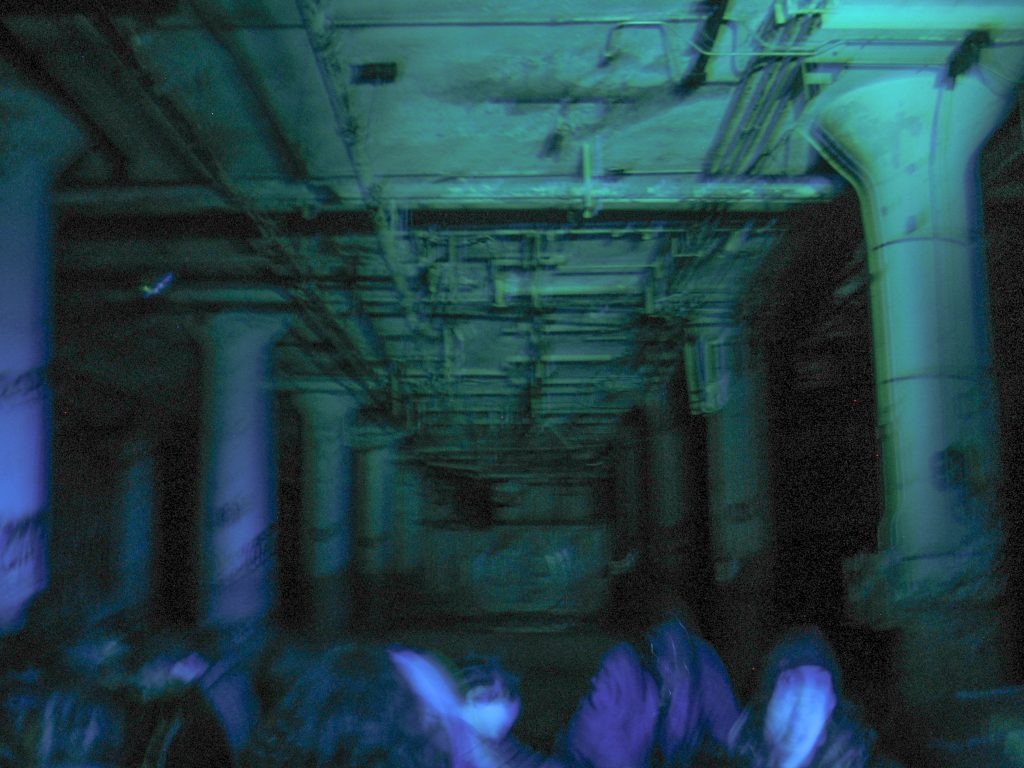
Unconventional spaces: dimly lit warehouses, repurposed factories, and decaying structures hidden in the woods. For some, wandering through dark woods or climbing through the decaying stairwells of an abandoned building at night sounds like something out of a horror movie. The peeling walls and worn-out structures are uninviting, even dangerous. For me, these places offer something profoundly rare, a welcoming community where people embrace one another’s identities, express themselves without fear, and create art that wouldn’t survive in the mainstream. For most, clubs are the typical go-to on a night out, dancing to favorite songs with friends. In Philadelphia, these abandoned buildings and repurposed spaces are more than remnants of the past. They have become vibrant settings for underground music scenes that serve as sanctuaries for self-discovery, where marginalized people find refuge, solidarity, and the freedom to push creative boundaries. In these “unwanted” spaces, I’ve found not only a place to belong but also a source of inspiration that challenges how I see music, community, and myself. These spaces aren’t just places for a night of loud music, but a thriving network of people united by a shared drive to create, explore, and redefine what’s possible.
These sites are a canvas for collaboration and creativity. The concept of music thriving in abandoned spaces is not new; cities like Detroit and Berlin have long embraced this idea, transforming forgotten industrial sites into vibrant cultural hubs where marginalized communities find refuge in the margins. This has led to the emergence of unwanted spaces overlooked or deemed unworthy by mainstream society being inhabited by individuals who identify as “unwanted.” Creating our own worlds in these spaces allows for the reclamation of what was once deemed undesirable. My experience in underground raves, often held in repurposed factories, are mirrored in cities all across the world. In these repurposed venues, the atmosphere is filled with a sense of liberation. It’s somewhat ironic, though, that many feel safe in abandoned buildings. Those bound by societal constructs find freedom in spaces where no one is around to impose expectations, judgments and fear. Growing up I struggled to find such freedom, which is why discovering these spaces felt like a revelation. It was here that I found a true sense of belonging

Being a part of this underground community in Philly has allowed me to experiment and explore my identity without fear of judgment. The acceptance and encouragement I’ve found in these raves have empowered me to push boundaries in my self-expression. This sense of belonging fueled my growth, as well as many others. Historically, underground spaces have served as havens for marginalized communities. Queer, trans, Latinx, and Black communities, in particular, have long relied on these “unwanted” spaces for a sense of belonging. These repurposed venues have been more than just places for music; they’ve been sanctuaries where people can freely express themselves. These spaces became a vital part of cultural movements such as disco in the 1970s, where marginalized individuals came together in secret clubs, creating both music and a community that celebrated difference rather than suppressing it. Disco was born out of these spaces as more than just a genre of music. It became a movement that redefined culture. Who doesn’t know what disco is? Exactly. It notably blended sounds of Latin, funk, soul, and the innovation of queer and Black communities and built a bridge between different identities and experiences. It offered a shared space where people could celebrate their individuality and the collective energy of the community. Part of what makes the community so vital to queer individuals is the ability to see and appreciate the full spectrum of how others present themselves and create art. The diversity in expression from how people dress, to the music they make, to the way they move, gives a sense of endless possibility. Being surrounded by this range of individuality and creativity pushes you to explore your own boundaries. Seeing the differences in others around you inspires growth. This is a fact that all humans know: Culture and community is built around inspiration.
This freedom to explore is crucial for creativity. Marginalized communities have long pushed the envelope, and the underground scene has historically been a breeding ground for innovation. Genres emerged from these spaces, only to be co-opted and popularized in the popular culture. This trend is evident in the evolution of music over the years, from disco to techno. These spaces pushed boundaries in music, exemplified by the birth of techno in Detroit, a city deeply influenced by post-industrial decline. As factories and industrial buildings were left abandoned in the wake of deindustrialization, techno emerged in these very spaces. The raw, experimental sound of techno fit the decaying, forgotten venues where it was created, capturing the intensity and energy of the environment. Techno’s hard, driving beats mirrored the mechanical, harsh backdrop of the industrial sites, making the sound itself an extension of its surroundings. The genre was not only a product of the community but also of the spaces that helped shape it proving that these physical spaces pushing also push boundaries.

In reflection, it’s clear that the underground music scene and the spaces they inhabit have changed me a a person. I’ve not only embraced my queerness but also developed a deeper sense of who I am and how I view the world. The encouragement I’ve found in these spaces has inspired me to explore my artistic passions. What started as a love for attending concerts and raves has evolved a potential career path, where I can express myself through photography, videography, editing, and DJing and make a living doing what I love.
While most of what I’ve shared highlights how incredible the community has been for me, there are still a few things that need to be prioritized and kept in mind. While the community has been incredible for me, it’s important to recognize that these spaces must remain safe and inclusive for everyone. Recently, there have been troubling incidents that highlight how fragile this sense of safety can be. Last month, a rave, “created for queer people, by queer people”, was disrupted by heterosexual outsiders who had no respect for the space. What started as a fight escalated quickly, and a man was shot. Thankfully, he made a full recovery but this tragedy has deeply affected the community, and since then, no queer raves have taken place. While the community will rebuild, this incident shows that we need to prioritize keeping these spaces safe.
As I continue my journey within my underground community, I’m committed to ensuring that these spaces remain welcoming and secure. We can prevent future harm by fostering mutual respect, implementing community-led safety measures, and making sure newcomers understand the importance of preserving these spaces. Given their marginal nature and lack of surveillance, these spaces are at a higher risk, but their value for personal growth and cultural innovation is what makes them so vital. As I continue to navigate my path in this world and within my community, I am committed to giving back to the spaces that have given me so much, making sure they stay welcoming for anyone who seeks a community that embraces them without hesitation.
All images © Cooper Davis. All rights reserved.