Authors: Nour Elkassabany and Gabby Lemonier
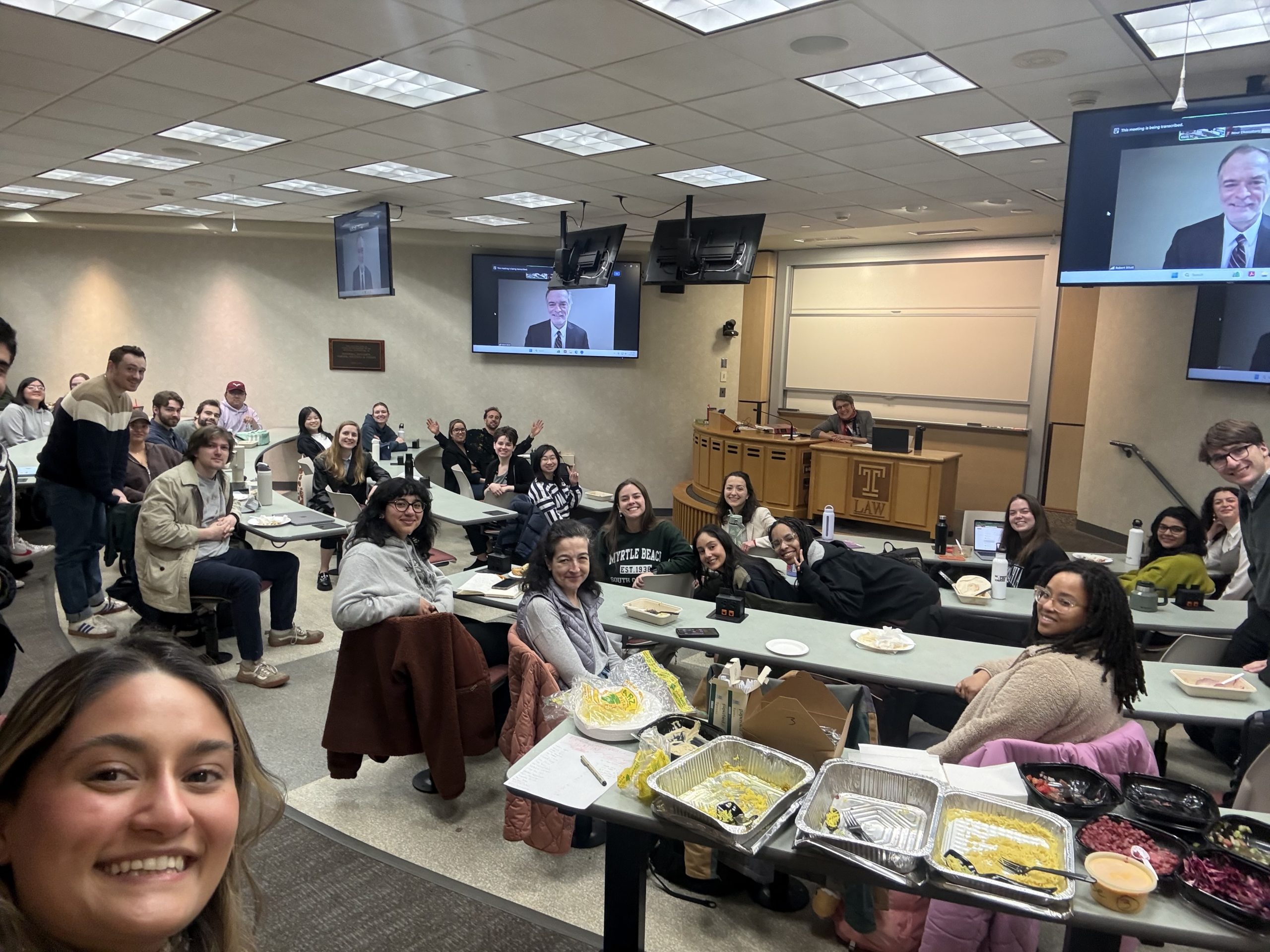
On April 9, Temple Law was honored to host Robert Bilott as the Keynote Speaker of the 2026 Environmental Justice Conference. Bilott is an environmental attorney who the New York Times has called “DuPont’s worst nightmare” given his work exposing the effects of “forever” chemical contamination. He is also the inspiration for the 2019 feature film Dark Waters, featuring Mark Ruffalo as Mr. Bilott. Students packed the room to hear Bilott recount his multi-decade litigation against DuPont.

It began in 1998 when a West Virginia farmer approached Bilott about a strange white foam in his property’s water. He thought the foam might be the reason his cattle were dying and calves were being born with deformities. What Bilott thought would be a quick case handled as a personal favor evolved into high profile, multi-decade long litigation against the chemical company DuPont.
After ruling out issues regarding regulated chemicals, Bilott dug deeper. He eventually discovered that DuPont was releasing an unregulated chemical, now known as PFOA, into this West Virginia community’s water. It was the root cause of issues with the farmer’s cattle and the high rates of cancer among the community’s residents. PFOA is now categorized as a “forever” chemical because of its strong carbon-fluorine bond and environmental persistence.
Because PFOA was unregulated at the time, DuPont did not have standardized reporting requirements. After reviewing over 100,000 pages of discovery documents, Mr. Bilott realized the company had coined various terms for PFOA, making it difficult to track the information he needed. Mr. Bilott noted that this breakthrough would be virtually impossible in today’s world of electronic discovery, where lawyers must begin with known search terms rather than openly searching files.
Ultimately, after two decades of litigation, Mr. Bilott collectively secured over $1 billion in settlement payments for West Virginia residents affected by DuPont’s PFOA pollution. Throughout the Keynote, he shared some of the most important lessons he learned as a lawyer along this journey:
- Be neutral. Mr. Bilott emphasized that DuPont would have loved to paint him as an emotional, environmental crusader. Instead, he found success by sticking to the facts and building thorough, data-backed arguments. A comprehensive human health study conducted by an independent panel of scientists was instrumental in establishing a causal link between PFOA exposure and the observed negative health effects in West Virginia.
- Be adaptable. When Mr. Bilott realized DuPont was emitting PFOA, he couldn’t use environmental laws against the company because the chemical was unregulated. He pivoted by using common law tort claims instead against DuPont. This flexibility is equally important for today’s environmental litigators, as the EPA only started regulating forever chemicals in 2024.
- Be patient. By the late 2010s, Mr. Bilott was shocked that PFOA wasn’t a national concern. There was clear proof that DuPont and other chemical companies were releasing harmful, cancer-causing forever chemicals, yet no one seemed to care. Mr. Bilott said the issue didn’t gain traction until Mark Ruffalo read a New York Times article about the DuPont litigation. The article inspired Ruffalo to create the 2019 film Dark Waters, which made forever chemicals a national talking point. The recognition of the issue has been rewarding for Mr. Bilott, but it came over 20 years after he began working on the DuPont litigation. His key to success in the intervening period was staying committed to his work, regardless of public sentiment.
The Temple Law community is beyond thankful to Mr. Bilott for taking the time to speak with us. We look forward to following his work as he continues fighting against the spread of forever chemicals.
This Environmental Justice conference is hosted annually by Temple Law’s Environmental, Energy, and Climate Justice (EECJ) Fellows. Learn more about Temple’s EECJ program here.
