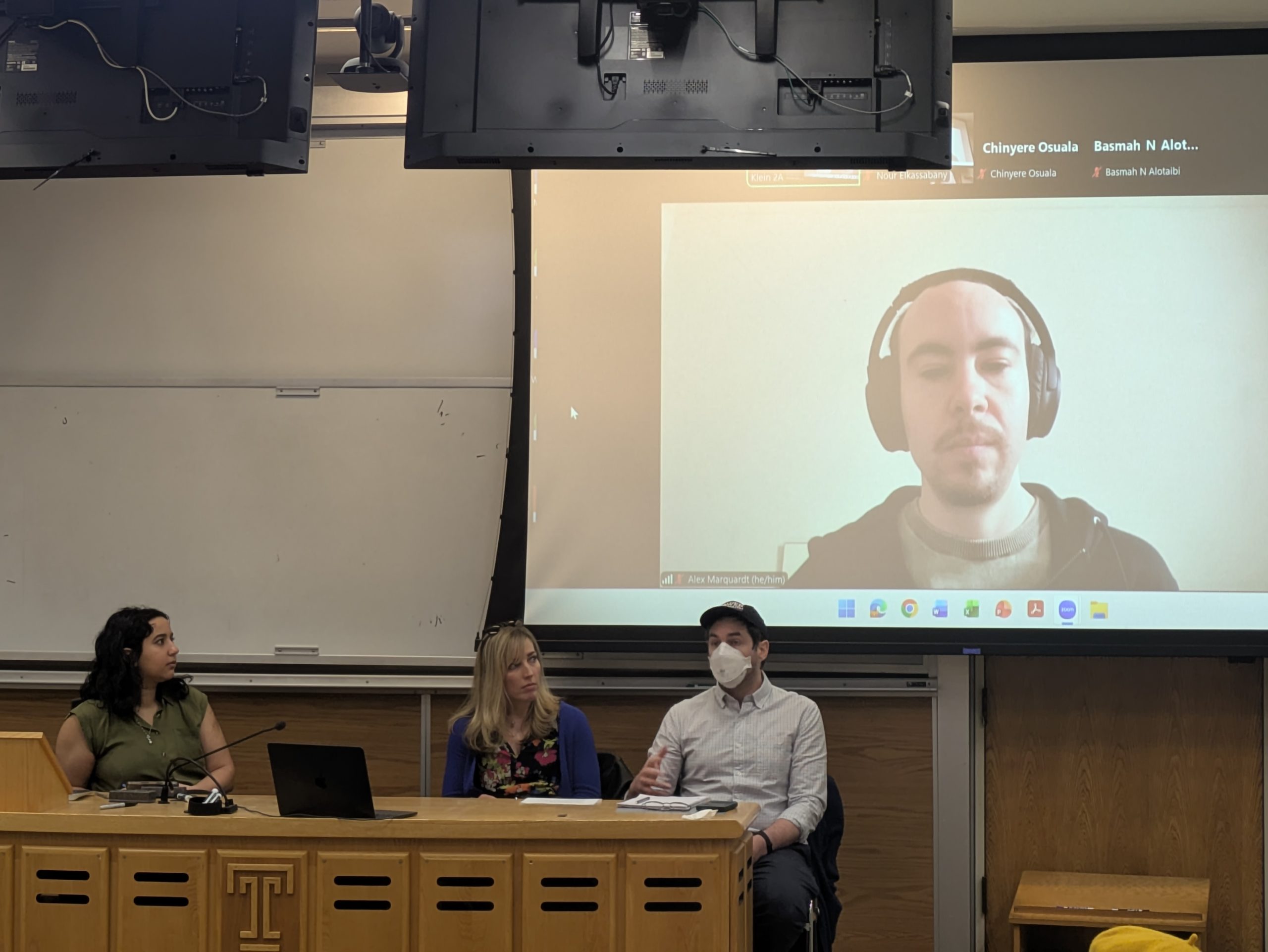
Three attorneys from a diverse array of climate justice organizations— Devin McDougall (Senior Attorney, Earthjustice), Kathryn Urbanowicz (Deputy Director, Clean Air Council), and Alex Marquardt (Executive Director, Climate Defense Project)—spoke at the April 6 Movement Lawyering panel in Temple Law’s Environmental Justice Conference.
The discussion began with what the phrase “movement lawyering” means to each panelist. To Marquardt, the phrase means “not seeing your client as an island.” He also highlighted the role of attorneys in “helping to build connective tissue between interconnected movements.” Urbanowicz contended that it’s okay that the phrase has become a bit of a trend – it reminds lawyers to avoid being siloed. All agreed that it is crucial to understand attorneys as part of a broader climate coalition.
When asked about valuable movement lawyering skills, the panelists emphasized the importance “helpful humility,” with McDougall pointing out that “law alone is rarely going to be sufficient to solve our largest and most pressing problems.” Marquardt also noted that attorneys must understand the critical, non-legal issues affecting their work—such as clients’ transportation to court and potential mistrust of lawyers. To him, this awareness goes hand-in-hand with working in consensus-based spaces and getting buy-in from people you may not expect.
Looking to the panelists’ broader visions for the climate movement, Marquardt is turning his attention to data centers as a “cross-cutting issue.” McDougall is looking to energy law; he sees parallels between the questions of “How do we build out our energy systems?” and “How do we maintain and deepen our democracy?” Urbanowicz cautioned that progressive infighting is counterproductive. She is looking toward a climate movement that brings in people and organizations from across the board.
Finally, we were buoyed by the panelists’ recounting of recent wins and ways they maintain long-term motivation. For instance, McDougall shared Earthjustice recently reached a favorable settlement with PPL Electric, a utility provider in central Pennsylvania. Marquardt implored students to stay motivated by viewing their emotions as signals for what they should be doing and where they should be putting their energy.” He also implored students to get offline! Finally, Urbanowicz said that despair is a luxury we can’t afford because it takes up too much energy and time. She differentiated between sadness and despair: “You can hold the feeling of being sad,” she said, “without letting it push you to a place of inaction.” She also encouraged students to be shameless in remembering and capturing even the small wins.
During the final Q&A portion of the event, there was a great discussion about what genuine popular participation looks like. McDougall suggested that attorneys help clients use existing political participation channels, while Urbanowicz highlighted the importance of getting in front of lawmakers. She finds that they can be underinformed even about issues they genuinely care about. Attorneys with expertise in a particular topic can help bridge that gap.
