In this week’s readings, it is clear that archivists have a responsibility which goes beyond simply collecting. The “three-legged stool” of collecting, preserving, and sharing collections should also be balanced with ethical questions of trauma, accountability, and digital literacy. Eira Tansey’s piece, “No one owes their trauma to archivists, or, the commodification of contemporaneous collecting,” explores some of the issues surrounding what she sees as the exploitative and clumsy efforts of archivists to preserve the historical record of momentous times. Exploring the responsibilities that archivists have to not just the future historical record, but the current political moment reveals that contemporaneous collecting policies (particularly in June of 2020) ignored those who COVID most affected, and potentially endangered some of the subjects whose lives and works archivists were trying to preserve, like Black Lives Matter protestors. Tansey wrote this piece in 2020- I wonder how she would feel about it three years out from the onset of the COVID-19 pandemic.
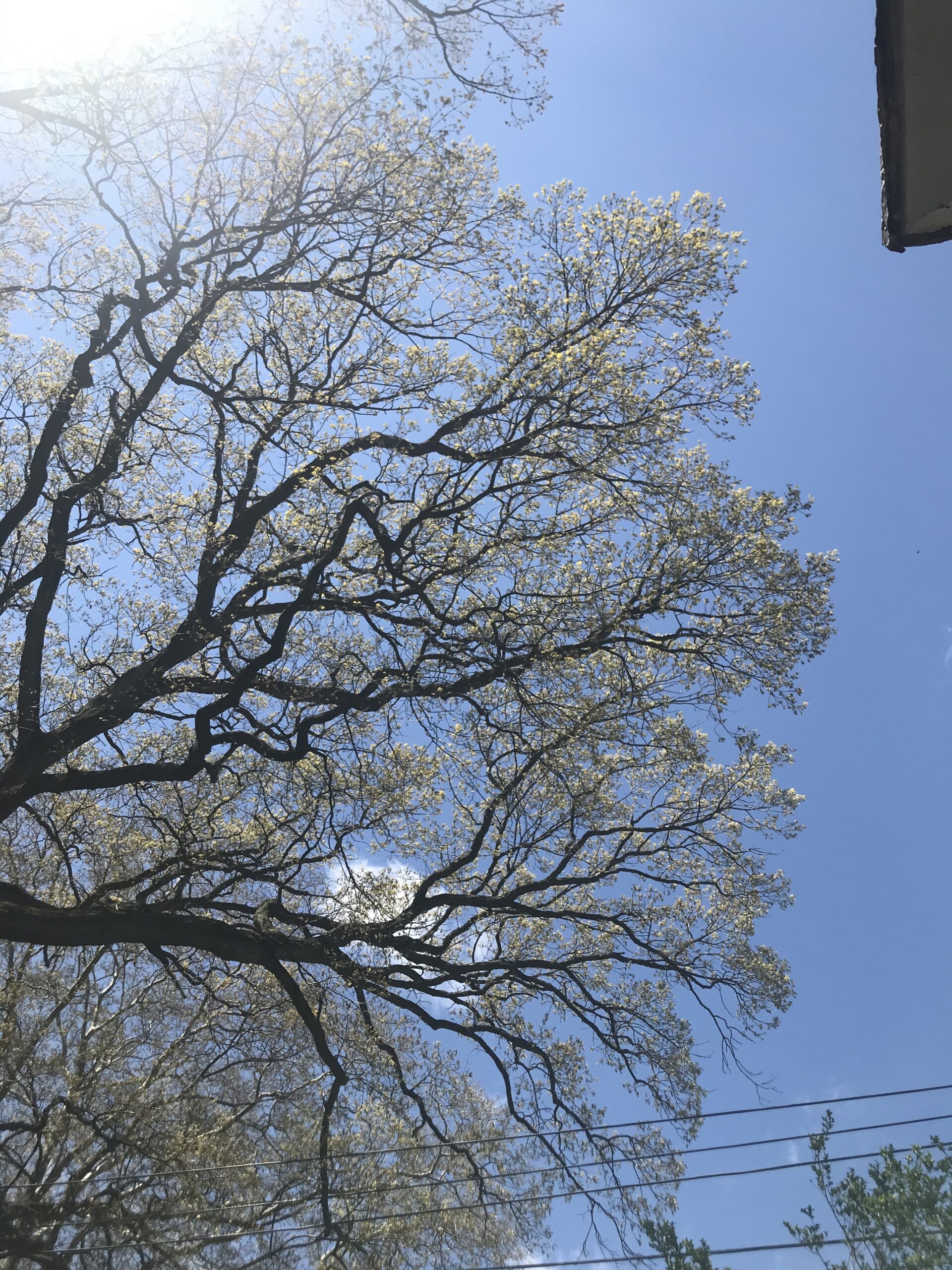
This piece got me thinking about my own pandemic record- while I did not keep a journal, like Tansey did, and like archivists encouraged many to, I did take a walk every day. I was laid off from my museum job and had moved home with my parents. The photograph of a tree which heads this short reflection piece was taken in April of 2020, on one of my walks.
Tansey also draws attention to a little explored aspect of archivist’s work- the navigation of their own trauma surrounding historical moments. Her example of national archival groups asking New Orleans archivists to recount or relive their experiences of Hurricane Katrina shows that for many, they felt archives had no right to their traumatic memories and experiences, particularly if they were to be used to further a narrative that subjects resented in the first place.
Tansey’s conclusion, the acceptance that we may lose part of the historical record, may be difficult for historians and archivists alike to process. As a scholar of early America interested in poor pregnant women and their experiences of childbirth, I wish nearly every day that I had their thoughts, hopes, dreams, and experiences to draw from. But instead, I am often left to piece together what I think they experienced, from the remains of the historical record. Though I do not necessarily wish this experience on future historians, I do think that the art of history is, to a certain extent, speculative.