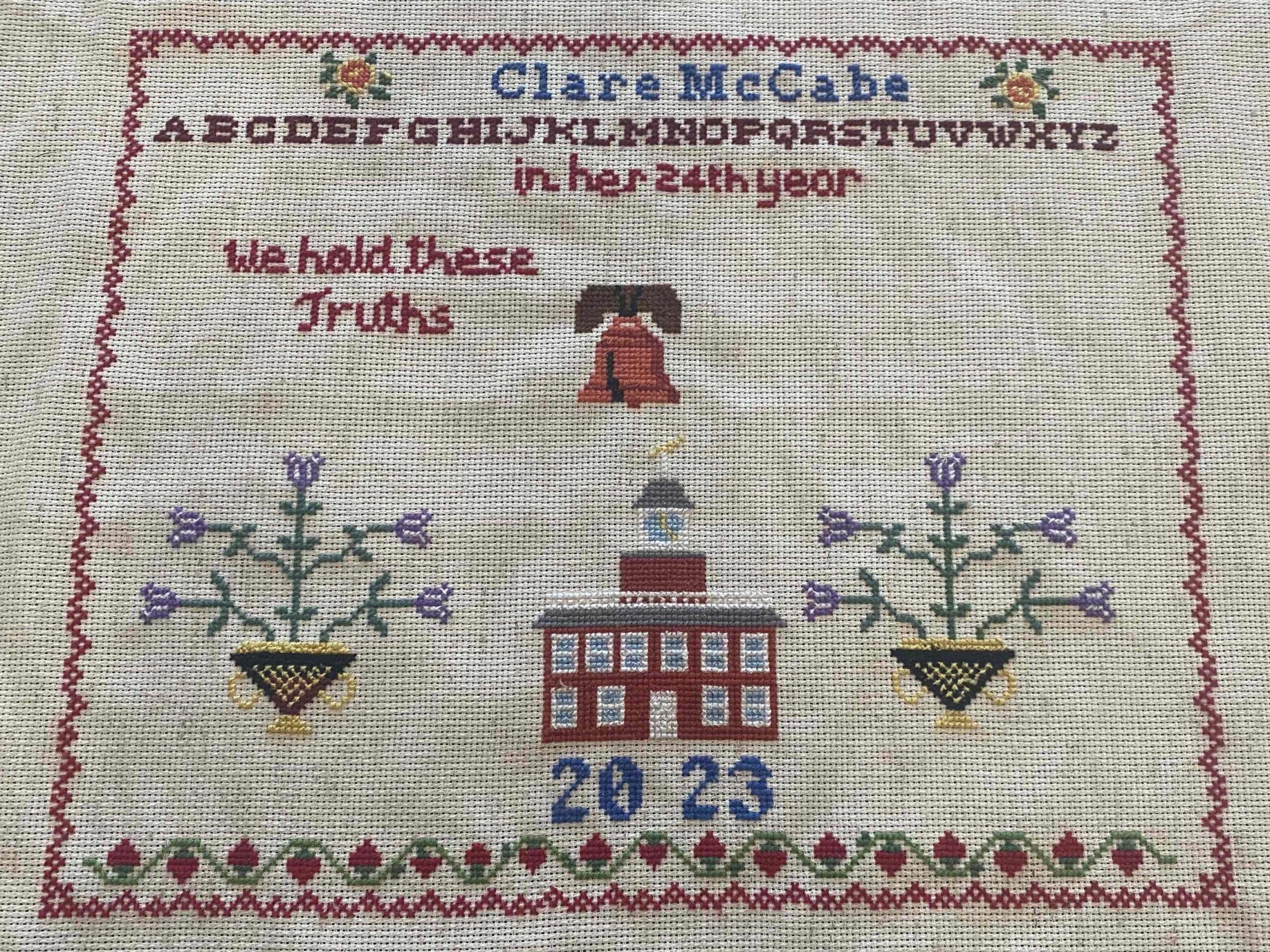
- Clare McCabe
- Philadelphian, 1998-
- Philadelphia Sampler, 2023
- Cotton Thread on Linen
In 2023, Clare McCabe took a class on American Material Culture. The sampler she created over the course of that class is displayed here. Her name, age, and year are all stitched into the fabric, in accordance with the conventions of sampler making throughout the 18th and 19th Centuries. Samplers were an important part of girls’ education in the early years of the nation, and the sampler uses evokes samplers typical to that those years by utilizing motifs common in early American samplers. McCabe’s intellectual focus lies in early American women’s history, and her interest in Philadelphia specifically is reflected here. Independence Hall and the Liberty Bell are the central images in the sampler, emphasizing her Philadelphia roots. The quote, which begins “We hold these truths,” is unfinished. Originally, she meant to quote not the Declaration of Independence but instead the Declaration of Sentiments, the early American feminist manifesto written at the Seneca Falls Convention of 1848. However, due to time constraints, the quote is ambiguous. Which truths are we meant to hold? McCabe leaves us unsure, in a commentary perhaps on the ambiguity of America.
I thoroughly enjoyed the process of making this sampler. I had never cross stitched before and had done only the most rudimentary of hand sewn mending before this project (think sewing on a button). While I initially struggled with some of the basics, like splitting up thread and counting out the squares accurately, I eventually found the process of stitching very relaxing. I watch a lot of basketball, and the sampler was the perfect activity during commercial breaks, so I could de-stress from my 76ers related woes. I have also developed a slightly pavlovian response to basketball now, as every time I hear the crowd, I feel the urge to reach for my needle. I also gained a respect for cross stitch as an art that cannot be rushed. As I learned over the last week, as I tried to finish my sampler as much as possible before our last class, there is no shortcut. To create the image you want, you must stitch each square. You cannot jump ahead nor finish quickly. It is methodical and steady.
Creating this sampler gave me a deep appreciation for the skill and labor creating cross stitched and embroidered textiles takes. Textiles are a window into the lives and creativity of girls and young women throughout history, and the sampler is a specific genre of those windows. I remember the article we read at the beginning of class about art and embroidery, and I feel much more confident that what I, and countless women before me have created, is art. Is it good art? That is a subjective question, but the creative labor which went into creating it is not insignificant, and I think deserves recognition. As a result of this project, I feel a connection to the nine-year-old schoolgirls whose samplers we viewed at the Perelman Museum which goes beyond my historical interest in their lives. We are connected by thread, albeit a tenuous one.
My design for this sampler is based around my connection to Philadelphia and my intellectual interest in its history. The process of design was slightly hodge-podge– inspired by the samplers we saw on display at the Perelman Museum, I elected to not plan anything out beforehand. Running out of space and needing to put my ‘XYZ’ somewhere else wouldn’t be poor planning, it would be period accurate! I also did not sketch anything out on the aida beforehand, and as a result most things are slightly off center. Again, I attribute this not to poor planning on my part, but on a commitment to accuracy. I knew I wanted Philadelphia related imagery, and I decided on Independence Hall as my centerpiece. There are quite a few samplers which feature a house as the center, and this is a play on those samplers. That building is the only section which I designed myself, using the website FlossCross, a free and easy to use cross stitch design website. The Liberty Bell design I found online, in one of the large pinterest collections of cross stitch patterns. My name, the year, and the alphabet were all required pieces, but they fit nicely into my sampler, which I wanted to be an homage to historical samplers done by schoolgirls in the late eighteenth and early nineteenth centuries. As a result, most of the other motifs were inspired early American samplers. The row of strawberries beneath Independence hall is lifted from samplers on display at the Museum of the American Revolution stitched by Mary Isabella and Margaretta Forten. The strawberries were typical of samplers stitched in Philadelphia schools, and the strawberries as well as the two potted plants are copied directly from early American samplers.
The quote is the one place I feel I fell short. I struggled with choosing a quote which would feel Philadelphia appropriate but also reflect my interest in women’s history, and a recognition of cross-stitch and textile art as predominantly female art forms. I ended up intending to quote the Declaration of Sentiments, which begins “We hold these truths to be self-evident; that all men and women are created equal.” The Declaration of Sentiments was written collectively but predominantly by Elizabeth Cady Stanton at the Seneca Falls Convention in 1848. The Seneca Falls Convention was one of the first and certainly most impactful meetings of the early feminist and suffragist movement, and the Declaration of Sentiments was their assertion of women’s rights and liberties. It plays on the Declaration of Independence, of course editing Jefferson’s words. Despite my intentions, however, I simply did not have time to finish stitching the quote. I got as far as “we hold these truths,” and while I may return to the project at some point, I also enjoy the ambiguity of where I left the quote. Which document am I quoting? Which truths are we holding? It all remains to be seen.