This week’s readings emphasized the long and fraught history of the bathroom. Both Simon and Schultz discuss the racist and unequal history of the public restroom, and the important role it played both in the Civil Rights movement, including important legal cases in the 1940s.
Using the bathroom is a primal and often immediate need. I think Molotch is right that it is embarrassing in part because it is so animal: when we use the bathroom, we are reduced to the body. And whose bodies we share space with is a problem wrapped up in the layers of body policing on the basis of race, gender, class, and sexuality. There are bodies which are appropriate in public spaces, and then there are those who are unwelcome.
The material culture of the bathroom is deeply present in all of our readings. The prison like infrastructure which Simon shows us in the Washington Square Park bathrooms are of course a form of “callous objects,” with their reminders about who is welcome in public and who is not.
Reading the Molotch, I was reminded of a TikTok series I watched a few months ago (I deleted my TikTok recently, in an attempt to prevent the time suck of infinite scrolling) of a woman, Teddy Siegel, who had made it her mission to find and rate every so called “semi-public” restroom in New York City. Her account, @got2gonyc, chronicles her experiences and shares them for the benefit of her fellow New Yorkers. There is a live crowd sourced map on her Instagram page with bathroom locations highlighted. While Siegel’s page is mostly “rankings,” she does engage in what we might call bathroom advocacy, as she published an op-ed in the New York Times to press the city for more public restrooms. Her map also includes the codes for certain bathrooms, thereby democratizing bathrooms which require speaking to an employee to use.
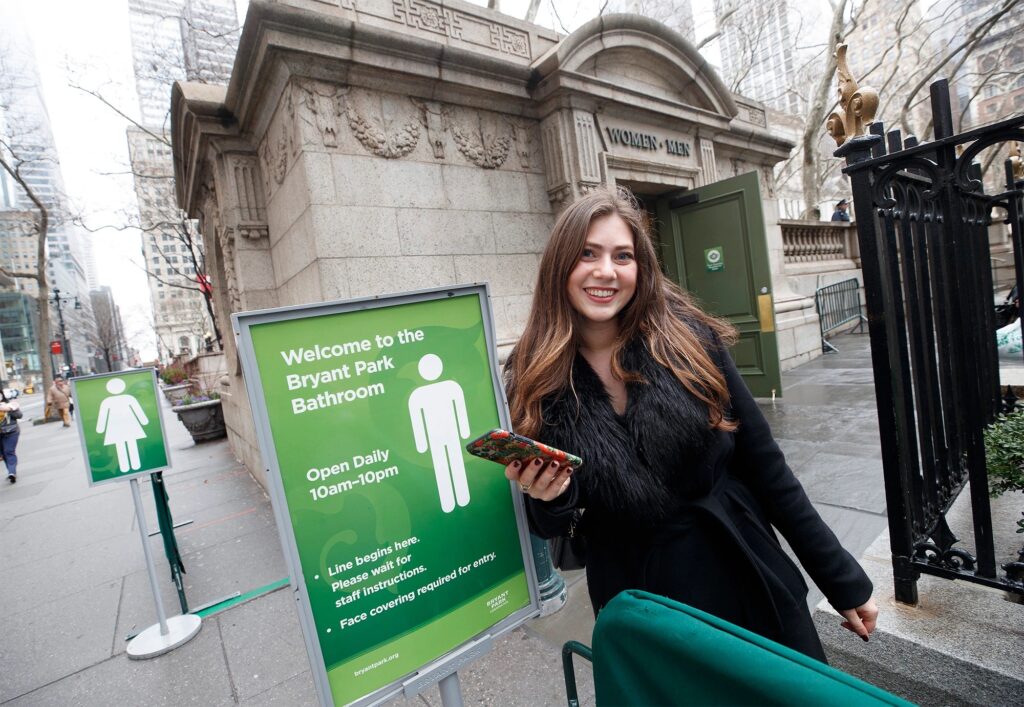
Siegel’s definition of public is expansive; the Saks 5th Avenue bathroom, for example, ranks high on the list, with funnily enough the American Girl Doll store right behind it! Those bathrooms may be clean, but as Siegel acknowledges, even though those bathrooms are technically accessible to the public, they are within private and often elite businesses who may require specific presentation to enter. Those who do not fit the mold are of course, often those who most need a publicly accessible restroom.
Molotch’s solution is simple: build more bathrooms. The ideal bathroom he presents is ambitious, and seems like a moonshot. While this is of course the obvious solution, I found the Simon helpful in answering the question: why don’t we just build more bathrooms? Bathrooms, especially public ones, are an indication of who is worthy of public investment. Fear of the deviant body is ultimately at the root of the bathroom problem, and if we want to solve it, we will need to confront that first.