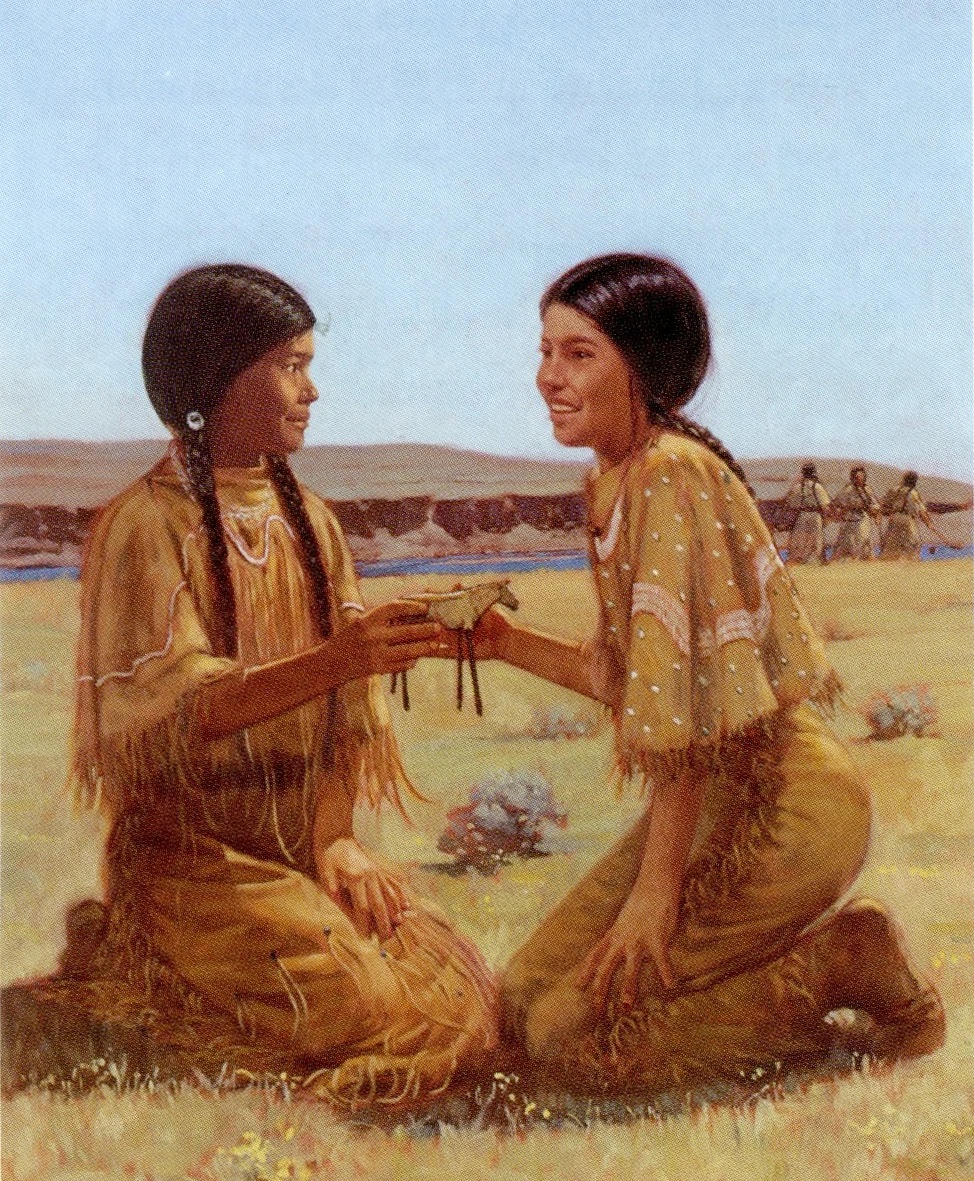
My object is the first American Girl Doll that I received, Kaya. (I had originally planned to choose Samantha, another one of my dolls, but when I went to my parent’s house to retrieve the doll, Samantha was not there! I suspect she ended up with one of my younger cousins.)

The Kaya doll is meant to represent Kaya’aton’my, a nine year old Nimíipuu, or Nez Perce girl living in the Pacific Northwest in 1764. She is the first Native American historical character that the American Girl Doll Company introduced. Kaya was first debuted in 2002, after Mattel purchased the company from its founder Pleasant Rowland, though she had been in development since at least 1996. She was created in conjunction with the Nez Perce tribe, and was debuted in Lawpai, Idaho, on the Nez Perce reservation.
My own doll was given to me sometime in the mid 2000s, probably around 2004 or 2005. She is an 18’’ doll with vinyl limbs and a cloth body stuffed with polyester fluff. Her tag says she is made in China. Her legs are a little loose; they rotate with just too much ease. Her hands and feet have little fingers and toes, including lines to indicate knuckles. There is a little bit of something, possibly white-out, stuck to her left foot. Her black hair, which now hangs in two very loose braids, originally came in two very neat braids. My own experiments braiding and unbraiding Kaya’s hair have left them messy and tangled. They are tied off with faux shell hair ties, meant to connect with the region and culture which Kaya lived in. Her hair is matted in the place it is not braided, and although I was tempted to clean her up before writing this assignment, I left the mats for the sake of historical accuracy. The instinct to brush her hair is still there, but the warnings I received from the American Girl Doll Company against brushing her hair with my brush still linger. The oils from human hair can damage a doll’s hair, and devoted owners of American Girl Dolls learned that lesson well. Unfortunately for Kaya, the doll sized hairbrush I once owned is no longer with her.
Her face, which has brown eyes that open and close when she sits up, features a closed mouth smile. She is the only historical character to not smile with an open mouth. Kaya’s face mold was created specifically for her in consultation with members of the Nez Perce tribe, because for the Nez Perce showing one’s teeth is considered rude. Her eyebrows are drawn on, but her eyelashes are three dimensional. Her lips and cheeks have an almost reddish tint to them, and over time her face has become a little scuffed.

Her dress is meant to evoke a deerskin dress and it is soft to the touch (almost like suede) and although the tag gives cleaning instructions, it does not list a material. The dress is fringed under the sleeves, along the side, and at the bottom. There are also fringed tassels at the top and bottom of the dress attached with beads. A row of white beads crosses Kaya’s shoulder, and the fringe at the bottom is attached with blue beads. Two tassels and their beads are missing altogether. On the website, the white beads are described as “quillwork,” and the dark spot at Kaya’s heart is meant to represent the deer’s tail. The dress velcros in the back. Kaya originally came with moccasins, but when I dug her out of the box in my parent’s basement, her feet were bare. I have a distinct memory of struggling to tie the moccasins, and so perhaps I jettisoned them long ago. Looking at her original ‘Meet’ outfit, the clothes that the dolls come with, I can see that Kaya is also missing a belt and two extra hair ties to keep her braids tidy.
Currently, Kaya sells for $115 and comes with her original outfit and a book, Kaya: The Journey Begins. In 2014, Mattel conducted a sizable overhaul of its historical dolls, condensing and sometimes rewriting books, archiving dolls and outfits, and rebranding many of their promotional materials. As a result, the book I received with my Kaya doll, Meet Kaya, is no longer for sale. In 2002, when the doll was released, it sold for $90, $84 with a paperback book. My book was a paperback, but as I was given the doll probably four years after its release, I am unsure exactly how much the doll cost.

In American Girl history, Kaya represents a break from standard narratives about American history. Previously, the earliest doll was Felicity Merriman, a girl who lived in Williamsburg in 1774, whose stories revolved around the lead up to the American Revolution. Kaya’s stories are about the Nimíipuu before sustained contact with Europeans, and even her books follow a different format. Previous doll’s books followed a standard formula: ‘Meet’ books, and then a birthday, Christmas, school, and usually two adventure stories. Kaya’s books necessitated different events to circle around, and her books are often themed around important cultural events like the salmon run, or more adventure stories. The Kaya doll, and her books, represented the company’s willingness to showcase that “our country’s history did not begin with the American Revolution,” said Julie Proshaka, the company’s brand director in 2002, when Kaya was launched.