BEMC Calibration
The Barrel Electromagnetic Calorimeter (BEMC) is a subsystem for the detector of the STAR experiment at Brookhaven National Laboratory (BNL) in Upton, New York. BNL is home to the Relativistic Heavy Ion Collider (RHIC) and the Solenoidal Tracker at RHIC (STAR) Detector. This detector can analyze events from colliding particle beams such as protons, gold atoms, and other heavy nuclei.
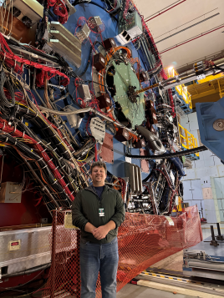
Me with the STAR detector at BNL.
The BEMC measures the energy deposition of particles coming from the interaction region of the STAR detector. It has a medium of alternating lead-scintillating plastic that goes 20 radiation lengths (X0) deep. The scintillating plastic layers sends a signal of scintillating light to photo multiplier tubes and is goes through a process of analog-to-digital conversion (ADC). The BEMC is also segmented into 4800 towers of the calorimeter layers to distinguish detection in energy deposition in isolated parts of the calorimeter.
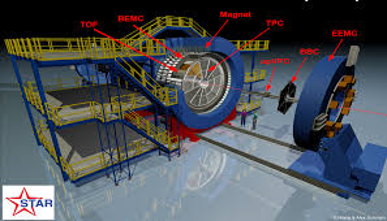
Schematic of the STAR detector with TPC as the heart and surrounded by the BEMC. Other subsystems are used for particle detection and local polarimetry monitoring.
The BEMC calibration compares the energy deposition from the BEMC to the momentum measured by another subsystem of STAR called the Time Projection Chamber (TPC) which measures the path and momentum of particles. The TPC can also identify particles from the energy loss due to ionization. The ideal particle candidates that could be used for the calibration are electrons (and positrons) because they deposit their energy in an isolated region of the detector, their energy loss band can easily be distinguish from other particles such as hadrons (protons, neutrons, pions, etc.) and the particle identification for the TPC. Because of the energy scale at RHIC, there are not enough electrons to do a calibration across the whole detector. The strategy then is to measure the energy deposition from minimum ionizing particles across the whole detector and calculate the relative gain from each calorimeter tower. Then the energy deposition of electrons from the BEMC are compared to their momentum measured from the TPC as a ratio, E/p, to convert the relative gains to absolute gains. These absolute gains are then applied to the STAR dataset as a correction to the signal coming from the BEMC.
The dataset that was used for this calibration are events collected from RHIC run of proton-proton collisions with a center of mass energy of 510 GeV sometime in between December 2021 and April of 2022. This data was collected from personal at BNL during experimental shifts of STAR which runs 24/7 during the run period mentioned above. The data was analyzed using the C++ programming in the STAR framework and visualized using CERN ROOT.
Relative Calibration
The relative calibration of the BEMC calibration analyze the MIP ADC output signal from all towers. The procedure was a quality assurance for each tower to show a clear MIP signal in a range of ADC of 10 to 50 where a peak appears in that range. These towers were labeled as good towers. Some towers do not show this peak and mostly show noise in ADC. These towers were labeled as bad towers, and they were not included in the rest of the calibration. The relative gain for each good tower based on their position of the tower in pseudo-rapidity and azimuth and the MIP ADC mean from the tower’s signal. This mean is given from a fit of a landua*gaussian product distribution that was fitted for each good tower. The relative gains are saved for the absolute calibration with electrons. The equation to calculate the relative gains are given in my presentation slides that I provide below the project’s title.
Absolute Calibration
The absolute calibration uses electrons to analyze the E/p ratio for a collection of BEMC towers in the same bin of pseudo-rapidity from -1 to 1. There were 40 bins that were used for this part of the analysis. The E/p signal from electrons were fitted with a gaussian to have the mean and an exponential function for the background contribution. The relative gain of good towers is normalized to the E/p mean from their respective pseudo-rapidity bin. The equation for the absolute gains is given my presentation slides. The electron data is used for systematic uncertainties study that contribute to the E/p calculation.