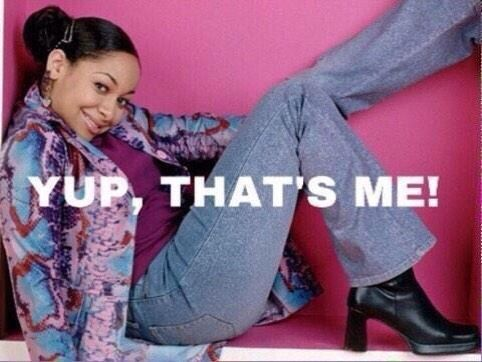
Image: Raven Symone as Raven Baxter in Disney’s That’s So Raven
Growing up, I didn’t have a real idea of what representation was. I just knew what felt familiar and what didn’t. I’ve always been a true media girl at heart and watching television was (still is) one of my greatest pastimes. I knew which characters looked like me, sounded like me, or reminded me of my friends.
In “Through the Eyes of a Child,” Ebony Roberts (2004) explores how Blackness is portrayed in children’s television, focusing on Sesame Street and Mighty Morphin Power Rangers. Roberts points out the argument made by others that representations of Black people in children’s popular culture and television “have a potentially negative influence” (Roberts, 2004). She argues that since children are now “glued” to their tv screens that are showing negative portrayals of Black people, we should be concerned with how the Black community is represented in those programs and how it affects children’s development. The first few times I saw characters that represented me well was on Disney’s hit shows The Proud Family and That’s So Raven.
This contributes to my project because it shows the root of where many Black women experienced representation — in children’s media. Before I ever stepped into classrooms or boardrooms, I was absorbing silent lessons about who gets to lead, who gets to be soft, and who’s always the sidekick through these shows. The same children who watched these shows grow up to navigate corporate spaces where code-switching becomes survival. We learn to adjust our tone, our hair, and our rhythm because we’ve been taught that our full selves might be “too much.”
I shared so much about my project with my big sister because I knew she would relate. We grew up in the same house, raised by the same parents, and we’ve shared many of the same experiences. Our adulthoods look very different: She’s a stay-at-home wife and mother while I’m a full-time career woman and graduate student. It’s still so interesting to see how we navigate certain spaces with the same struggles. After looking at the work I’ve done so far, she told me she was proud of me for advocating for Black women. It meant the world to me. She suggested that I be mindful of the tone of documentary through the interview questions I ask. She was clear that Black women shouldn’t be portrayed as “victims” in this project, but as survivors, perserverers, and women of resilience. I couldn’t agree with her more.
Sources:
Roberts, E. M. (2004). Through the eyes of a child: Representations of Blackness in
children’s television programming. Race, Gender & Class, 11(2), 130-139.
Yup, That’s Me! That’s so Raven. (n.d.). Pinterest. Retrieved October 27, 2025, from https://pin.it/6BPPIW5cG
Comments